Healthcare computer-use agents: OpenAI’s promising 94.3% score faces a critical test
OpenAI reports a 94.3% healthcare administration benchmark score and new deployments involving CVS Health, Cigna, Abridge and Ambience. What do the results establish about safe, reliable automation?


OpenAI says GPT-6 Astra earned 94.3% of available rubric points on a healthcare administration benchmark, while a cheaper model delivered a closely matched result. CVS Health and Cigna are among the organizations putting computer-use capabilities into operational workflows. The bigger question is how reliably these agents finish the work.
A clinician orders an MRI. The patient has already undergone physical therapy, the medical record contains the supporting evidence, and an insurance authorization is required before the scan can proceed.
The clinical decision has been made. The administrative work has barely started.
Someone must review the record, collect the relevant documentation, enter details into another system and prepare a request for approval.
OpenAI wants healthcare computer-use agents to handle more of that work.
On November 16, the company announced improved computer-use capabilities for clinical and administrative tasks, alongside benchmark results for GPT-6 Astra and GPT-6 Luna. It also detailed deployments and development work involving CVS Health, Cigna Healthcare, Abridge and Ambience.
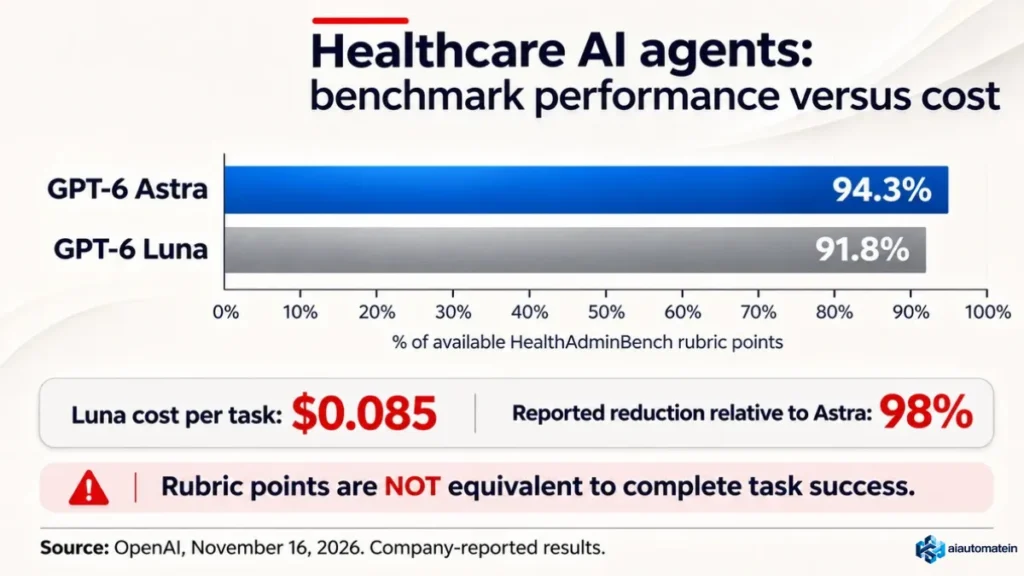
The central claim is significant: GPT-6 Astra achieved 94.3% of available rubric points on HealthAdminBench, an independently developed benchmark for healthcare administration. GPT-6 Luna achieved 91.8%, with OpenAI reporting a 98% lower task cost.
That sounds like a major step toward affordable automation. Whether it translates into dependable end-to-end performance is a different question.
OpenAI reports strong results on healthcare administration tasks
HealthAdminBench was developed by researchers affiliated with Stanford University, Stanford Health Care and Kinetic Systems.
The benchmark uses simulated healthcare software to test activities such as prior authorization, insurance appeals and durable medical equipment ordering.
Its environment includes an electronic health record, two payer portals and a fax system. Agents must navigate interfaces, inspect documentation and complete administrative steps rather than simply answer questions.
OpenAI reported the following results with both models operating at maximum reasoning effort:
| Measure | GPT-6 Astra | GPT-6 Luna |
|---|---|---|
| Available rubric points earned | 94.3% | 91.8% |
| Reported cost per task | Not separately stated | $0.085 |
| Cost comparison | Baseline model | 98% below Astra |
The company did not publish enough information in the announcement to establish that the newer models completed 94.3% or 91.8% of entire workflows without error.
That distinction matters because the original HealthAdminBench research identified a substantial gap between completing individual steps and finishing entire administrative tasks.
The researchers’ April 2026 paper reported a highest full-task success rate of 36.3% among the agent configurations evaluated in that study.
Those earlier results and OpenAI’s new rubric scores use different model configurations and reporting measures. They should not be treated as a direct before-and-after performance comparison.
For hospital buyers, the critical metric is whether an authorization, referral or equipment order reaches the correct final state, without introducing errors that employees must later repair.
Clinical safety testing adds another important qualification
OpenAI separately evaluated GPT-6 Astra on clinical inbox tasks involving patient context, notes, orders and messages.
The company said reviewers rated 99% of 325 reviewed tasks as clinically safe.
Physicians also rated the model very helpful or extremely helpful in 93% of 646 assessments.
These results describe specific evaluation samples. They do not establish that the system is 99% safe across every clinical setting or suitable for autonomous medical decision-making.
The demonstration involving an MRI request illustrates OpenAI’s intended operating model. Using synthetic patient data, an agent reviews relevant records and drafts an order, clinical note and patient reply for professional review. It then prepares the insurer-facing authorization request.
The clinician and authorization specialist remain responsible for reviewing the work.
This separation between preparation and approval is essential when healthcare computer-use agents interact with records and systems that influence patient care.
CVS Health says agents are already handling production workflows
The announcement goes beyond laboratory testing.
CVS Health is using computer-use capabilities to move information across clinical systems, send documents, process referrals and support specialist consultations.
According to OpenAI, one production agent cleared a document-sending backlog that had accumulated over months, completing the work during a weekend.
Another handles system steps associated with tens of thousands of consultations each day.
These are company-reported operational examples. OpenAI did not provide an independently audited comparison of accuracy, staffing costs or total productivity gains for those workflows.
CVS Health uses screenshots, action records, validation checks and human oversight to verify execution.
Lagan Khare, Executive Director of Engineering at CVS Health, said:
“Less time on administrative work means more time for care.”
CVS Health is also open-sourcing an Agent Kit based on OpenAI’s Agents SDK, intended to make this approach easier to reproduce.
The development is commercially important because the software agents are working through existing applications, including workflows that cannot be completed through conventional APIs.
That removes some integration barriers, but it also creates a new responsibility: confirming that the software actually completed each transaction.
Cigna, Abridge and Ambience target different bottlenecks
Cigna Healthcare is applying the technology to care management.
Its case managers previously needed to consult more than ten clinical and administrative systems to assemble relevant member information, according to OpenAI.
Computer-use capabilities can help gather that context across applications, including coverage, appointments, providers and previous interactions.
Cigna CIO Madhu Nutakki said the organization moved from concept to deployment in under eight weeks.
Abridge is developing capabilities that extend beyond clinical documentation into care coordination. Its planned inpatient use case includes helping clinicians investigate discharge barriers, medication access and home-health arrangements.
Ambience is concentrating on governed execution. In a prior-authorization demonstration, an agent prepares a request using information from the patient record, but pauses when the evidence is ambiguous and seeks clinician approval before submission.
These implementations address different problems.
CVS Health emphasizes repetitive execution. Cigna focuses on assembling fragmented information. Abridge is exploring coordination across clinical tasks. Ambience emphasizes controls and approvals.
Together, they illustrate how healthcare computer-use agents are moving from answering questions toward working inside operational systems.
The hidden difficulty is completing work across applications
Healthcare software has long suffered from fragmented workflows.
An EHR may store the diagnosis, a payer portal may require authorization details, and another application may record whether a referral was completed.
An agent that can click, type and navigate these interfaces offers a practical alternative when clean APIs do not exist.
Yet interface access creates failure modes that ordinary language-model benchmarks may miss.
A form might submit without displaying a confirmation. A page might change unexpectedly. A document may be attached to the wrong record. A partially completed action may be retried after it has already succeeded.
In each case, the agent’s internal record of success could differ from the system’s actual state.
Stanford’s HealthAdminBench research is relevant precisely because it measures interactions across simulated healthcare applications, not just the quality of generated text.
The same production challenge appears in enterprise software outside healthcare.
As aiautomatein examined in its report on nine AI agent evaluation metrics, successful tool calls and verified business outcomes are not interchangeable.
Patient data controls remain central to deployment
OpenAI says organizations can configure role-based access, approval requirements, permitted environments and audit logs.
It also states that organizational data is not used to train its foundation models.
For workflows involving protected health information, the company says organizations must use eligible services covered by a Business Associate Agreement and apply the required security and retention settings.
These safeguards do not make every deployment automatically HIPAA-compliant.
Organizations remain responsible for establishing appropriate access, reviewing vendor agreements, protecting patient information and validating system behavior.
A related challenge concerns delegated authority.
An agent might have permission to open a patient chart and prepare a referral without having permission to submit an order or disclose information to an unrelated system.
The boundary between those activities needs to be enforced technically.
aiautomatein’s AI agent identity governance analysis explores why authenticated access alone does not establish that every action is authorized.
aiautomatein analysis: Healthcare automation needs proof of completion
OpenAI’s reported benchmark improvements make a compelling case for continued investment in healthcare computer-use agents.
The more important signal, however, comes from the production examples.
CVS Health is describing workflows that move records and complete administrative steps. Cigna is assembling information across previously disconnected systems. Ambience is showing how an agent can stop when the evidence is insufficient.
These are distinct forms of progress.
They also suggest that the competitive advantage in healthcare agent software may lie less in conversational fluency and more in dependable execution across imperfect enterprise applications.
A model can generate an accurate authorization request and still fail to submit it. It can submit the correct form but attach the wrong document. It can complete a task while exceeding the authority granted to it.
The final outcome must therefore be checked against the healthcare system’s authoritative records.
For providers and insurers evaluating healthcare computer-use agents, four measures deserve particular attention: independently verified task completion, clinically consequential errors, human correction requirements and the full cost of completing an accepted workflow.
The cost question is especially important.
OpenAI reports that Luna costs 98% less than Astra in its evaluated administrative setting while achieving a rubric score only 2.5 percentage points lower.
That is promising, but the least expensive task attempt may not be the least expensive completed workflow if failures require rework.
The distinction echoes aiautomatein’s earlier analysis of AI model routing and failure-adjusted economics.
There is also a practical procurement question: can buyers reproduce the reported results using their own applications, documentation standards, approval rules and patient populations?
OpenAI’s announcement does not establish that outcome universally.
Healthcare organizations should test it.
What hospitals and insurers should ask before deployment
A healthcare organization considering healthcare computer-use agents should begin with one narrowly defined administrative workflow and a measurable baseline.
For prior authorization, that baseline could include completion time, accepted submissions, corrected submissions, human review time and the frequency of actions requiring escalation.
The pilot should then compare the agent’s final results with authoritative system records.
It should also test ambiguous documentation, unavailable applications, interrupted sessions, duplicate requests and access restrictions.
This approach is less glamorous than demonstrating an agent navigating a browser. It is also the difference between a promising demonstration and a dependable operational system.
OpenAI’s November 16 announcement brings computer-use capabilities closer to ordinary healthcare workflows.
The next question is whether providers can independently establish that the work was completed correctly, safely and at a sustainable cost.
Frequently asked questions
What are healthcare computer-use agents?
Healthcare computer-use agents are AI systems that interact with existing healthcare software through interfaces such as screens, forms and buttons. They can assist with administrative activities including prior authorization, referrals and document transfer, subject to appropriate controls and review.
What did OpenAI report on HealthAdminBench?
OpenAI reported that GPT-6 Astra earned 94.3% of available benchmark rubric points, while GPT-6 Luna earned 91.8% at a reported cost of $0.085 per task. These are not automatically equivalent to full-workflow success rates.
Are healthcare computer-use agents HIPAA-compliant?
Compliance depends on the complete deployment. OpenAI says eligible services can support HIPAA-compliant workflows under a Business Associate Agreement with appropriate settings. Healthcare organizations must still assess access controls, privacy requirements, contracts, oversight and operational risk.
Sources
- OpenAI, Advancing computer-use agents for healthcare teams, November 16, 2026
- OpenAI, More ways to move care forward with ChatGPT for Healthcare, November 16, 2026
- Stanford researchers, HealthAdminBench technical paper, April 2026
- Stanford HealthAdminBench, official benchmark and methodology
- Stanford HAI, Measuring What Medical AI Can Actually Do