
9 Critical AI Agent Evaluation Metrics That Expose Hidden Production Failures
LangChain reports 89% agent observability adoption but only 37.3% online evaluation. Explore 9 essential metrics, five platforms and the business-outcome gap.


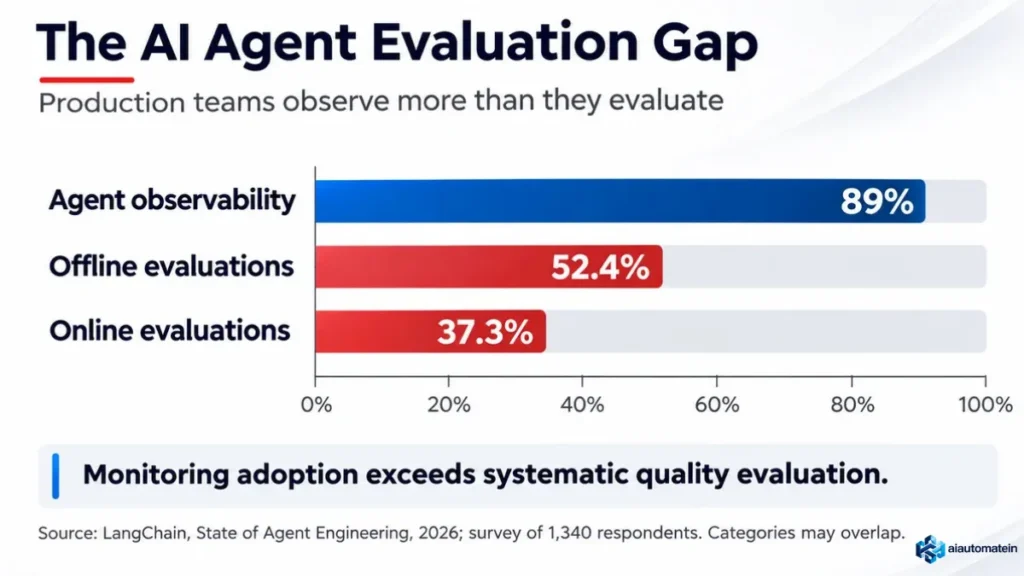
LangChain’s 2026 research finds that agent observability is considerably more widespread than systematic evaluation. LangSmith, Braintrust, Arize, Langfuse and Datadog offer different routes to measuring agent behavior, but the decisive benchmark is whether the business task succeeded.
AI agent evaluation metrics are becoming essential to enterprise software reliability as autonomous systems move into production without equally mature methods for determining whether they perform useful work.
LangChain’s June 2026 State of Agent Engineering survey found that 57.3% of its 1,340 respondents had agents running in production. Yet while approximately 89% reported some form of agent observability, only 52.4% used offline evaluations and 37.3% performed online evaluations.
The gap matters. Seeing an agent’s execution trace is not equivalent to proving that its decisions were correct.
Quality was the leading reported deployment barrier, cited by roughly one-third of respondents. Latency ranked second at 20%. Among larger organizations with at least 2,000 employees, security emerged as another major concern, cited by 24.9%.
These are practitioner survey findings, not a census of all enterprises.
Together, they show why agent performance must be assessed beyond model accuracy and infrastructure uptime.
Why AI agent evaluation metrics must go beyond successful API calls
Traditional application monitoring can establish whether a service is available, whether requests fail, and how long operations take.
Autonomous agents introduce additional decision points.
An agent may select a tool, retrieve information, interpret results, update a system, and produce a final answer. Each step can return successfully even when the final business outcome is wrong.
A purchasing agent, for example, could authenticate properly, retrieve supplier records, and submit a valid transaction—yet select the incorrect supplier.
The failure is not necessarily visible in API error rates.
As aiautomatein examined in its analysis of enterprise AI observability and task outcomes, technical execution and business completion require separate measurement.
A production scorecard should therefore connect application traces with authoritative outcome records.
9 AI agent evaluation metrics for production
1. End-to-end task success rate
Measurement: Verified tasks completed correctly ÷ total eligible task attempts.
A support agent should be credited for resolving a customer issue only when the designated resolution condition is met—not simply when it sends a reply.
LangSmith and Braintrust support evaluations against datasets and defined success criteria.
The key is independent verification. A model’s self-reported success should not determine its own score.
2. Factual accuracy and decision correctness
Measurement: Correct assessed outputs or decisions ÷ evaluated outputs or decisions.
Correctness should be judged against authoritative records, accepted answers, or qualified human review.
Braintrust supports code-based scorers and model-based judges. Arize Phoenix provides response evaluations and experimentation workflows.
LLM judges can scale review, but their judgments should be calibrated against human-labeled examples. A plausible explanation is not necessarily a correct decision.
3. Tool-call reliability and recovery rate
Measurement: Successful required tool operations ÷ attempted required operations; separately report recovery after failure.
Tools may reject malformed arguments, time out, or return incomplete data.
LangSmith, Langfuse and Datadog support tracing across agent steps and tool calls, helping engineering teams locate failures.
The relevant question is whether the agent recovered safely. Repeatedly retrying an invalid financial transaction should not count as resilience.
4. Human intervention and escalation rate
Measurement: Tasks requiring human correction, approval or takeover ÷ eligible tasks.
Human participation is not automatically a defect.
An agent handling a regulated transaction may require mandatory approval even when its recommendation is correct.
Separate planned approvals from unexpected rescue interventions. A rising rescue rate can signal declining agent quality.
LangSmith’s annotation workflows and Langfuse’s human scoring capabilities can support review, but organizations must establish their own intervention taxonomy.
5. Cost per successfully completed task
Measurement: Fully allocated operating cost ÷ verified successful outcomes.
The numerator should include model consumption, supporting infrastructure, failed attempts, retries, and relevant human review.
Datadog provides token and cost telemetry. Langfuse and Arize Phoenix also expose usage and cost signals.
However, cost telemetry must be combined with actual business completion records.
A lower token bill does not prove a cheaper workflow when failures increase.
This is directly connected to aiautomatein’s research on enterprise AI cost management and verified outcomes.
6. End-to-end latency and tail performance
Measurement: Median, 95th-percentile and 99th-percentile time from task submission to verified completion.
An agent can provide a fast first response while taking far longer to complete the underlying operation.
Datadog and Arize Phoenix document trace-level latency metrics that help locate slow model, retrieval and tool steps.
Teams should monitor total workflow completion time rather than optimize individual model calls in isolation.
7. Policy and authorization violation rate
Measurement: Confirmed prohibited actions or attempted violations ÷ evaluated actions, reported alongside severity.
A completed task is unacceptable if the agent accessed restricted data or performed an unauthorized operation.
Policy tests should include excessive permissions, unsafe tool arguments, and attempts to act outside delegated authority.
Evaluation frameworks can implement custom rule-based or model-based checks, but actual authorization must be enforced by security controls outside the evaluator.
The issue is explored further in aiautomatein’s AI agent identity governance analysis.
8. Retrieval relevance and evidence grounding
Measurement: Relevant retrieved evidence ÷ retrieved evidence, supplemented by supported-claim or faithfulness assessments.
An agent can retrieve valid documents while using outdated or irrelevant passages to make its decision.
Arize Phoenix supports retrieval and response evaluation. LangSmith offers RAG evaluation techniques, while Braintrust supports custom scoring workflows.
Enterprise teams should distinguish retrieval quality from the correctness of the final answer.
A properly cited source can still be unsuitable for the decision being made.
9. Regression and repeatability failure rate
Measurement: Previously passing evaluation cases that fail after an agent change ÷ previously passing cases retested.
Prompt changes, model updates, tool revisions, and retrieval changes can alter behavior unexpectedly.
Braintrust, LangSmith and Langfuse provide dataset-driven experiments and evaluation workflows that can support release testing.
For nondeterministic agents, repeat critical cases across multiple runs and inspect failure patterns.
Passing once is weaker evidence than consistently passing under representative conditions.
Five vendor approaches: Different strengths, shared limitations
The leading evaluation platforms overlap, but they enter the problem from distinct technical directions.
LangSmith emphasizes agent traces, evaluation datasets, human annotation and release-time regression testing. Its documentation supports evaluating intermediate agent trajectories as well as final outputs.
Braintrust centers its workflow on data, tasks and scorers. Its evaluation model combines deterministic checks, LLM judges, experiments and production feedback.
Arize Phoenix offers open-source tracing, datasets, retrieval and response evaluations, and experiments. Its OpenTelemetry-based approach makes it useful for inspecting agent execution across supported frameworks.
Langfuse connects production traces with scoring, curated datasets and offline experiments. Its documentation describes both online and offline evaluations, with custom and model-based scoring.
Datadog connects agent traces with latency, tokens, costs, errors and configurable evaluators. Its operational observability background provides a route from application performance problems toward agent-quality investigation.
None should be assumed to measure verified business outcomes automatically.
That requires connecting agent telemetry to the systems that record completed transactions, resolved cases, accepted decisions or other authoritative results.
Independent analyst perspective: Observability is not evaluation
LangChain’s 2026 survey exposes an important operational distinction.
Approximately 89% of respondents reported agent observability, but fewer than four in ten reported online evaluation.
LangChain’s published evaluation guidance argues that teams need to examine the final result and the execution path together, because a correct answer can conceal an unsafe or inefficient sequence.
This perspective comes from a company selling agent development and evaluation technology. Its recommendations are useful, but they are not an independent comparative benchmark proving LangSmith’s superiority.
The broader finding remains consequential: engineering teams are increasingly able to inspect what their agents do without consistently testing whether the behavior meets production standards.
aiautomatein analysis: The missing metric is business consequence
The most dangerous agent failure is not always an obvious error. It can be a technically successful workflow that produces the wrong business result.
An agent may complete 99% of tool calls while incorrectly processing transactions. Another may show excellent answer accuracy while repeatedly escalating ordinary cases to employees.
Neither outcome can be understood through one dashboard metric.
Enterprise AI evaluation should operate across three layers: execution integrity, decision quality and verified business consequence.
The first establishes whether components functioned. The second assesses whether actions and outputs were appropriate. The third confirms whether the intended outcome occurred and at what cost.
This also changes how companies should evaluate the vendors providing observability and testing tools.
The procurement question is not simply how many traces a platform collects or how many evaluators it provides.
It is whether the system helps teams reproduce a failure, identify its cause, improve the agent, and demonstrate that the correction worked in production.
That closed-loop discipline is central to an effective AgentOps operating model.
The next competitive frontier in agent evaluation will be outcome evidence—not increasingly elaborate performance dashboards.
Building a production evaluation scorecard
Organizations should define task eligibility, authoritative success records, acceptable error thresholds and intervention categories before deploying new agents.
They should then run offline tests against representative scenarios, monitor production behavior, sample results for human review, and convert confirmed failures into regression tests.
Thresholds should reflect business impact. A minor formatting error and an unauthorized financial transaction should not carry equal severity.
The strongest AI agent evaluation metrics combine operational visibility with proof that the right work was completed safely, reliably and economically.
Frequently asked questions
What are AI agent evaluation metrics?
AI agent evaluation metrics are measures used to assess an agent’s task outcomes, decision accuracy, tool use, latency, operating costs, security compliance and reliability across repeated execution.
Which platforms support production AI agent evaluation?
LangSmith, Braintrust, Arize Phoenix, Langfuse and Datadog provide overlapping capabilities involving tracing, datasets, automated evaluation, human review or operational monitoring. Specific features and deployment requirements vary.
How do companies measure whether AI agents actually work?
Organizations should compare agent activity with authoritative business records, assess task success and decision correctness, track failures and human intervention, and calculate the full cost of verified outcomes.
Sources and references
- LangChain — State of Agent Engineering, June 2026
- LangChain — Evaluating Agents at Run, Trace and Thread Level
- LangSmith — Agent Evaluation
- Braintrust — How to Evaluate AI Agents in Production
- Arize Phoenix — Open-source tracing and evaluation
- Langfuse — Evaluation Documentation
- Datadog — Agent Observability
- Datadog — Evaluation Documentation