An AI Contract Redline Can Improve a Clause and Break the Contract Around It
AI contract redlining can improve an individual clause while creating inconsistencies elsewhere in the agreement. See how defined terms, cross-references, exceptions and related provisions can be checked for dependencies before a proposed redline is accepted.

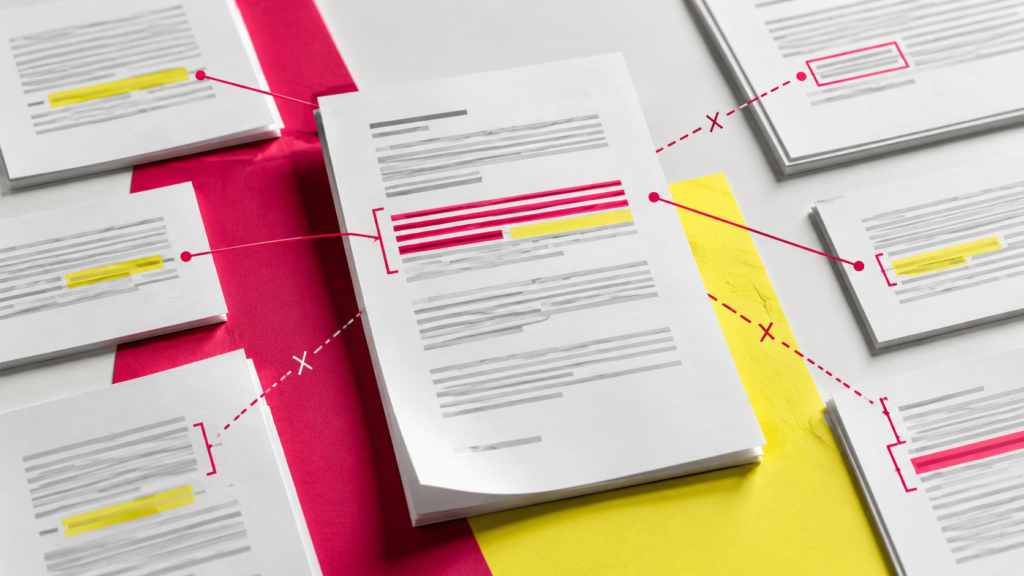
AI contract redlining can produce language that is stronger at clause level while weakening the agreement around it. A revision to a defined term, cross-reference, exception or related obligation needs to be checked against the provisions that depend on the language being changed.
The AI improves the limitation-of-liability clause, and the lawyer accepts the redline. Nothing in the revised paragraph looks wrong.
Three pages earlier, however, the agreement defines Losses. The new clause uses Damages, which is not defined. Elsewhere, the indemnity provision still refers to Losses.
The clause got better. The contract did not.
AI contract redlining creates a dependency problem
Contract redlining tools increasingly operate at clause level.
Thomson Reuters CoCounsel for Microsoft Word can compare an agreement against a playbook, identify issues and offer AI-assisted clause revisions that a lawyer can insert directly into the document. Harvey similarly describes AI-assisted redlining as a first-pass process in which contract language is compared against established positions before the lawyer evaluates the proposed changes.
That workflow is useful because much negotiation is expressed through individual provisions. A liability cap is too high, an indemnity is too broad, a termination right is missing, or a confidentiality provision diverges from the organisation’s preferred position.
AI can address each problem locally. The complication is that one provision may rely on language elsewhere in the agreement.
Defined terms turn one edit into a contract-wide change
Defined terms are an obvious example.
Suppose an agreement defines:
“Losses” means all losses, liabilities, damages, costs and expenses…
The same defined term appears in indemnification, liability allocation and several contractual remedies.
An AI redline replaces Losses with Damages in one clause because the revised wording is cleaner or closer to a playbook provision. The sentence itself may be entirely understandable, but its relationship with the rest of the contract has changed.
Thomson Reuters Drafting Assistant treats this as a separate drafting problem. Its Deal Proof capability checks whether terms that appear to need definitions are actually defined, whether defined terms are used consistently, whether they are defined more than once, and whether a capitalised term is being used without a definition.
The useful review questions are therefore different:
Is the new wording legally or commercially preferable?
What else in the agreement depended on the language the AI just changed?
Cross-references can survive after their meaning moves
Numbered references create another dependency.
A clause may say:
subject to Section 8.3
or:
except as provided in Section 12.2(b)
If the AI inserts, removes or restructures language, the reference can become wrong even though the provision containing it remains grammatically perfect. More subtly, the section number may still be correct while the referenced provision no longer performs the function the drafting originally assumed.
Drafting Assistant separately identifies and analyzes internal cross-references, allows users to preview the referenced section and flags invalid references that may need correction.
For AI redlining, that suggests a useful validation concept: an affected-dependency set.
If Section 8.3 changes, the workflow should identify other provisions that point to Section 8.3 before the redline is treated as complete.
The redline itself may be one paragraph. Its review boundary may be much larger.
Exceptions are dependencies even when there is no formal link
Some contract relationships are harder to detect because they are semantic rather than numbered.
Consider:
Neither party shall disclose Confidential Information…
Elsewhere:
Notwithstanding Section 6, disclosure is permitted where required by law…
An AI may narrow or broaden the primary confidentiality obligation while the carve-out remains unchanged. Whether the agreement still expresses the intended position now depends on how those two provisions interact.
The same problem can appear with phrases such as:
- subject to;
- notwithstanding;
- except that;
- provided that;
- unless otherwise agreed;
- to the extent permitted under;
- without limiting.
These phrases create dependencies without necessarily producing a broken cross-reference.
Thomson Reuters’ Deal Proof tooling also checks the consistency of similar phrases and expressions across a document, alongside defined terms and cross-references.
Contract coherence often lives in repeated language and exceptions, not merely section numbering.
A redline should be reviewed for its blast radius
A limitation-of-liability change could affect an indemnity carve-out, exclusions from the liability cap, definitions of Losses or Damages, confidentiality remedies, data-protection liability, insurance obligations and termination rights tied to particular breaches.
Not every edit will reach that far. But a redlining workflow should distinguish a largely self-contained wording improvement from a change to language that other provisions reuse or depend upon.
That creates a practical sequence:
propose redline → identify affected dependencies → review dependent provisions → resolve inconsistencies → accept change
The AI can still perform the first drafting pass quickly. The completion condition changes: the relevant dependencies have to be checked before the edit is closed.
The original and the redline both matter
Dependency checking becomes more useful when it asks what changed between the pre-edit and post-edit agreement.
Drafting Assistant can analyze document references and inconsistencies, including undefined terms, inconsistent phrases and invalid internal references.
For AI-assisted redlining, the more interesting signal may be the inconsistency introduced by the revision.
If Losses was used consistently before the redline and Damages appears only afterward, that delta deserves attention. If Section 12.2 previously contained the exception expected by three other provisions and the AI rewrites that section, those inbound dependencies should be reconsidered.
A useful contract-control record can therefore retain:
- the provision changed;
- the original wording;
- the proposed wording;
- defined terms added, removed or altered;
- inbound and outbound cross-references;
- materially similar phrases elsewhere;
- provisions identified as dependent on the changed language.
This is not the same as preserving every prompt or model token. It is preserving the contractual relationships the edit may have disturbed.
Human approval should include the effect of the edit
Legal AI products correctly keep lawyers in the review loop.
CoCounsel presents identified issues and proposed redlines for review before they are inserted into the document, while Harvey describes AI-assisted contract redlining as a workflow in which lawyers retain judgment over the resulting changes.
But the usefulness of that approval depends on what the reviewer can see.
If the interface presents only the changed liability clause, the lawyer is being asked to evaluate local drafting quality. If it also shows that four provisions depend on a term changed in that clause, the lawyer can evaluate contractual effect.
The system does not need to decide whether those dependencies are legally acceptable. It needs to make them visible before the redline is treated as complete.
Contract correctness is relational
AI can make a sentence clearer, bring a clause closer to a playbook and replace an undesirable position with preferred language in seconds.
Defined terms, cross-references, carve-outs and related obligations still connect that edit to the rest of the agreement.
That makes one question particularly useful after an AI redline:
What else did this clause change without changing its words?
The best contract revision is not merely the clause that reads better. It is the revision whose consequences across the agreement have also been checked.