
Fractal AI acquisitions: Ambitious talks with 25 startups signal a bold expansion
Fractal Analytics is discussing potential acquisitions with 20 to 25 AI startups after evaluating around 800 companies. Its CEO identifies healthcare, agentic AI, engineering talent and frontier-model relationships as priorities.


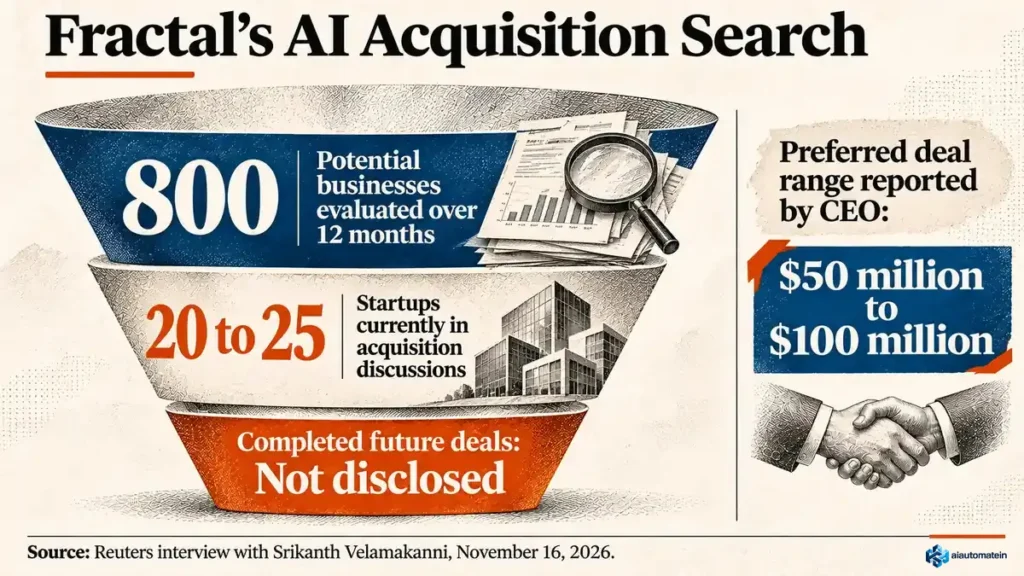
Fractal Analytics has reviewed roughly 800 potential acquisition targets and is now discussing deals with 20 to 25 AI startups. Healthcare expertise, engineering talent and relationships with frontier AI providers are on its shopping list. But the acquisition strategy raises a more interesting question about the future of enterprise AI services.
Fractal Analytics is looking for something it cannot necessarily obtain by hiring more engineers: a faster route into specialized AI markets.
The Indian enterprise AI company is in discussions with 20 to 25 startups about possible acquisitions, Group CEO Srikanth Velamakanni told Reuters on November 16. Fractal has assessed around 800 potential targets over the preceding 12 months.
The conversations cover healthcare, agentic AI and AI engineering. Velamakanni also identified engineering talent and relationships with major cloud providers and frontier AI laboratories as potential attractions.
Fractal AI acquisitions could therefore involve more than purchasing technology. The company appears interested in businesses that can bring industry expertise, product capabilities and commercial relationships into its existing operation.
No agreement involving the 20 to 25 companies has been announced. Discussions do not mean those businesses will be acquired.
Fractal AI acquisitions could reach $100 million in the preferred spending range
Velamakanni told Reuters that Fractal does not have a fixed number of acquisitions it intends to complete.
The company is willing to consider individual deals valued at up to ₹10 billion, or ₹1,000 crore, according to the interview.
Its preferred spending range is $50 million to $100 million.
That is not an announced acquisition budget. Nor does it mean Fractal plans to spend that amount on each company under discussion.
The distinction matters. A pipeline of 25 conversations can produce a handful of transactions, one transaction or none at all.
What the figures establish is that Fractal is taking a systematic approach to identifying possible targets.
Screening approximately 800 companies in a year indicates a broad search. The reasons for selecting particular businesses remain more important than the number being considered.
Why healthcare is central to Fractal’s acquisition strategy
Fractal is not approaching healthcare as an entirely new market.
Its November 4 earnings commentary identified healthcare and life sciences as its fastest-growing industry segment, with revenue increasing 79% year over year in the September quarter.
Healthcare and life sciences also represented approximately one-quarter of Fractal’s quarterly revenue mix, according to the company’s published financial handbook.
That provides useful context for its interest in acquiring healthcare-focused AI businesses.
A company serving hospitals, pharmaceutical manufacturers or insurers needs more than general-purpose models. It needs to understand the data, regulations, purchasing processes and operational requirements of those customers.
Healthcare AI also has substantial implementation complexity. Data access, patient privacy, clinical review and integration with existing software can determine whether an application moves beyond a demonstration.
Fractal could seek businesses that already possess such expertise or have built working relationships with healthcare customers.
That is a plausible commercial rationale, not confirmation of the characteristics of any undisclosed target.
For context, aiautomatein recently examined how healthcare computer-use agents are entering administrative workflows. Those deployments illustrate why sector-specific integration and verification matter.
The frontier model relationship is an overlooked part of the story
One detail in Velamakanni’s remarks deserves closer attention.
Fractal is not looking only for software products or specialist engineers. It also wants access to relationships that potential acquisition targets have with cloud companies and frontier AI laboratories.
That is a different acquisition objective.
An enterprise AI provider may have strong customer relationships but lack early access to particular models, engineering support or partner programs.
A smaller AI company may have precisely those relationships because its business was built around a newer generation of tools.
Buying the smaller company could offer a route to technical expertise and commercial access that would otherwise take time to develop.
Fractal is already active in this ecosystem. In July 2026, it announced selection as a preferred services partner in the Claude Partner Network.
That existing relationship does not establish which other partnerships Fractal might pursue through acquisitions.
It does show why the company’s M&A strategy should be understood alongside its efforts to develop relationships with major AI platform providers.
For potential customers, the practical issue will be whether those relationships improve implementation quality, product access and long-term support.
PricingOne provides a recent example, but not a template for every deal
Fractal’s acquisition interest is not purely theoretical.
Earlier this month, its Asper business acquired certain assets and took on specified liabilities associated with Geneva-based analytics company PricingOne.
Reuters described the transaction as an acquisition of the Swiss business.
The distinction between purchasing a company outright and acquiring selected assets matters, particularly when comparing transaction values or assessing what capabilities have actually transferred.
The disclosed transaction is considerably smaller than Fractal’s stated preferred acquisition range.
That suggests the company is willing to consider different transaction structures and sizes when a target fits a strategic need.
It does not establish that future acquisitions will follow the same approach.
For Fractal, the important question is what happens after a deal closes. Will the acquired technology become part of an existing product? Will its specialists join a larger delivery organization? Will the customer relationships survive integration?
These factors ultimately determine whether an acquisition creates value.
Independent research shows AI acquisitions are becoming an industry strategy
Fractal is not alone in examining acquisitions as a route to AI capability.
In August 2026, Crisil Ratings published research covering acquisition rationales among 26 major Indian IT companies.
Crisil found that nearly half of the deals completed over the preceding two fiscal years involved AI or related technologies.
More than 70% of acquisition targets were based in the United States or Europe.
The research describes a wider transition in Indian technology services. Companies are using acquisitions to obtain specialist talent, proprietary technology, industry knowledge and access to customers.
Aditya Jhaver, Director at Crisil Ratings, described AI as a strategic acquisition driver and said acquisitions could shorten the time needed to build new capabilities.
Crisil also identified important risks, including integration effectiveness, retaining specialist talent and converting acquired capabilities into revenue.
Those risks apply directly to the discussion around Fractal AI acquisitions.
Buying expertise may be faster than building it. Making that expertise commercially useful is a separate challenge.
The financial backdrop gives Fractal room to consider deals
Fractal reported revenue of approximately ₹957 crore for the quarter ended September 30, 2026, representing roughly 20% year-over-year growth.
The company reported profit of ₹81.2 crore for the same quarter, according to Reuters.
Its published financial handbook also shows that the Americas generated 67.3% of quarterly revenue, with Europe accounting for 21.5% and Asia-Pacific and other markets contributing 11.2%.
This geographic mix matters for an international acquisition strategy.
Buying a specialist business in the United States or Europe could provide technology and talent, but it might also strengthen customer relationships in markets where Fractal already generates most of its revenue.
That is one possible strategic outcome, not a stated target for any specific transaction.
For investors, acquisition spending must be evaluated against Fractal’s existing profitability, cash position, integration requirements and growth prospects.
The company’s willingness to consider transactions does not establish that any particular deal will deliver an adequate return.
What Fractal AI acquisitions could mean for enterprise customers
For large enterprises, the immediate benefit of consolidation can be convenience.
A buyer might prefer one provider that combines domain consulting, data engineering, AI applications and ongoing support.
But acquiring those capabilities does not automatically integrate them.
A healthcare AI startup may operate on a different cloud platform from Fractal’s existing customers. An agentic AI developer may use different security, evaluation and deployment practices.
A specialist team might also lose valuable expertise if its original engineers leave after an acquisition.
Enterprise buyers should therefore examine the operational result of any transaction.
Can the provider support the acquired technology? Are data and security responsibilities clear? Can customers move between platforms without rebuilding workflows?
aiautomatein’s earlier reporting on AI agent evaluation metrics explains why working software demonstrations should be judged against verified business outcomes.
That standard becomes even more important when an enterprise technology provider acquires and combines multiple AI capabilities.
aiautomatein analysis: The scarce asset may be market access
The conventional explanation for AI acquisitions is that companies want better technology.
Fractal’s remarks point to a broader possibility.
The most valuable asset in some targets may be the combination of engineering knowledge, customer trust and access to the companies building foundational AI technology.
A small specialist firm can occupy an influential position in an emerging market before its revenue becomes substantial.
It may understand a difficult industry workflow, have an experienced technical team and maintain relationships with providers that larger organizations want to work with.
An acquisition can potentially transfer several of those advantages at once.
But there is a limit to that logic.
Relationships are not always transferable. Specialized teams can leave. Customers may resist a change in ownership. The acquired product may require significant integration before it contributes to revenue.
The success of Fractal AI acquisitions should therefore be measured by capability integration and revenue contribution, not the number of startups purchased.
Three questions deserve particular attention.
First, how much of the acquisition value depends on technology the buyer can continue to develop?
Second, how much depends on people and commercial relationships that could weaken after the transaction?
Third, how quickly can Fractal turn acquired capabilities into products or services that customers actually purchase?
These are not merely financial questions. They are questions about execution.
The same discipline applies to the company’s broader enterprise AI cost management challenge: expenditure becomes meaningful only when it can be connected to an outcome.
What happens next
The immediate development to watch is whether Fractal announces a definitive agreement with any of the companies under discussion.
Investors and customers should examine the target’s actual products, customer base, deal structure and planned integration rather than assume every transaction advances the same strategy.
It will also be important to establish whether a deal strengthens Fractal’s healthcare business, agentic AI engineering capabilities or relationships within the cloud and model ecosystem.
For now, the 20 to 25 discussions demonstrate intent rather than completed expansion.
The broader significance of Fractal AI acquisitions lies in what they reveal about the enterprise AI market.
Technology companies are increasingly willing to buy the expertise and relationships needed to serve specialized enterprise customers.
The test is whether those assets remain valuable after the acquisition.
Frequently asked questions
How many AI startups is Fractal Analytics planning to acquire?
Fractal is in discussions with approximately 20 to 25 startups, according to CEO Srikanth Velamakanni’s November 16 interview with Reuters. It has not announced a target number of completed acquisitions.
Which sectors are attracting Fractal AI acquisitions?
Fractal is examining healthcare, agentic AI and AI engineering businesses. The company is interested in specialist talent, industry capabilities and relationships with major cloud and frontier AI providers.
How much could Fractal spend on an acquisition?
The CEO said Fractal is open to deals worth up to ₹1,000 crore, with a preferred spending range of $50 million to $100 million. These figures describe deal preferences, not an approved total acquisition budget.
Sources and references
- Reuters, Fractal in talks with up to 25 AI startups for acquisitions, November 16, 2026
- Fractal Analytics, investor relations and Q2 FY2027 financial reports
- Fractal Analytics, November 4 earnings call transcript
- Fractal Analytics, September 2026 quarterly financial results
- Crisil Ratings, Quest for AI chops drove approximately 50% of IT sector M&As, August 17, 2026
- Fractal Analytics, company newsroom
Editorial disclosure: The reported acquisition discussions are sourced to Reuters’ interview with Srikanth Velamakanni. Financial and industry data are attributed to Fractal and Crisil Ratings. aiautomatein has not independently confirmed any pending transaction or interviewed the acquisition targets.