AI governance enforcement: Promising IBM upgrade faces 3 unresolved challenges
IBM now connects Langfuse and Arize AX evaluation metrics with watsonx.governance controls. We examine what the integration proves, what it cannot prevent and the evidence enterprise buyers should demand.


IBM has connected Langfuse and Arize AX evaluation metrics to watsonx.governance controls. The integration could reduce manual audit work, but buyers need to distinguish evidence that an agent was assessed from proof that an unsafe action was stopped.
A bank deploys an AI agent to answer questions about mortgage eligibility.
The agent retrieves policy documents, evaluates customer information and recommends whether an application meets the bank’s requirements.
One afternoon, its responses begin drifting from the approved lending policy.
The AI monitoring platform detects a decline in answer quality. A governance dashboard flags the result. The compliance team receives an alert.
But what happens to the customer who received the incorrect recommendation before anyone investigated?
That question gets to the heart of AI governance enforcement tracking, the capability IBM is expanding through integrations with Langfuse and Arize AX.
On November 12, IBM detailed how its watsonx.governance platform can collect runtime evaluation metrics from both tools, associate those measurements with governance controls and initiate workflows when performance falls outside defined thresholds.
The capability was first described in IBM’s broader October 14 watsonx.governance release. The November announcement provides a more focused account of how the two integrations work.
IBM has not disclosed a measured improvement in compliance rates or a reduction in actual incidents resulting from these integrations.
The immediate development is a new connection between evaluation data and governance records.
What IBM actually introduced
AI engineering and governance teams often work with different systems.
Developers use tracing and evaluation platforms to understand model responses, tool calls and application failures.
Risk and compliance teams maintain inventories, policies, control requirements and evidence of oversight.
When these records are disconnected, governance teams may need to request screenshots, export evaluation results or manually reconcile evidence during reviews.
IBM wants to automate more of that process.
Through its new integrations, Langfuse and Arize AX evaluation results can be ingested into watsonx.governance as agents operate.
The governance platform can associate those results with defined controls and compare them against thresholds established by the organization.
When a threshold is exceeded, a workflow can be triggered for investigation, documentation or remediation.
That is the practical proposition behind AI governance enforcement tracking.
It also clarifies what is being integrated.
IBM is not announcing that Langfuse and Arize AX have become the same product, or that watsonx.governance replaces their evaluation capabilities.
The products retain different roles.
Langfuse and Arize AX provide different sources of evaluation evidence
Langfuse records evaluation results as scores associated with traces, observations, sessions or dataset runs.
Its documentation supports evaluations performed by humans, application code, automated model judges and external pipelines.
A score can describe factual correctness, relevance, harmful output or another criterion defined by the application team.
Arize AX provides tracing and evaluation capabilities across model responses, retrieval, tools and agent execution paths.
Its documentation describes evaluations of tool selection, parameter extraction, retrieval relevance, response correctness and agent trajectories.
Both platforms support production evaluation workflows.
But neither platform automatically decides whether a particular numerical score satisfies a bank’s legal obligations or internal risk policy.
That determination depends on the evaluation method, the quality of its test data and the governance requirements established by the organization.
IBM’s integration connects those previously separate responsibilities.
For example, a bank might use Langfuse to evaluate whether an agent’s answers are grounded in the retrieved lending policy. The results could be associated with a corresponding governance control inside watsonx.governance.
A different team might use Arize AX to evaluate tool selection or investigate failure patterns.
The governance platform could then connect those measurements to its risk oversight process.
The benefit is a more consistent route from technical evidence to business accountability.
The limitation is that a measurement remains only as trustworthy as the method used to produce it.
Why a passing evaluation is not proof of compliance
Consider a hypothetical lending agent evaluated for factual faithfulness.
Suppose its monitoring system reports that 96% of assessed responses were supported by the documents supplied to the model.
The governance team has established a passing threshold of 95%.
The control appears to pass.
Yet the agent might be using a superseded policy document. Its responses could faithfully reproduce the wrong policy.
A high faithfulness score would not detect that problem unless the evaluation also examined source authority and freshness.
The percentages in this example are illustrative, not IBM, Langfuse or Arize performance data.
The example demonstrates a weakness that can affect any automated evaluation program.
A passing metric proves that a defined test passed. It does not prove that every relevant risk was tested.
This is why AI governance enforcement tracking cannot depend solely on score thresholds.
Organizations must define what is being evaluated, which failures the evaluation can detect and which risks remain outside its coverage.
The same issue appears in aiautomatein’s context engineering for AI agents checklist, particularly when agents rely on incomplete or outdated evidence.
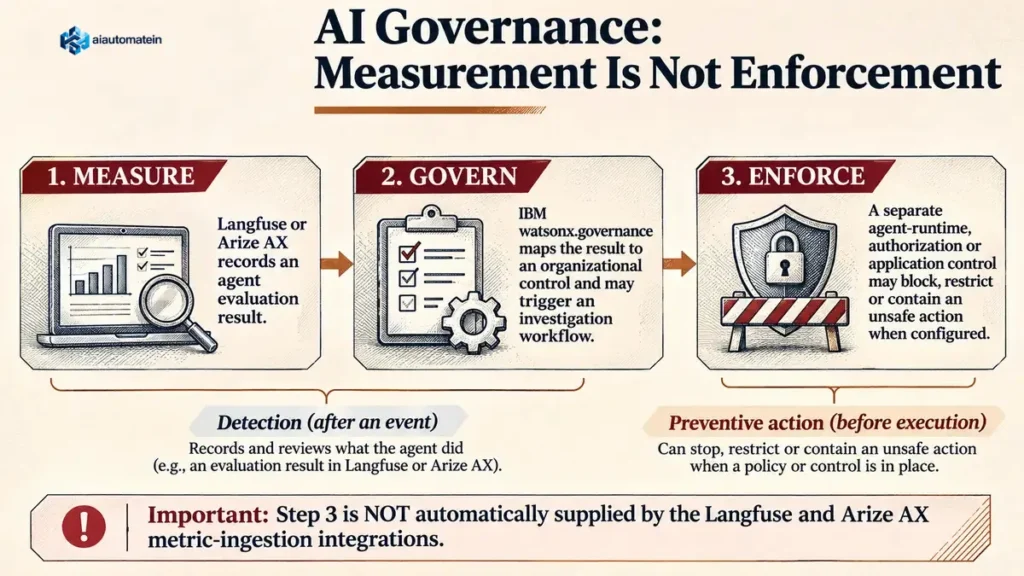
Monitoring a breach and preventing it are different capabilities
The November 12 IBM announcement describes ingestion of evaluation metrics and the ability to trigger governance workflows.
It does not establish that the Langfuse or Arize AX integrations universally intercept an unsafe agent action before execution.
That distinction is important.
If a monitoring system identifies a harmful response after the user has received it, the resulting governance workflow can support investigation and corrective action.
It cannot retroactively prevent that response.
If an agent is about to transfer funds, delete records or change access permissions, an enterprise may also require preventive controls at the application, tool or authorization layer.
IBM has a related but distinct enforcement-tracking integration with watsonx Orchestrate.
In its August 11 and October 14 announcements, IBM described synchronizing defined governance controls with the agent runtime and recording evaluation results as evidence.
The Langfuse and Arize AX integrations extend governance evidence collection to additional observability systems.
They should not be assumed to provide identical runtime enforcement capabilities.
That is a distinction buyers should ask IBM to demonstrate.
The missing question is how much agent activity gets evaluated
Automated evaluation sounds continuous, but production monitoring does not necessarily assess every interaction.
Langfuse supports automated and human evaluation workflows. Arize AX allows customers to configure evaluation tasks and sampling for production traces.
Its documentation describes sampling rates that may range from all eligible traces to much smaller proportions, depending on application volume and operational needs.
For low-risk applications, a representative sample may be sufficient.
For consequential financial or healthcare activities, sampling may leave important gaps unless organizations combine it with deterministic controls and targeted reviews.
A governance record should therefore identify more than the score itself.
It should also explain which interactions were eligible, which were actually evaluated, how the sample was selected and whether errors occurred during collection.
Without that information, a dashboard could display apparently healthy measurements while overlooking an unexamined portion of the workload.
The relevance of AI governance enforcement tracking depends partly on whether coverage gaps remain visible to the people responsible for the control.
This is also why aiautomatein’s AI agent evaluation metrics for production distinguishes technical monitoring from verified business outcomes.
Independent research supports the need for stronger evidence
IBM’s direction is consistent with the National Institute of Standards and Technology’s AI Risk Management Framework.
NIST organizes AI risk management around four functions: Govern, Map, Measure and Manage.
The framework treats governance as a continuing organizational responsibility rather than a final certification step.
Its measurement guidance calls for evaluating whether the selected metrics and evaluation methods are effective.
Its management guidance emphasizes acting on identified risks.
That provides an important independent reference point.
Connecting a quality score to a governance control contributes to measurement and oversight.
The next question is whether the resulting information causes an organization to manage the risk effectively.
For example, if an AI agent repeatedly produces unauthorized financial recommendations, the governance process must identify an accountable owner and determine what action is appropriate.
That response might involve revising prompts, changing source data, restricting permissions, retraining an evaluator or suspending the application.
The evaluation platform supplies evidence. The organization remains responsible for the response.
NIST does not certify IBM’s integration or establish that it satisfies a particular regulatory obligation.
Why the IBM announcement matters commercially
Enterprise AI governance is becoming a coordination problem.
Organizations may have agents built on different frameworks, deployed across several clouds and monitored by multiple platforms.
The operational data needed for governance may be scattered across engineering tools.
IBM’s strategy is to make watsonx.governance a destination for that information.
Support for Langfuse and Arize AX is significant because it extends the governance workflow beyond metrics originating solely within IBM’s agent ecosystem.
For customers already using either platform, the integrations may reduce custom export work and manual reconciliation.
But several implementation questions remain unanswered by the public announcement.
How frequently are evaluation results transferred? What happens when a source platform is unavailable? Can the governance team detect incomplete ingestion? How are evaluator versions preserved when scoring methods change?
These are reasonable questions for procurement and technical validation, not confirmed defects.
The answers will determine how defensible the resulting governance records are during a difficult investigation.
aiautomatein analysis: The evidence chain is the product
IBM is selling an increasingly valuable idea: governance teams should not have to collect screenshots from engineering tools whenever they need to demonstrate oversight.
But the harder problem is making that evidence reliable enough to support decisions.
For AI governance enforcement tracking to become a meaningful enterprise control, an organization needs to establish five relationships.
The first connects the deployed agent to an accountable owner.
The second connects the agent’s business purpose to the risks the organization intends to manage.
The third connects those risks to measurable controls.
The fourth connects evaluation results to the actions taken when controls fail.
The fifth connects those actions to evidence that the underlying problem was resolved.
Without the last two connections, organizations may have excellent documentation of problems that remain unresolved.
This creates a different test for IBM’s integration.
The question is not simply whether watsonx.governance receives a faithfulness score from Langfuse or Arize AX.
It is whether an auditor or incident investigator can reconstruct the chain from a specific agent version and observed failure to the control that detected it, the person responsible and the corrective action taken.
The design should also preserve evaluator versions, timestamps, sampling information and failed collection attempts.
Otherwise, organizations risk producing governance records that are orderly but incomplete.
The parallel with AI agent identity governance is clear. Accountability requires linking the technical system to ownership and authorized behavior.
A score without context can be misleading. A control without an owner can become ceremonial. A remediation ticket without verified closure may leave the original risk untouched.
The strongest contribution of AI governance enforcement tracking will be making those gaps visible and actionable.
What enterprise buyers should ask IBM, Langfuse and Arize
Before relying on the integration for a critical governance process, teams should test a controlled failure.
Create a defined policy requirement and connect it to a measurable evaluation. Introduce a known failing interaction and confirm that the result reaches watsonx.governance with the correct control association.
Then establish whether the workflow assigns ownership, records remediation and confirms that the agent’s behavior has improved.
Repeat the test with missing telemetry, an unavailable evaluation service and a changed scoring method.
The final result should establish not only whether a governance record exists, but whether that record accurately reflects the operational system.
IBM’s integration with Langfuse and Arize AX addresses a real enterprise need: connecting agent evaluations with governance oversight.
The remaining test is whether that connection helps organizations prevent, detect and resolve consequential failures with evidence that holds up to scrutiny.
Frequently asked questions
What is AI governance enforcement tracking?
AI governance enforcement tracking connects operational evaluation results with governance controls, thresholds, ownership and remediation workflows. It helps organizations monitor whether defined controls are being met and document responses to failures.
How does IBM connect Langfuse and Arize AX to watsonx.governance?
IBM says the integrations ingest evaluation metrics from Langfuse and Arize AX, associate results with governance controls and allow threshold breaches to trigger governance workflows.
Does AI governance enforcement tracking prove regulatory compliance?
No. Evaluation records can support governance and audits, but compliance depends on applicable requirements, control design, evidence quality, operating procedures and whether identified risks are appropriately managed.
Sources and references
- IBM, Track governance control enforcement with Langfuse and Arize AX, November 12, 2026
- IBM, New in watsonx.governance, October 14, 2026
- IBM, Enforcement Tracking for watsonx Orchestrate, August 11, 2026
- Langfuse, Evaluation scores documentation
- Arize AX, Production evaluation documentation
- NIST, Artificial Intelligence Risk Management Framework
- NIST, AI RMF Core
Editorial disclosure: The integrations and capabilities are described by IBM and the respective platform providers. aiautomatein has not independently tested the products or audited customer deployments. The banking scenario and proposed evidence-chain framework are original illustrative analysis.