
AgentOps Starts Where the Demo Stops Being Impressive
AgentOps operating model for production agents begins after deployment. See how ownership, behavioural release control, evaluation, incident learning, execution limits and retirement keep production agents fit to run as their environment changes.

Introduction
On March 31, 2026, Amazon Bedrock AgentCore Evaluations became generally available with continuous production evaluation and on-demand testing. By the end of April, AWS was connecting those signals to recommendations, batch evaluation and A/B testing through an observe → evaluate → improve loop. On June 17, recommendations, batch evaluation and A/B testing reached general availability, while Failure Insights began targeting recurring behavioural failures that may never show up as conventional errors.
Microsoft’s production guidance, updated in July, now treats agents as products with named owners, release gates, improvement paths and retirement stages. In September, OpenAI introduced the Agents API in public beta around long-running agents that may operate for days and need durable execution infrastructure rather than a short request-response runtime.
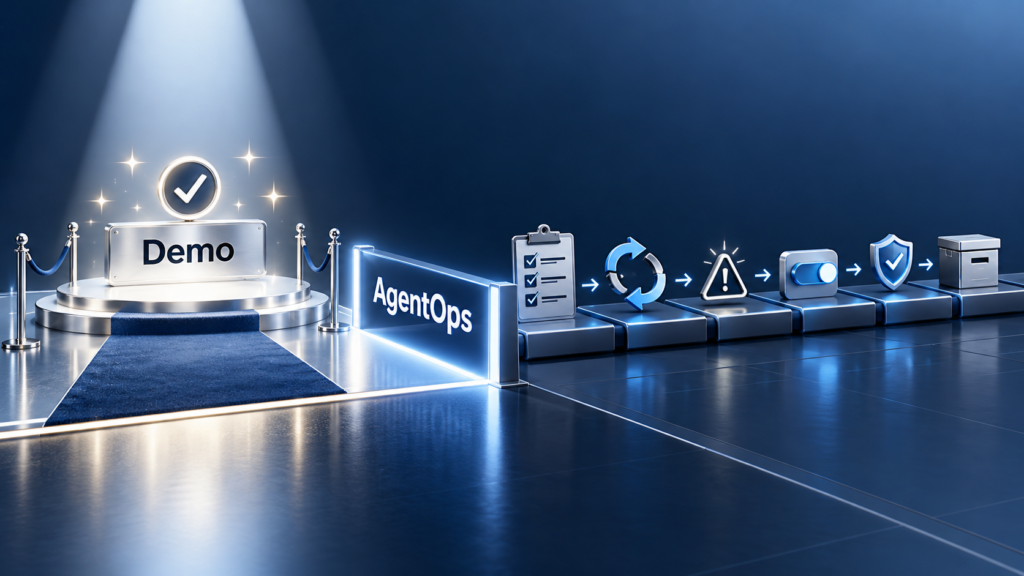
These developments make the direction of AgentOps operating models for production agents much clearer. A successful demo proves that an agent can perform a task under controlled conditions. Production requires an organization to keep that behaviour useful while prompts, models, tools, knowledge, users and business conditions continue changing around it.
AgentOps is increasingly the discipline that connects those changes to ownership, release decisions, incident handling, evaluation, bounded execution and eventual retirement.
At a glance
- AgentOps is developing into a production operating discipline rather than another name for tracing.
- Production agents need accountable ownership and a defined baseline against which later behavioural changes can be judged.
- Prompts, models, tools, retrieval, knowledge and policies can create a behavioural release even when application code is unchanged.
- Production signals matter when they feed incident review, evaluation, release decisions and improvement work.
- A mature operating model includes retirement as well as deployment and optimization.
2026 is closing the production loop
Early agent platforms concentrated on construction: model choice, tool calling, orchestration and debugging. The 2026 product shift is filling in the operating cycle after deployment.
AWS now combines continuous production evaluation with recommendations based on real traces, batch evaluation against defined test cases and A/B testing on live traffic. Its June announcement explicitly describes silent behavioural failures that can look normal on conventional dashboards and surface only later through user complaints.
The connection among those capabilities creates a repeatable operating cycle:
production behaviour → evaluation → proposed change → validation → controlled rollout → new baseline
Going live establishes the first production baseline rather than completing the engineering work. An AgentOps team then needs to keep moving through that cycle without allowing every production problem to become an improvised debugging exercise.
Agent behaviour has more release surfaces than application code
A production agent can change materially without a conventional software release.
Teams can modify the system prompt, model, tool descriptions, available tools, retrieval configuration, knowledge sources, routing behaviour, memory settings or policies. Some changes arrive through the agent team; others come from platform, data, security or knowledge-management teams.
AWS’s current AgentCore optimization architecture reflects this explicitly. Configuration bundles can version system prompts, model identifiers and tool descriptions independently of application code, and A/B testing can compare those configurations against one another or against separate runtime implementations.
A useful operating concept follows from that architecture: behavioural release. A prompt correction may look smaller than a code deployment, but it deserves release treatment if it can materially change task outcomes. The same applies to tool metadata, model replacement or knowledge changes that alter how the agent interprets a case.
AgentOps therefore needs a threshold for deciding when a behavioural change requires evaluation, controlled exposure and a new baseline. The threshold should depend on expected effect, not on whether the change happened to live in source code.
Production ownership continues after launch
Prototype ownership is usually obvious because the team building the agent is still nearby. Production separates the responsibilities.
A platform team may operate infrastructure. Security may manage identity and policy. A business team owns the underlying process. Knowledge owners maintain source material. Model and tool providers continue changing independently.
Microsoft’s current lifecycle guidance addresses that fragmentation by requiring a named owner who remains accountable for the agent’s value and risk after deployment. The same lifecycle includes monitoring, improvement and retirement rather than ending at launch.
The owner does not have to operate every technical component, but production evidence still needs somewhere to terminate as a decision. That includes whether the agent is completing the intended work, whether a dependency or user pattern has shifted, whether the latest configuration change improved behaviour and whether the agent still justifies its operational and control burden.
Quality signals are inputs to operating decisions
An agent can remain technically available while becoming worse at its job.
Endpoints may respond normally, latency can remain within range and tool calls can succeed while task quality deteriorates. Microsoft’s current guidance therefore recommends tracking accuracy, review pass rate, incidents, policy compliance and business outcomes alongside uptime and reliability. It also recommends running evaluation around releases and on a schedule against production agents.
AWS’s production evaluations support the same operating need: teams can evaluate live traffic and measure task completion, tool behaviour and other quality dimensions rather than relying only on infrastructure health.
The detailed monitoring architecture—what telemetry exists, how task and tool signals are correlated and how alerting is implemented—is a separate engineering problem. For AgentOps, the useful question comes after those signals exist: what decision should they trigger?
A falling review-pass rate may require investigation. A task-completion drop after a knowledge change may block rollout. Repeated complaints may create a new regression case. Persistent degradation may eventually support a retirement decision. The production signal earns its place when it changes the operating response.
Behavioural incidents need an improvement path
Some agent incidents look like ordinary outages. Others do not.
A source update may change retrieval behaviour. A new tool description can make the agent select a different action. Users may begin asking for work that was absent from the original evaluation set. A new model can handle one edge case differently while the surrounding service remains healthy.
AWS’s June Failure Insights announcement is useful evidence because it explicitly focuses on recurring behavioural failures that may generate no conventional error signal.
Rather than ending with a one-time fix, the operational response can feed the failure back into the quality system:
production issue → reproducible case → evaluation coverage → proposed change → regression test → controlled rollout
A customer complaint about a bad tool choice becomes much more useful if the case is preserved in a representative evaluation set. The team can then test whether the proposed correction resolves that failure without damaging unrelated tasks, allowing production history to accumulate as durable test coverage instead of a collection of closed tickets.
Evaluation becomes part of change control
Before launch, evaluation asks whether an agent is ready to enter production. After launch, the stronger question is whether a proposed change is better than the current production baseline.
AWS now supports batch evaluation of candidate changes and A/B testing on live production traffic before broad promotion. OpenAI’s current agent-evaluation guidance similarly moves teams from individual trace inspection toward repeatable datasets and eval runs when they need to benchmark prompts or workflow changes over time.
Evaluation can therefore sit directly inside change control. A team can reproduce the behaviour it wants to change, compare the candidate against the existing baseline, expose it to limited traffic where appropriate and promote it only when the evidence supports the move.
The tooling will vary across platforms. The operating requirement is more stable: production changes need a way to demonstrate that they improved the agent rather than merely altered it.
Long-running agents need explicit run boundaries
A production agent can behave correctly and still run for too long.
Multi-step execution may accumulate model calls, tool operations, browser sessions, memory work and sandbox activity. If the agent continues making plausible progress, none of those actions has to look individually defective.
AWS’s current AgentCore harness exposes maxIterations, wall-clock timeout and token-budget controls for individual invocations, alongside runtime-session lifetime limits.
These controls function as production run policies: the team can define how long an invocation may continue, how many reasoning/action cycles are acceptable and what happens when those limits are reached. That provides a predictable operating envelope even when no engineer is watching the run interactively.
Repeated exhaustion of those limits is also useful incident evidence. A task that routinely reaches its execution ceiling may need different decomposition, a workflow change or a narrower responsibility rather than a permanently larger allowance.
AgentOps needs a recurring decision cadence
Continuous telemetry does not create an operating model by itself. Teams need a recurring place where production evidence leads to ownership decisions.
Microsoft’s July 2026 operating-rhythm guidance recommends weekly, monthly and quarterly loops. Weekly reviews handle day-to-day monitoring and intake; monthly steering reviews bring together reliability, risk and cross-team issues; quarterly reviews revisit maturity, value and what should scale or retire.
The precise schedule can vary, but the evidence brought into that rhythm should usually span four different questions:
Production health
Is the service available, responsive and operating within its run boundaries?
Behaviour quality
Is the agent still completing tasks at the expected level, and are incidents or review failures increasing?
Change state
What prompts, models, tools, knowledge, routing or policies changed, and what evidence supported those releases?
Business state
Is the agent still being used, producing the intended outcome and earning its place in the production estate?
The dashboard supplies evidence. The operating rhythm brings monitoring, evaluation and business ownership together so that the evidence can result in investigation, release, investment or retirement decisions.
Retirement is part of production operations
Agent estates will eventually contain systems that no longer deserve continued operation.
Some will lose usage. Others will support a process that has changed materially. A useful agent can also become too difficult to repair relative to the value it still creates, or depend on knowledge and integrations that the organization no longer wants to maintain.
Microsoft’s lifecycle model explicitly includes retirement and recommends removing access and dependencies when an agent no longer adds enough value.
The end of the lifecycle is therefore an AgentOps decision as much as deployment or improvement. A production agent should have a reason to remain in service and conditions under which the organization will decommission it when continued optimization no longer makes sense.
FAQs
What is AgentOps?
AgentOps is the operating discipline for AI agents after they enter production. It includes ownership, behavioural release management, incident handling, evaluation, execution limits, recurring production reviews, improvement and retirement.
How is AgentOps different from AI agent monitoring?
Monitoring produces signals about the agent and its environment. AgentOps uses those signals to make production decisions: investigate a failure, block or approve a change, expand evaluation coverage, adjust operating limits, improve the agent or retire it.
Why do agents need behavioural release management?
Agent behaviour can change through prompts, models, tools, retrieval, knowledge, memory, routing and policies even when application code stays unchanged. If one of those changes can materially alter task outcomes, it may deserve evaluation and controlled rollout.
Who should own a production agent?
Ownership should be explicit. The exact organizational role varies, but someone needs continuing accountability for whether the agent delivers enough value at an acceptable level of quality and risk after launch.
When should a production agent be retired?
Retirement is appropriate when the agent no longer produces enough value, the underlying process has changed, required dependencies are no longer supportable or continued improvement is no longer justified by the operating burden.
Production is a continuing decision
The 2026 AgentOps shift is visible in the way production capabilities are connecting. Evaluation now sits alongside live traffic. Configuration changes can be versioned and tested. Behavioural failures can feed improvement work. Enterprise guidance is assigning continuing owners, recurring review cadences and retirement stages.
Together, those capabilities create a more useful definition of production readiness than proving once that the agent worked in testing.
AgentOps starts when the team stops asking only whether the agent works and starts deciding, repeatedly, whether it is still fit to run.