Snowflake Cortex AI Gateway introduces governed end-to-end agent traces
Snowflake details governed agent tracing through Cortex AI Gateway, combining model and MCP tool activity in Snowflake with role-controlled access and optional payload capture.
Snowflake details governed agent tracing through Cortex AI Gateway, combining model and MCP tool activity in Snowflake with role-controlled access and optional payload capture.
MLflow 3.17 introduces structured AI evaluation decisions, granular permissions and faster trace analytics, with TypeSafe dependencies and database-upgrade requirements.

Probabilistic AI regression testing distinguishes legitimate output variation from behaviour that should block a release. See how exact checks, criteria-based evaluation, repeated sampling and critical failure boundaries can identify meaningful regressions without treating every textual difference as a defect.

AI task success production metrics measure whether a release still completes the work users came to accomplish. See how task outcomes, release identity, delayed business evidence and task-level comparisons can expose regressions that latency, error rates and tool-success metrics miss.

Multi model routing cost latency reliability determines which approved model route should serve each request under current operating conditions. See how tail latency, provider health, capacity, timeouts, retries and failover affect the true cost and reliability of the completed request.

MLOps observability task quality connects technical health with evidence about whether AI behaviour remains acceptable. See how traces, configuration identity, task cohorts and production evaluation can reveal where groundedness, adherence or tool-use quality deteriorates even while latency and availability remain healthy.

GenAI evaluation pipeline release gate places repeatable evidence between a behavioural change and production promotion. It tests models, prompts, retrieval, tools and agent configurations against stable datasets, evaluators, baselines and must-pass criteria before a candidate can replace the current version.

Multi model lifecycle management enterprise turns model lifecycle control into a portfolio problem. See how dependencies, ownership, provider retirements, fine-tuned variants and migration plans help enterprises manage many production models across different lifecycle clocks.
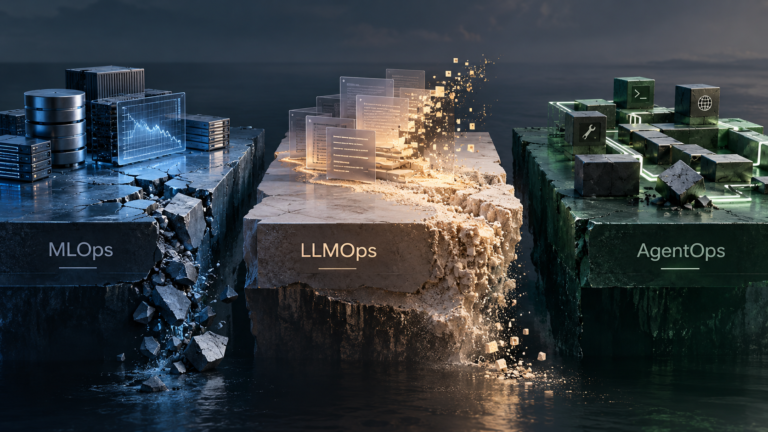
MLOps vs LLMOps vs AgentOps failure surfaces reveal different places where production AI can break. Compare model and data lifecycle failures, prompt and retrieval problems, and agent execution failures involving tool choice, task state and orchestration.

Modern MLOps generative agentic AI expands production discipline beyond the model lifecycle. It brings prompts, retrieval configuration, tools, orchestration, evaluation baselines and execution traces into the versioning, testing, release and recovery boundary.