AWS AgentCore Lifecycle Hooks: Four essential safeguards strengthen AI agent control
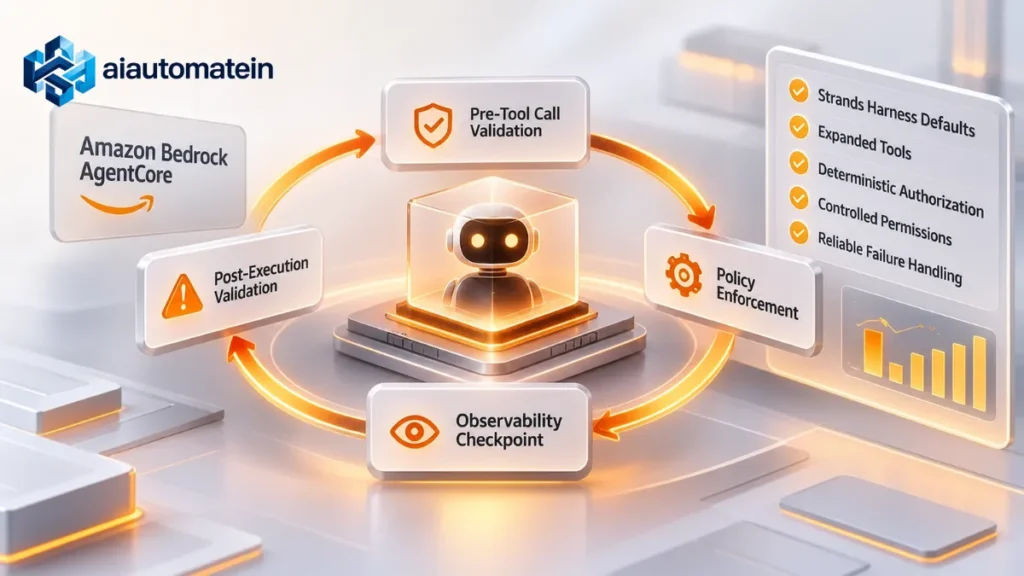
AWS AgentCore Lifecycle Hooks introduce four execution checkpoints designed to strengthen control over autonomous AI agent operations. Announced November 19, 2026, the update to Amazon Bedrock AgentCore harness also adds Strands harness defaults and expanded tools. Developers can use lifecycle checks to validate proposed tool calls, enforce business policies, and support operational visibility across delegated workflows. The release highlights the importance of deterministic authorization, carefully configured permissions, and reliable failure handling as enterprises deploy agents capable of taking consequential actions.

An enterprise AI agent can retrieve customer records, invoke business applications, and recommend actions that affect financial or operational systems. Those capabilities create an important distinction between an action proposed by a language model and an action an organization has actually authorized.
Amazon Web Services is addressing that distinction through AWS AgentCore Lifecycle Hooks, announced on November 19, 2026, as part of an update to Amazon Bedrock AgentCore harness. The release introduces four execution checkpoints, along with Strands harness defaults and additional tools designed to support managed agent development.
Why Agent Instructions Are Not Sufficient Security Controls
Developers commonly use system prompts to explain how an AI agent should behave, including which actions are permitted and when human approval is required. However, instructions interpreted by a language model do not provide the same enforcement guarantees as application code that independently checks an authorization policy.
That difference becomes consequential when an agent can issue refunds, change customer records, submit purchase orders, or modify infrastructure configurations. A model may determine that an action is appropriate, while the organization’s business rules require additional verification before execution.
AWS AgentCore Lifecycle Hooks allow developers to insert deterministic application logic at defined stages of the agent’s workflow. The intent is to preserve the model’s flexibility in selecting useful actions while separating that decision-making process from the authority to execute sensitive operations.
Independent research reinforces the importance of separating tool availability from transaction-level authorization. In the June 2026 preprint Capability Gates Are Not Authorization, researchers examined agent frameworks and demonstrated how exposing a tool to an agent can leave individual actions insufficiently constrained unless the runtime independently validates their parameters and permissions. The findings support the case for deterministic enforcement, although the study did not evaluate AWS AgentCore Lifecycle Hooks directly.
Four Checkpoints Define the Enforcement Model
AWS describes four lifecycle events: before_invocation, before_tool_call, after_tool_call, and after_invocation. Each event gives developers an opportunity to execute supporting logic at a particular point in the agent’s processing sequence.
The before_invocation event occurs before the agent processes an incoming request, making it suitable for preliminary validation and other controls that should run before execution begins. The before_tool_call event occurs after the agent proposes using a tool but before the tool executes, providing an especially important opportunity to evaluate whether the requested operation is authorized.
The remaining checkpoints allow supporting logic to run after individual tool calls and after the agent completes an invocation. Together, these mechanisms provide developers with a structured way to add validation, notifications, and operational controls without relying exclusively on model-generated instructions.
Refund Authorization Demonstrates the Practical Difference
AWS illustrates the capability through a customer-service workflow in which an AI agent can initiate refunds. In the company’s example, a Lambda-based policy checks the requested amount and rejects transactions exceeding $500 when the required approval has not been obtained.
The agent can then inform the customer that the request requires escalation rather than proceeding with the transaction. This preserves the agent’s conversational role while ensuring that an independently executed policy determines whether the financial action can occur.
The example also shows why reliable authorization requires more than observing what the model intends to do. A security control must operate before a consequential request reaches the downstream system, particularly when the action cannot be easily reversed.
Synchronous Enforcement and Notifications Serve Different Purposes
AWS supports Lambda-based lifecycle hooks as well as integrations involving Amazon Simple Notification Service and Amazon EventBridge. These capabilities provide different forms of operational functionality, but organizations should not assume that every hook destination can prevent an action from executing.
According to AWS, synchronous Lambda hooks can influence the execution loop, while notification-oriented integrations provide visibility into events. The distinction is essential because recording an unauthorized tool call is not equivalent to blocking it before it reaches the target application.
Enterprises should therefore classify their controls according to whether they enforce a decision, provide monitoring evidence, or support incident investigation. Sensitive operations may require all three, but each capability addresses a different part of the security problem.
Delegated Agents Introduce Additional Governance Requirements
Multi-agent applications frequently divide work between a coordinating agent and specialized subagents. This architecture can improve task execution, but it also creates the possibility that delegated operations will encounter different authorization boundaries from those applied to the original request.
AWS states that tool-call lifecycle hooks apply to subagents, allowing configured checks to remain relevant when work is delegated. This is important for enterprise workflows in which an agent might ask another agent to retrieve sensitive information, execute a transaction, or operate a specialized tool.
The effectiveness of the safeguard still depends on the policy implemented by the developer. A poorly designed authorization rule can approve an inappropriate request regardless of whether the request originates from a parent agent or a delegated component.
Strands Harness Expands the Managed Execution Environment
The update also introduces Strands harness defaults intended to simplify the configuration and operation of AI agents within AgentCore. AWS describes managed capabilities covering model selection, system instructions, context management, prompt caching, and additional tools.
The platform supports activities such as task planning, file operations, web retrieval, and delegation to specialized agents. These capabilities can reduce the engineering effort required to assemble an execution environment, although application developers remain responsible for deciding which functions their agents should access.
AWS notes that the upgraded experience began rolling out on November 11, before the November 19 technical announcement. Organizations using existing harness configurations should therefore review how managed defaults interact with explicitly configured tools and permissions.
Broad Tool Permissions Can Expand the Attack Surface
A particularly important configuration issue involves applications using wildcard tool permissions such as allowedTools: ["*"]. AWS explains that managed updates can introduce newly recommended built-in tools into environments where broad permission settings allow them.
This behavior may be convenient during development, but it can undermine the predictability of a production security boundary. An agent intended to retrieve information should not acquire additional execution capabilities simply because the managed environment introduces new tools.
AWS AgentCore Lifecycle Hooks provide an additional enforcement mechanism, but least-privilege permissions and explicit tool selection remain necessary. Organizations should test their configurations after platform changes and confirm that protected resources are inaccessible to unauthorized operations.
What Enterprise Architects Should Test Before Deployment
The release provides a clearer architectural model for separating model-generated decisions from deterministic application controls. However, implementing a lifecycle hook does not automatically guarantee that a business process is secure or that every failure will produce the intended result.
Engineering teams should test rejected tool calls, malformed requests, delegated operations, policy-service failures, and unexpected timeout conditions. They should also verify what information is recorded for incident investigation and whether the agent can recover appropriately when a proposed operation is denied.
The central design objective is to ensure that AI agents remain useful without becoming independent sources of authority over sensitive enterprise systems. AWS AgentCore Lifecycle Hooks offer a practical mechanism for pursuing that objective, provided the surrounding policies are designed, tested, and maintained carefully.
How is your organization enforcing authorization across autonomous workflows? aiautomatein welcomes technical contributions from enterprise architects, security engineers, and developers evaluating policy checkpoints, delegated-agent permissions, and operational safeguards. Submit implementation insights or propose an expert interview.
Source: AWS Machine Learning Blog — November 19, 2026.