AI Model Routing Strategy: 7 Critical Decisions to Avoid Costly Failures
A practical AI model routing strategy can reduce inference spending without sacrificing quality. Explore seven decisions, five vendors, published research and a worked cost comparison.


AWS Bedrock, Portkey, LiteLLM, Cloudflare and OpenRouter take different approaches to routing AI requests. The best architecture is not necessarily the one that selects the cheapest model. It is the one that completes the job reliably at an acceptable total cost.
Imagine a customer service agent processing 10,000 requests a day.
Some requests need a straightforward classification. Others involve account histories, policy interpretation or a decision that could affect a customer’s finances.
Would you use the same expensive language model for every request?
Probably not.
But routing every request to the cheapest model creates another problem. A weak answer can trigger retries, human intervention and additional model calls. The apparent savings disappear.
An effective AI model routing strategy must account for the work being performed, the quality required and the cost of getting it wrong.
Research suggests routing can deliver substantial savings under suitable conditions. The RouteLLM project, developed by researchers including members of UC Berkeley’s Sky Computing Lab, reported cost reductions exceeding 85% on MT Bench while retaining 95% of GPT-4’s performance in its evaluated setup.
The researchers reported smaller savings on other benchmarks, including 45% on MMLU and 35% on GSM8K.
Those results demonstrate what adaptive routing can achieve on particular datasets and model combinations. They do not establish that enterprises can reproduce the same savings across production workloads.
The challenge is turning that research into an operating system for real applications.
Why AI model routing strategy matters in production
The financial pressure is already visible.
The FinOps Foundation’s 2026 State of FinOps survey found that 98% of its 1,192 respondents were managing AI expenditure, compared with 31% in 2024.
Managing the bill, however, is different from understanding why a particular model was selected.
An organization may have dozens of applications using different providers, models, context windows and billing arrangements.
For agentic workflows, a single business request may generate multiple inference calls before completing.
As aiautomatein examined in its enterprise AI cost management analysis, the meaningful financial measure is the cost of a verified business outcome.
Model routing is one way to influence that cost. It is not a substitute for measuring it.
7 critical AI model routing decisions
1. Does the task need a language model at all?
Before selecting an inexpensive model, determine whether the operation requires inference.
Extracting a fixed field from structured data, applying an established rule or looking up a known account status may not require a language model.
Conventional code can often handle predictable operations with fewer failure modes.
Production test: Identify repetitive tasks and compare deterministic execution with model-based execution for accuracy, latency and maintenance effort.
AWS and other cloud providers offer the infrastructure to implement these alternatives, but the decision belongs in the application architecture.
A well-designed AI model routing strategy should permit a no-model path.
2. When is a smaller model sufficient?
A simple classification request may not require the same model as a complex financial analysis.
Amazon Bedrock Intelligent Prompt Routing selects between supported models within a family using predicted response quality and configured routing criteria.
AWS says the capability can reduce costs by up to 30% without compromising accuracy in its tested scenarios.
Its documentation also identifies limitations. Routing is optimized for English prompts and cannot automatically incorporate an application’s own performance data into its selection decisions.
For specialized enterprise workflows, those limitations matter.
Production test: Compare smaller and larger models using actual application requests, with independent scoring against accepted outcomes.
Do not assume a lower-cost model is suitable because it performs well on general benchmarks.
3. Should the agent retrieve information or ask another model?
An agent that lacks a current policy document may produce a plausible but incorrect answer.
Invoking a larger model does not necessarily solve the missing-information problem.
Retrieval may be the better execution path when the task depends on current enterprise records.
But retrieval has its own costs. Search, reranking, data preparation and context processing can add latency and consumption.
Production test: Compare direct inference, retrieval-assisted inference and escalation to a stronger model against the same verified questions.
The distinction connects to aiautomatein’s context engineering checklist.
A router should not treat missing evidence as a problem that model size alone can resolve.
4. Should the workflow use one model or multiple agents?
Adding agents can introduce useful specialization. It can also multiply inference calls and create additional coordination failures.
A workflow involving planning, retrieval, validation and final response generation may be appropriate when the tasks are genuinely distinct.
For simpler requests, one model call may be sufficient.
Portkey provides configurable routing across providers and models, while LiteLLM supports routing groups, deployment strategies and fallback configurations.
These tools manage parts of request execution. They do not independently determine whether a multi-agent workflow is necessary.
Production test: Compare a single-agent implementation with a coordinated multi-agent design using task success, total calls, end-to-end latency and human correction.
More components should earn their place through better outcomes.
5. When should the application use cached responses?
Caching can eliminate repeated paid model calls.
Cloudflare AI Gateway documents response caching for identical eligible requests. Its implementation is useful for predictable text or image requests, particularly when the same prompt appears repeatedly.
However, identical requests do not always require identical answers.
A cached product price, authorization decision or account status can become incorrect when the underlying data changes.
Production test: Define which requests are safe to cache, how long results remain valid and which data changes must invalidate cached output.
Caching is an important part of an AI model routing strategy, but correctness must take precedence over cache-hit rates.
For sensitive workloads, cache design should also account for user-specific context and access permissions.
6. What should happen when a model fails?
Retries and fallbacks can improve resilience, but poorly configured recovery logic may increase expenditure or duplicate consequential actions.
LiteLLM distinguishes retries within a model group from fallbacks to another group. Its router also supports cooldowns for unhealthy deployments and policies that treat failures differently.
Portkey documents conditional routing, load balancing and fallback configurations.
These capabilities provide useful building blocks for handling provider outages, rate limits and model errors.
But not every operation is safe to repeat.
A failed response after a payment request does not prove that the transaction itself failed.
Production test: Simulate timeouts, rate limits, malformed outputs and partial tool execution. Confirm that recovery does not duplicate business actions.
Use idempotency controls and authoritative transaction status checks where necessary.
7. Are you optimizing token price or successful business outcomes?
The cheapest model request may produce the most expensive business result.
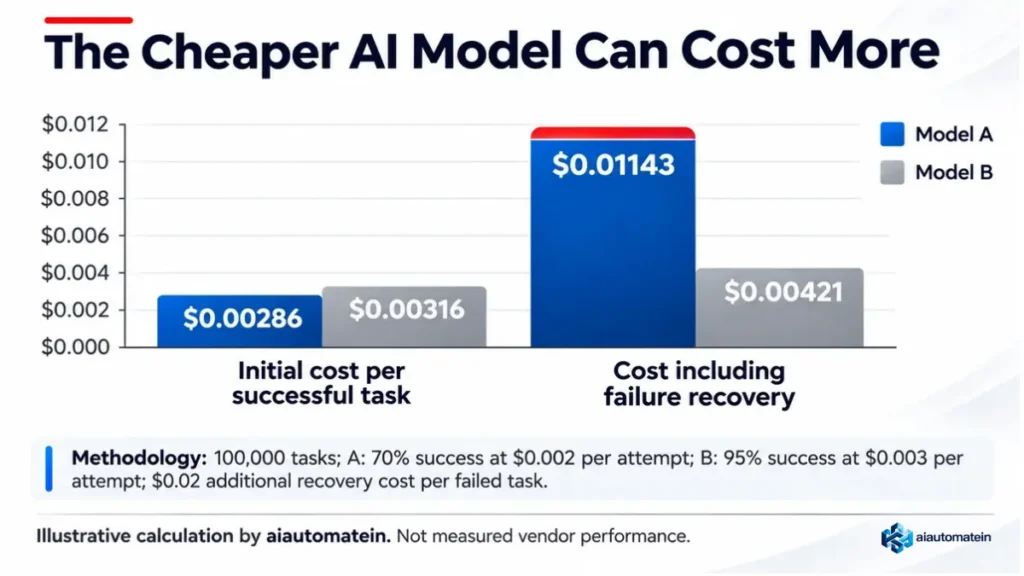
Suppose a company processes 100,000 tasks.
Model A costs $0.002 per attempt and completes 70% successfully. Model B costs $0.003 per attempt and completes 95%.
Ignoring review and recovery costs, Model A costs approximately $0.00286 per successful task. Model B costs approximately $0.00316.
At first glance, Model A remains cheaper.
Now suppose unsuccessful attempts require an additional $0.02 in review and recovery.
Model A’s total cost becomes $800, or approximately $0.01143 per successful task. Model B’s total becomes $400, or approximately $0.00421 per successful task.
These figures are illustrative calculations, not measured vendor performance.
The model with the higher initial price becomes substantially cheaper once failure costs are included.
Production test: Compare total costs against verified successful outcomes, not merely input and output token rates.
This should be the final decision criterion for any AI model routing strategy.
Five vendor approaches to model routing
The commercial market contains several overlapping but distinct approaches.
Amazon Bedrock offers intelligent prompt routing based on predicted response quality and model-selection criteria within supported model families.
Portkey provides an AI gateway with conditional routing, provider fallbacks, load balancing, caching and observability.
LiteLLM provides a configurable router and proxy with model groups, retry policies, deployment selection, usage-based routing and fallback controls.
Cloudflare AI Gateway offers response caching, rate limiting, model aliases and dynamic routing. Its November 2026 documentation also describes an Auto Router intended to select cost-effective models while maintaining response quality.
OpenRouter connects applications to multiple model providers and routes requests using provider-level factors including price, latency, throughput and reliability.
These capabilities are not identical.
Some systems primarily select models. Others manage which provider serves a selected model. Some also provide gateway-level control over budgets and request execution.
A buyer should distinguish model selection from provider selection before comparing platforms.
Independent research: Routing efficiency depends on the workload
The RouteLLM research provides evidence that intelligent selection between stronger and weaker models can reduce inference expenditure without a corresponding loss of measured benchmark quality.
Its authors evaluated different router architectures using human preference information and publicly available benchmarks.
The important finding is not that one router achieved an impressive percentage saving.
It is that different requests require different amounts of model capability.
The research also has limits. Benchmark questions do not replicate every enterprise application, and model performance changes as providers release new versions.
More recent research has examined another issue: the upfront cost of developing and evaluating a routing policy.
A September 2026 preprint, Routing Should Pay for Itself, argues that collecting performance feedback across many candidate models can become expensive enough to affect the return on routing optimization itself.
That introduces an additional financial question.
How much testing and infrastructure expenditure is justified before the expected savings begin?
aiautomatein analysis: The cheapest route can be the wrong route
An AI model routing strategy is often described as a way to reduce token expenditure.
That is too narrow.
The more important question is whether the routing system preserves the quality of decisions while reducing the total resources required to complete work.
Consider the customer support example.
One request may require only a classification. Another may need access to current account information. A third may involve a regulated decision requiring human approval.
Routing all three requests through one model ignores their different technical and business requirements.
But routing solely by prompt complexity is also insufficient.
The system must account for data freshness, permission boundaries, expected error costs and the consequences of failure.
That is why AI agent evaluation metrics belong inside the routing strategy.
A router should be evaluated against completed tasks, policy compliance and recovery costs, not only response speed or predicted model quality.
OpenRouter’s October 2026 provider-routing update offers a useful industry example. The company reported improvements of 16.9% in time to first token, 16.3% in throughput and a 46% reduction in capacity errors, accompanied by a 6% increase in cost.
Those figures are company-reported measurements of its own provider-routing changes, not an independent comparative benchmark.
They nevertheless demonstrate a legitimate tradeoff: a modest increase in direct inference cost can accompany improvements in reliability and speed.
The missing layer in most vendor comparisons is the business outcome.
Did customers receive correct answers? Did agents complete their assigned tasks? Did failures require additional work?
These are the questions that determine whether routing has produced genuine economic value.
What enterprise AI teams should measure
Before implementing routing, organizations should build an evaluation dataset representing actual workloads.
Each request should have a task category, acceptable quality threshold, latency requirement, security constraints and authoritative success condition.
Teams can then measure model selection, inference cost, recovery attempts, human intervention and final task outcome.
A successful AI model routing strategy should reduce total cost without increasing unacceptable errors, security violations or operational risk.
If it cannot demonstrate that result against a stable baseline, a cheaper average token price is not enough.
Frequently asked questions
What is an AI model routing strategy?
An AI model routing strategy determines which model, provider or execution path should handle a request based on factors such as task requirements, quality, cost, latency, availability and security policies.
How much can AI model routing reduce inference costs?
Savings depend on the workload, models and evaluation criteria. RouteLLM reported more than 85% cost reduction in one benchmark setting, while AWS promotes savings of up to 30% for Bedrock Intelligent Prompt Routing. Neither figure is a general enterprise guarantee.
Which platforms support AI model routing?
Amazon Bedrock, Portkey, LiteLLM, Cloudflare AI Gateway and OpenRouter offer different model-selection, provider-routing, fallback or gateway-management capabilities. Buyers should assess each against their application requirements and documented limitations.
Sources and references
- FinOps Foundation, State of FinOps 2026
- RouteLLM, University of California, Berkeley
- RouteLLM, ICLR 2025 research paper
- Amazon Bedrock Intelligent Prompt Routing documentation
- Portkey conditional routing documentation
- LiteLLM routing documentation
- Cloudflare AI Gateway routing
- Cloudflare AI Gateway caching
- OpenRouter provider-routing update, October 2026
- Routing Should Pay for Itself, September 2026 preprint