
Continuous assurance is replacing the annual AI review
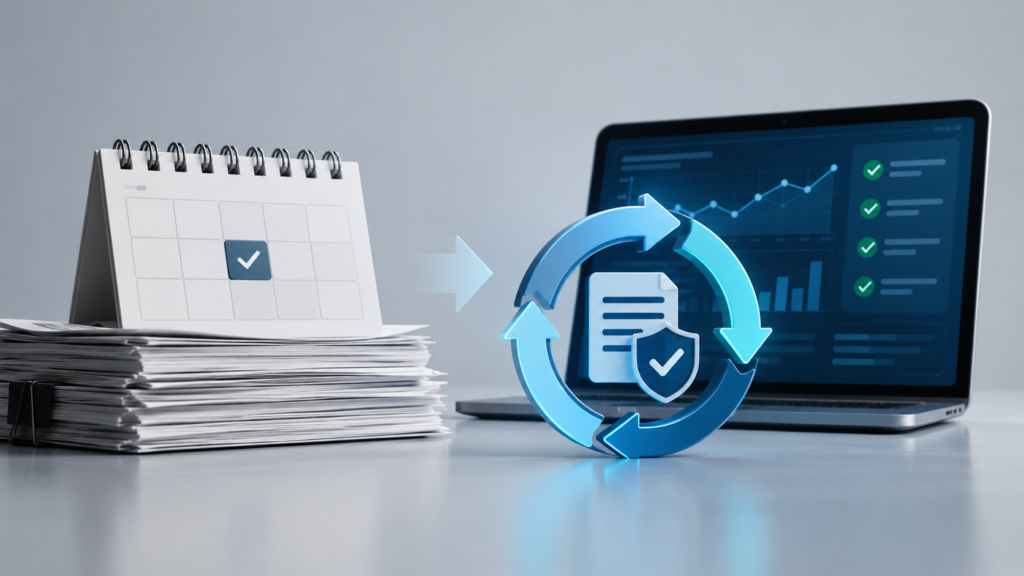
Continuous AI assurance framework keeps approval evidence current as models, tools, data, suppliers and operating conditions change. See how scheduled reassessment, material-change triggers and production monitoring can refresh assurance throughout the lifecycle while annual reviews become portfolio-level summaries.

Introduction
In August 2026, the U.S. Government Accountability Office published an AI Strategy with a pillar titled “Establish Continuous Monitoring.”
On the same page, it retained an annual governance mechanism: the CTO is expected to prepare a yearly state-of-AI report for GAO’s governance board in the GAO AI Strategy.
That pairing captures the change more accurately than an argument for abolishing annual governance. GAO’s strategy puts lifecycle performance indicators, compliance reviews, privacy assessments, internal-control audits, security assessments, incident tracking and root-cause analysis underneath the annual report.
The annual review can still summarize portfolio performance, recurring risks, investment outcomes and lessons learned.
It stops being the place where the organization first discovers whether the AI estate is still behaving as approved.
That is the operating shift behind a continuous AI assurance framework.
At a glance
- Annual AI reviews are increasingly becoming summaries of evidence collected throughout the year rather than the primary point at which assurance is recreated.
- NIST’s 2026 monitoring work treats post-deployment functionality, security, compliance, human factors and other concerns as ongoing measurement problems.
- U.S. federal guidance already expects high-impact AI assessments to be revisited through the lifecycle and calls for ongoing post-deployment monitoring.
- Continuous assurance does not require every control to be tested continuously; evidence can be sampled, scheduled or refreshed after material change.
- Monitoring becomes assurance only when evidence is tied to a claim, acceptable state, accountable owner and response.
The annual review was built for a slower change cycle
Periodic review works reasonably well when the object being reviewed changes slowly. A system is approved, important controls are recorded and the organization revisits the position months later. If the application, suppliers, user population and operating context remain fairly stable, the review may still describe the system that exists.
AI systems make that assumption harder to sustain.
A model can be replaced without a major application redesign. An agent can gain another tool. A retrieval source can expand. An embedded AI feature can be activated inside an existing product. Usage can move from a controlled pilot to a much larger population while the original governance record remains unchanged.
An annual review can still discover those changes, but it can discover them late. If something material happens in February and the formal checkpoint arrives in November, the enterprise may spend most of the year relying on evidence collected against a different system state.
The issue is not that twelve months is always the wrong interval.
Calendar time alone is a weak trigger for re-establishing assurance.
2026 monitoring guidance makes the lifecycle problem explicit
NIST’s March 2026 report on monitoring deployed AI systems gives this shift a stronger technical basis.
NIST notes that pre-deployment evaluations remain valuable but largely occur under controlled conditions. Real-world deployment introduces changing inputs, users, environments and interaction effects that pre-release evaluation cannot fully reproduce.
The report separates post-deployment monitoring into areas including functionality, operations, human factors, security, compliance and large-scale impact.
That separation matters because an AI system can remain available while its security exposure changes, retain acceptable technical quality while creating a compliance problem, or continue behaving consistently while the population affected by its outputs changes.
NIST does not pretend the operating model is settled. Its 2026 work still raises questions about appropriate monitoring frequency, risk-sensitive cadence and the division between automated monitoring and human validation.
That uncertainty is important.
Continuous assurance is not a demand to monitor everything at maximum frequency. It is a recognition that evidence supporting an approval can require renewal after deployment.
Federal high-impact AI guidance already assumes reassessment
The same operating logic appears in U.S. federal guidance.
OMB Memorandum M-25-21 requires agencies to complete an AI impact assessment before deploying a high-impact AI use case and says the assessment should be updated periodically and throughout the AI lifecycle as appropriate. It also requires documented reassessment schedules and reassessment after significant modifications.
The memorandum separately requires ongoing monitoring for performance and potential adverse impacts, including detection of unforeseen circumstances, post-deployment system changes and changes in context or associated data.
M-25-21 was issued on 3 April 2025 and gave agencies 365 days to document implementation of the minimum risk-management practices for high-impact AI. By April 2026, ongoing monitoring was therefore no longer just an abstract future-state principle within that framework.
An annual inventory or governance review can still provide accountability.
The risk-management machinery beneath it increasingly depends on lifecycle evidence.
Monitoring and assurance are not the same thing
Monitoring produces observations. Assurance supports a claim.
A monitoring system may report declining groundedness, a higher intervention rate from a safety evaluator or increasing tool failures. Those signals become assurance-relevant only when the enterprise knows what requirement they relate to, what condition is acceptable, who owns the response and what happens when the evidence moves outside that condition.
Without that relationship, an organization can collect large volumes of telemetry without knowing whether an important governance claim is still defensible.
A continuous AI assurance framework therefore connects the claim being relied on to the evidence that supports or weakens it, the condition that should trigger attention, the accountable owner and the response available when the claim can no longer be sustained.
Annual governance processes often perform those connections manually.
The emerging operating model moves part of that work between meetings.
Assurance can operate on more than one clock
“Continuous” does not mean every AI system requires every risk to be tested on every interaction.
Production quality and safety evidence may be sampled from live traffic. Other controls may justify daily, weekly or monthly testing. Supplier evidence may remain quarterly. Some questions require longer observation periods before useful conclusions can be drawn.
Material change introduces another clock entirely. A different model provider, a newly autonomous action, an expanded user population or another consequential change may justify reassessment immediately rather than at the next scheduled checkpoint.
NIST’s 2026 report explicitly leaves cadence open rather than imposing a universal monitoring frequency. It also notes the practical difficulty of scaling human-driven monitoring alongside rapidly expanding AI deployments.
The resulting operating model is risk-sensitive and evidence-sensitive.
Annual review becomes too blunt when it is the only clock available.
Scheduled assurance deals with evidence that ages predictably
Some evidence loses value gradually.
Performance baselines become less representative as adoption expands. Evaluation datasets age. Supplier attestations become stale. A human-oversight arrangement that worked during a limited deployment may behave differently after the process scales.
Those conditions make scheduled reassessment useful, but the interval should follow the assumption being tested rather than an inherited governance calendar.
A high-consequence system exposed to rapidly changing production inputs may need shorter evidence intervals than a stable low-risk internal assistant. OMB’s requirement that high-impact AI assessments include reassessment schedules points toward the same discipline.
The schedule itself therefore becomes part of the assurance design: the organization decides not only what evidence was sufficient at approval, but when it should cease to be accepted without renewal.
Material change can reopen assurance before the calendar does
Not all consequential changes respect a schedule.
An AI system can gain a new purpose, model, tool, data source or deployment population the day after a formal review. Once the basis for the previous assurance claim has changed materially, waiting for the next calendar checkpoint may add little governance value.
This is why an operating model needs event-triggered reassessment alongside scheduled evidence refresh.
The trigger should be connected to the assurance claim rather than every technical edit. A logging configuration change may have no bearing on a model-quality assessment, while giving an agent access to a payment capability can affect several governance claims at once.
This article does not own the separate question of when a changed purpose, affected population or decision role crosses a formal risk-classification boundary; that remains distinct territory.
The operating principle needed here is narrower:
Material change should be capable of reopening assurance before the calendar does.
Production evaluation is making shorter assurance loops practical
The shift would be much harder if every review still required evidence to be assembled manually.
Current AI platforms increasingly expose recurring evaluation as part of production operations. Microsoft Foundry documents scheduled and continuous evaluations against agent traffic and datasets, while its broader Control Plane describes continuous evaluation across agent performance, quality and risk dimensions together with recurring security monitoring.
The maturity qualification matters.
In the current Foundry agent-monitoring experience, recurring evaluations, red-team scans and alerts are documented as preview. The existence of those capabilities therefore shows the direction of platform development; it does not prove that a standardized or fully mature continuous-assurance operating model already exists.
Even with that limitation, the operating implication is significant. Evidence that once required a dedicated review exercise can increasingly be generated as part of running the system, giving governance more opportunities to discover deterioration before the next formal checkpoint.
Assurance evidence needs a route into a decision
Recurring evidence is useful only if deterioration can cause something to happen.
GAO’s August 2026 AI Strategy makes this explicit. It says GAO will monitor AI use and investments at use-case, system and portfolio levels and establishes governance mechanisms that can consider suspension or termination of AI solutions that fail defined cost, schedule or performance thresholds.
The same strategy connects continuous improvement with performance indicators, lifecycle checkpoints, incident tracking, root-cause analysis and lessons learned.
An enterprise does not need suspension to be the default consequence of every threshold breach. Depending on the claim at risk, the response may be investigation, additional evaluation, narrower operating scope, a control change, increased human review or temporary restriction.
What matters is that the evidence has a route into a decision.
Without that connection, continuous monitoring can become continuous collection rather than continuous assurance.
Human review moves toward the exceptions that require judgment
Continuous assurance does not remove people from governance; it changes how their attention is allocated.
In a conventional annual review, people often have to collect evidence, determine what changed, locate control owners and judge whether the current position is still acceptable during the same exercise.
More continuous evidence can separate those activities.
Routine measurements can run without a committee meeting. Expected conditions can be checked automatically. Material changes and deteriorating evidence can surface earlier. Human reviewers can concentrate on cases that require interpretation, risk acceptance or a choice between competing business considerations.
NIST’s 2026 monitoring work explicitly raises the question of how automated and human-validated monitoring should be combined.
Neither extreme scales well: manually reviewing every interaction is impractical, while fully automated assurance cannot resolve every judgment that makes governance necessary.
The annual review still has a job
The title is not an argument for deleting annual governance.
GAO’s own strategy demonstrates the remaining role: the continuous-monitoring pillar still includes an annual state-of-AI report to the governance board.
That annual view can answer questions that continuous system-level evidence handles poorly on its own. It can compare business value across the portfolio, identify recurring control failures, examine whether the organization’s risk appetite still makes sense, direct investment and surface systemic issues that appear insignificant when each application is reviewed separately.
Its role becomes more useful when it does not have to recreate the year’s evidence history from scratch.
Instead of asking every system owner once a year to prove that nothing important happened, portfolio governance can begin with the evidence accumulated during operation and ask what that record means for the organization as a whole.
This is also where SEC-GOV-08 remains separate from agent-specific operating models. Detailed agent release management, retirement, run policies and incident-to-evaluation loops belong to AgentOps territory; here, the concern is how assurance claims across an AI estate remain current between formal governance cycles.
Continuous assurance can fail by becoming permanent review
The model can fail if evidence collection and governance escalation are treated as the same activity.
If every metric fluctuation, model update and configuration change opens a human approval workflow, continuous assurance becomes permanent review congestion.
Much of the evidence should be collected automatically or on an agreed schedule without creating another committee process. Escalation is warranted when a condition materially weakens an assurance claim, crosses a defined threshold or changes the basis on which the system was approved.
That requires clear ownership and a mapping between particular evidence and particular claims.
NIST’s 2026 report explains why this remains difficult. Monitoring practice is still immature, terminology is fragmented, human oversight does not scale easily and no universal monitoring cadence has emerged.
Continuous assurance is therefore not a packaged standard that enterprises can switch on.
It is an operating model that current policy, governance expectations and production tooling are making increasingly practical.
FAQs
What is a continuous AI assurance framework?
A continuous AI assurance framework is an operating model in which evidence supporting important AI risk and control claims is refreshed throughout the system lifecycle rather than being recreated only during periodic reviews. Evidence can be sampled, scheduled or triggered by material events depending on the risk and claim.
Does continuous AI assurance mean monitoring everything in real time?
No. Different assurance questions need different cadences. Production evidence may be sampled continuously, some controls may be reassessed periodically, and material changes may trigger targeted review. NIST’s 2026 monitoring work explicitly treats cadence as a risk-sensitive question rather than prescribing one frequency.
Is continuous assurance the same as AI observability?
No. Observability and monitoring produce evidence about system behavior. Assurance connects evidence to a claim or requirement, an acceptable state, ownership and a response when the evidence no longer supports that claim.
Does continuous assurance replace annual AI governance reviews completely?
No. Annual reviews remain useful for portfolio-level oversight, systemic risk, investment decisions and accountability. The shift is that the annual review increasingly synthesizes evidence generated throughout the year instead of being the main point at which the organization reconstructs whether previous approval is still valid.
What should trigger an AI assurance review?
Triggers can include scheduled reassessment, material system or use changes, threshold breaches, incidents and evidence suggesting that an existing assurance claim may no longer hold. The trigger should relate to the claim being protected rather than every minor technical modification.
The annual review becomes the summary, not the evidence source
The annual review made sense when governance could reasonably assume that the system examined early in the year would still resemble the one presented at the next review.
That assumption is becoming harder to defend.
AI systems change through models, tools, data, integrations, usage and business context. Production evidence can now be generated more frequently, while current governance frameworks increasingly expect monitoring and reassessment after deployment rather than treating approval as the end of the process.
This does not require a governance committee to operate continuously.
It requires the evidence supporting important assurance claims to have a lifecycle of its own.
Some evidence can be sampled.
Some can be scheduled.
Some should be refreshed when material change occurs.
The annual review can then do what annual governance is good at: step above individual signals and decide what the accumulated year says about the portfolio.
Continuous assurance is replacing the annual AI review where it was weakest: as the only moment the enterprise asks whether yesterday’s approval still describes today’s system.