
A Clinical Plan Change Should Invalidate an AI After-Visit Summary Before Release
AI after-visit summary release validation helps prevent an approved document from reaching a patient after medications, orders or follow-up plans have changed. It makes release readiness revocable when material clinical facts are updated.

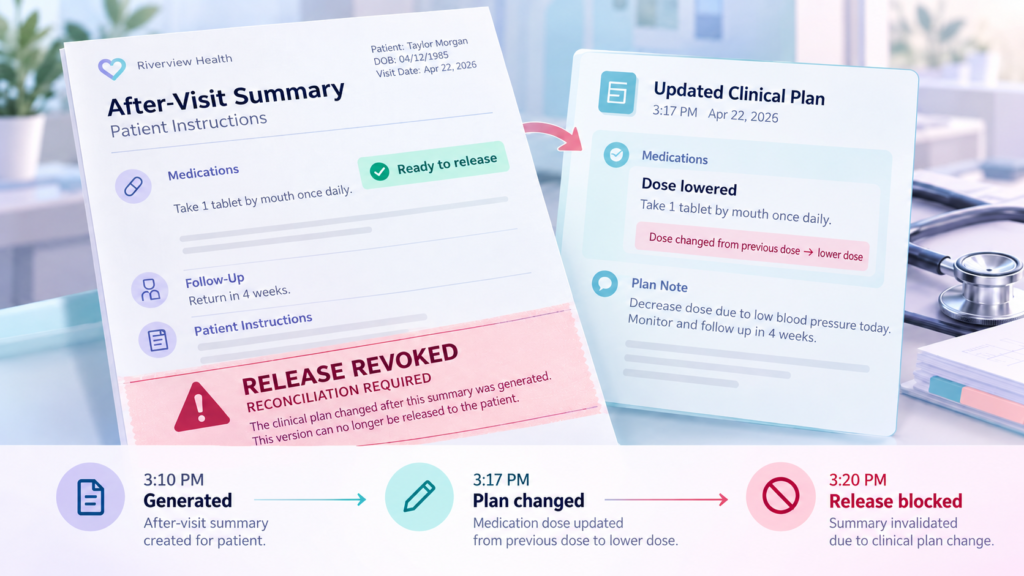
AI after-visit summary accuracy should be checked at release, not only at generation. If a medication, order or follow-up plan changes after a summary has been reviewed, that clinical event should be able to revoke the document’s ready-to-release state.
At 3:10 p.m., an AI-generated after-visit summary tells the patient to continue lisinopril 10 mg.
At 3:12, the clinician reviews the summary.
At 3:17, after checking the blood-pressure readings and laboratory results, the clinician changes the dose to 5 mg.
The summary is still sitting in the workflow, approved and waiting to be sent.
At 3:20, the patient receives it.
The important failure occurred before delivery.
A clinical fact that governed the document changed, but the document remained eligible for release.
Generated is not the same state as ready to release
Patient-facing output is already part of ambient clinical AI workflows. Abridge generates Patient Visit Summaries containing a plan and patient instructions, while Nabla generates post-visit instructions based on the encounter. Both workflows retain clinician review or editing before the content is shared with the patient.
That creates an artifact at a particular point in the encounter.
But generating the artifact and authorizing its release are different workflow events.
A useful lifecycle is closer to:
generated → reviewed → release-ready → released
with another path available when something important changes:
release-ready → reconciliation required → regenerated or corrected → release-ready
The additional state matters because clinician review is not necessarily the final clinical event of the encounter.
A prescription can change after review. An order can be cancelled. Follow-up can become more urgent. A new result can alter the plan.
If the workflow continues to treat the earlier document as approved, the problem is not generation quality. The release state is wrong.
The dangerous document may contain no invented information
Suppose the AI accurately converts the documented plan into patient-friendly instructions:
- continue lisinopril 10 mg;
- obtain repeat laboratory testing in four weeks;
- return for follow-up in three months.
Every statement is supported when the summary is generated.
The clinician later changes the dose, advances the laboratory testing and schedules an earlier review.
The original summary may still read perfectly well. It can remain fluent, internally consistent and traceable to genuine clinical information.
The issue is not unsupported generation.
It is a supported statement whose governing source state has been superseded.
That is why hallucination detection alone cannot protect the release workflow.
Clinical reconciliation already assumes that current state matters
Healthcare already has a useful precedent for this control.
AHRQ’s medication-reconciliation guidance describes discharge preparation as a process in which current medication orders are compared with the patient’s medication history to establish the discharge medication list. The patient should receive an updated list reflecting relevant changes.
The Joint Commission’s 2026 quality-measure documentation likewise defines discharge medications around the medications prescribed at discharge, including the relevant dosage information.
Generative AI introduces a new artifact into that sequence: a polished patient-facing document may exist before reconciliation is finished.
That means clinical reconciliation and document release cannot always be treated as unrelated steps.
If the underlying discharge plan changes, the workflow needs a way to determine whether an already-prepared summary remains eligible to leave the encounter.
Release-ready should be a revocable state
A clinician may legitimately approve a summary at 3:12.
That approval should not have to be considered erroneous simply because something changes five minutes later.
Instead, the system can treat release-ready as a state that remains valid only while its important dependencies remain unchanged.
The medication modification at 3:17 would then do more than update the prescription.
It would also invalidate any unreleased patient-facing artifact that depends on the old dose.
The summary moves back to reconciliation required.
That design avoids expecting clinicians to remember every generated document that might have been affected by a later decision.
The clinical event itself can trigger the workflow response.
The generation-to-release window creates the control boundary
The timestamps now have a narrow operational purpose.
Summary generated: 3:10
Clinician review completed: 3:12
Medication modified: 3:17
Document scheduled for release: 3:20
The medication change occurred inside the summary’s generation-to-release window.
That is enough to ask whether the document remains valid.
The system does not need to infer why the clinician changed the prescription. It needs to know that a source element material to the patient instructions changed after the current document version was produced or approved.
Generation time therefore becomes part of the release control rather than merely an audit timestamp.
The better question is what the document depends on
Not every edit should send the summary back through reconciliation.
A spelling correction in an internal note may be irrelevant.
Changing a medication dose is not.
Neither is cancelling a referral that appears in the instructions, changing the timing of an ordered test or adding a new warning sign that the patient must monitor.
So the useful question is not simply:
Did anything change?
It is:
Did anything the document depends on change?
That suggests a dependency set for patient-facing output.
For an after-visit summary, it might include medication name, dose and frequency; active orders; referral state; follow-up interval; restrictions; warning signs; and selected plan elements used to generate the instructions.
A change to one of those dependencies can revoke release readiness without treating every EHR modification as clinically significant to the document.
This is closer to dependency management than generic document freshness.
Release reconciliation is different from proofreading
Clinician review is an important safeguard for patient-facing AI-generated content, but it only establishes that the document was acceptable at the time it was reviewed.
Proofreading and release reconciliation answer different questions.
Proofreading asks whether the document is acceptable based on the information available when it is reviewed.
Release reconciliation asks whether a material dependency changed afterward.
A clinician could carefully approve the summary at 3:12 and then appropriately change the medication at 3:17.
The earlier review does not become negligent or meaningless.
It simply no longer establishes that the unchanged summary is ready to send.
Patient-facing AI documents need a release lifecycle
An AI-generated after-visit summary should not move directly from “created” to “safe forever.”
The release control has to remain connected to the clinical state that produced the document.
A summary that was valid when reviewed should not retain that status automatically if a medication, order, referral or follow-up plan changes before delivery. A material change to one of those dependencies should reopen the document for reconciliation before it reaches the patient.
That does not mean regenerating every document whenever the record changes. The workflow only needs to respond when a clinical fact the summary depends on has materially changed.
The model may have generated the document correctly.
The workflow still has to decide whether that version is allowed to leave the encounter.