AI Model Provenance: The Dangerous History Your Supplier Cannot Prove
A signed model and a completed model card cannot establish its entire training history. As EU disclosure rules advance, enterprise buyers face harder questions about training-data rights, lineage, supplier evidence and the risks hidden behind model documentation.


Part 12 of the aiautomatein AI Supply Chain Security series by Sudipto Ghosh
The growing divide between documented model identity, verifiable training history and the evidence enterprises need before deployment
An enterprise selects a third-party language model for an internal financial analysis application. The supplier provides a model card, licensing information, performance benchmarks and a signed release. The security team confirms that the downloaded files match the published artifact, while procurement records the supplier’s contractual assurances.
The model is approved. Six months later, an upstream dataset becomes the subject of a rights dispute. The original developer announces that certain training material may have been used without the necessary permissions. The enterprise asks whether the problem affects the model it purchased, including the version that was subsequently fine-tuned using proprietary information.
The supplier can identify the release. It can establish the signing identity and demonstrate that the model files have not changed since publication. What it cannot provide is a sufficiently detailed history of the contested material, its relationship to the training process and whether that material remained influential in the adapted model.
The original approval documents are genuine. They simply do not answer the question now facing the customer. This is the central weakness in AI model provenance. Enterprises can acquire increasingly sophisticated models while possessing limited independent evidence about the data, development processes and transformations that produced them.
The same problem appears in cybersecurity investigations. A malicious checkpoint may be distributed under a recognizable repository name. A model may be adapted from an upstream artifact whose limitations were never communicated to downstream users. A supplier may provide a clean software dependency inventory while disclosing little about training-data origins.
Cryptographic signatures, model cards, dataset documentation and machine-readable bills of materials have improved the tools available for establishing model history. Their adoption does not mean that the underlying history has become complete or independently verifiable. Regulation is making the distinction more consequential. The European Union now requires specified documentation and training-content disclosures from general-purpose AI model providers, while enterprises in regulated sectors face continuing obligations to evaluate the systems they deploy.
The central procurement challenge is determining what each document actually proves.
Part 9 of this series examined signatures, attestations and production evidence surrounding a model release. This article moves further upstream, asking how much of the model’s training history, data provenance and transformation lineage a supplier can actually substantiate.
Model identity is only the beginning of provenance
A model has an identity, but identity is not a complete history. A repository name can tell an engineer which project supplied an artifact. A release identifier can distinguish one published version from another. A cryptographic hash can identify exact file contents, and a valid signature can associate those contents with a particular signing identity.
These are useful properties. They allow a customer to establish whether the artifact it downloaded matches the version it intended to obtain. They do not necessarily describe where the training examples came from, how those examples were filtered, which upstream models contributed to the final weights or whether the reported evaluations apply to the deployed configuration.
Consider an organization that obtains a fine-tuned model from a specialist supplier. The model may have originated with a foundation-model developer, passed through a third-party adaptation project and undergone further conversion before arriving at the enterprise. Each stage can introduce new data, software dependencies, configuration changes or usage restrictions.
The final publisher may be able to identify its own contribution accurately while possessing only partial information about the earlier stages. A model-card field naming the upstream model is useful. It is not equivalent to a documented sequence of transformations linking independently identifiable input and output artifacts.
That distinction becomes important when a vulnerability, licensing concern or behavioral defect is discovered in an ancestor model. The enterprise needs to determine whether the affected component is actually present in its deployed system, not merely whether the current model shares a familiar name.
Model cards and datasheets improved disclosure without solving verification
The modern approach to machine-learning transparency has been shaped by two influential research contributions. In Model Cards for Model Reporting, published at the 2019 Conference on Fairness, Accountability, and Transparency, Margaret Mitchell and her co-authors proposed structured reporting of a model’s intended uses, evaluation procedures, performance characteristics and limitations.
The work was intended to make information about machine-learning models easier to communicate and assess. The subsequent paper Datasheets for Datasets, published in Communications of the ACM in 2021, proposed systematic documentation covering dataset motivation, composition, collection, preprocessing, distribution and maintenance.
These contributions established an important principle: information about a model’s development and the data used to produce it should accompany the resulting artifact. They did not establish that every assertion in a model card or dataset datasheet would be independently verified.
Nor did they solve the difficulty of tracing individual data items through large training pipelines involving filtering, deduplication, multiple sources and repeated transformations. The distinction between disclosure and verification remains fundamental.
A supplier may disclose that a model was trained on a mixture of licensed, publicly available and internally generated material. That statement can improve transparency while leaving a buyer unable to verify the rights associated with every source.
Documentation reduces uncertainty about what a supplier claims to have done. Its value depends on the detail, accuracy and supporting evidence behind those claims.
The 2026 research record identifies persistent training-data opacity
A January 2026 research preprint, Tracing the Data Trail: A Survey of Data Provenance, Transparency and Traceability in LLMs, examined the state of research on provenance across large language model development.
The survey distinguishes among provenance, transparency and traceability while examining related questions concerning privacy, bias and operational techniques. Those concepts are closely connected, but they answer different questions.
Provenance concerns the origins and history of information. Transparency concerns what developers and suppliers disclose about that information and their processes. Traceability concerns the ability to connect an observed artifact, output or decision to earlier materials and transformations.
A model provider may be transparent about broad training-data categories without preserving records that allow individual data sources to be traced. An organization may maintain detailed internal provenance records while declining to publish them because they contain confidential information or commercially valuable details.
A model may also contain information from a source that is difficult to identify reliably after training, even when the original data collection was documented.
The survey synthesizes a research area that remains methodologically difficult. It does not establish a universal numerical measure of how much training-data provenance is missing across commercial foundation models.
Its significance for enterprise procurement is the distinction between the availability of information and the ability to establish a defensible connection between that information and a specific model. A procurement team may receive a technically detailed document while lacking the evidence needed to answer a particular legal, security or operational question.
Training-data rights cannot be inferred from a model’s license
Licensing is an especially consequential source of confusion. A model repository may display a license governing the distribution or use of the published artifact. That license can establish important rights and restrictions for the customer.
It does not automatically prove that every dataset used during training was collected and processed with appropriate authorization.
Model licensing, dataset licensing, copyright compliance, privacy obligations and contractual restrictions involve different legal questions. An open-weight model may be distributed under terms that permit certain commercial uses while relying on training sources whose precise composition is not publicly disclosed.
A dataset may contain material governed by multiple licenses or rights arrangements. Some sources may have been lawfully accessed but remain subject to restrictions relevant to subsequent uses. A derivative model can also introduce new contractual issues if the base model’s terms restrict particular forms of adaptation or redistribution.
The applicable legal analysis depends on the relevant jurisdiction, the rights involved and the actual conditions of use. For enterprise buyers, the practical difficulty is that a visible license field may create an impression of completeness that the underlying evidence does not support.
The correct question is whether the supplier can substantiate the rights and permissions relevant to its development and distribution of the model, along with the customer’s intended deployment.
A declaration of commercial usability should be evaluated according to what it covers, rather than treated as a comprehensive guarantee about the entire upstream data supply chain.
The EU AI Act changes the expectations for training-content disclosure
Article 53 of the EU AI Act establishes obligations for providers of general-purpose AI models.
Among other requirements, applicable providers must maintain technical documentation, make specified information available to relevant downstream AI system providers, establish a policy addressing EU copyright law and publish a sufficiently detailed summary of the content used to train their models.
These requirements began applying to relevant providers on August 2, 2025, subject to the Act’s transitional provisions and other applicable conditions.
The European Commission published a training-content summary template in July 2025 to support a more consistent approach to public disclosure.
Its guidance recognizes that such summaries are not intended to disclose every individual training example. The legal requirement also does not provide every enterprise customer with unrestricted access to all proprietary training datasets.
Instead, it creates distinct disclosure obligations for public audiences, downstream providers and competent authorities. Those distinctions are important for procurement.
A publicly available training-content summary may help a customer understand the broad categories of material used during development. More detailed technical documentation may be available to relevant parties under the applicable legal framework.
Neither form of documentation necessarily allows a customer to reconstruct an entire training run independently.
The Commission’s guidance also recognizes that some providers of models already placed on the market before August 2, 2025, may face genuine limitations in recovering particular information. The public summary template requires such gaps to be identified and justified under specified conditions.
This is a revealing policy development. The regulations acknowledge that some provenance information may be unavailable even to the organization supplying the model.
For enterprise customers, the absence of information must therefore become an explicit risk consideration rather than being concealed inside a general compliance statement.
Public disclosure and procurement assurance serve different purposes
The EU training-content summary is intended to improve transparency about general-purpose AI model development. An enterprise procurement assessment has a narrower operational objective.
A bank considering a model for a significant risk-management function may need evidence about model behavior, change controls and the supplier’s ability to investigate specific failures. A healthcare organization may need information about relevant training populations, validation conditions and changes affecting its intended use.
A software company incorporating a model into a commercial product may need to understand distribution rights, upstream licenses and the conditions under which the model can be modified. Those questions cannot always be answered by the same document.
The regulatory framework creates a stronger foundation for disclosure, but the purchasing organization still needs to establish what evidence is appropriate for its own application.
Model cards remain useful—and susceptible to incomplete declarations
Hugging Face provides a widely used implementation of model cards through repository documentation and structured metadata.
The platform’s model-card documentation describes fields covering licenses, languages, datasets, evaluation results and other relevant characteristics. Its annotated template also supports identifying the base model from which a model was fine-tuned.
These mechanisms can make provenance relationships more visible. A developer can use metadata to discover the claimed parent model, inspect references to datasets and review the publisher’s description of intended use.
However, repository metadata generally depends on information submitted or maintained by the publisher. The presence of a base_model field does not independently prove that the named artifact was the only model used during development.
A dataset reference may identify a publicly released dataset without establishing that no additional private or undocumented material contributed to training. A license field records a declaration about terms of use. It is not an independent legal audit.
That distinction should not be used to dismiss model cards. They provide an essential structure for information that would otherwise be scattered across research papers, repository pages and supplier communications.
Their limitations become problematic when buyers treat the completion of the document as equivalent to verification of its claims. The appropriate procurement response is to distinguish fields backed by independently identifiable evidence from fields supported only by supplier declarations.
Cryptographic signatures establish a narrower form of trust
Model signing has advanced considerably. In April 2025, Google and partners in the Open Source Security Foundation announced version 1.0 of an open-source model-signing library developed with NVIDIA and HiddenLayer.
The project uses Sigstore-based mechanisms and supports traditional signing methods. Its purpose is to help consumers verify the integrity and publishing identity of machine-learning artifacts.
NVIDIA subsequently documented the signing of NVIDIA-published models in its NGC Catalog using the OpenSSF model-signing approach.
These developments address a genuine supply-chain risk. A customer can verify that downloaded files match the signed artifact published by an expected identity. That reduces the opportunity for undetected artifact substitution.
Yet the signature remains tied to the artifact and the signing process. It does not establish that a training-data source was properly licensed, that the model inherited no malicious behavior or that the publisher’s documentation is complete.
A correctly signed model can still contain problematic learned behavior. A signed fine-tuned model can also preserve limitations inherited from an upstream model whose full training history is unavailable.
Cryptographic integrity is therefore important provenance evidence, but it does not replace the need to evaluate the materials and processes associated with the artifact.
The commercial mistake is treating one verifiable property as evidence of another.
Fine-tuning can make the provenance chain harder to reconstruct
Enterprises rarely deploy every third-party model exactly as originally released. A development team may fine-tune the model using internal documents, apply parameter-efficient adapters, quantize the weights or convert the artifact for another inference environment.
Each transformation creates a new question about lineage. What was the exact upstream model? Which additional datasets were used? What code and configuration produced the adapted artifact? Which evaluation results apply to the final deployment?
The answers may be distributed across multiple development systems. A model registry can record the final version. An experiment tracker can document selected training parameters. A source-control system can identify the code revision. A dataset catalog can describe material used during adaptation.
Those records become useful when they are connected to the same identifiable artifact and process. The chain becomes weaker when a model is renamed, repackaged or converted without preserving its relationship to the parent.
The problem is not necessarily malicious. Routine development practices can obscure provenance when teams optimize for deployment speed rather than traceable lineage.
An enterprise may end up with a model that performs as expected but cannot be reliably associated with the original evaluations or upstream source.
That uncertainty becomes consequential if the original supplier later reports a vulnerability, licensing change or serious limitation. The organization needs to determine whether its adapted version is affected, not merely whether it shares the original model’s architecture.
AI Bills of Materials provide structure, but completeness is not guaranteed
CycloneDX and SPDX offer machine-readable formats for documenting AI-related components and relationships.
The CycloneDX 1.7 specification supports machine-learning-model components, model-card information and dependencies. The SPDX 3.0.1 AI Profile provides a standardized representation of AI-related information, while associated SPDX profiles address datasets and software components.
These standards can help enterprises maintain consistent records across development and procurement systems. A component inventory may identify the model, associated datasets, software libraries and relevant supplier relationships.
That information can support vulnerability management and incident response. The limitation is that the standard can represent information that the supplier does not actually possess.
A perfectly valid machine-readable inventory may contain incomplete upstream lineage. A dataset may be named without sufficient information about its composition. A model may have a version identifier without an independently verified link to its training run.
An inventory can also remain technically valid as a historical record while no longer describing the configuration operating in production. For enterprise assurance, structural validity and evidentiary completeness are separate properties.
The importance of that distinction is reinforced by 2026 research on AI bills of materials and verifiable provenance, which implements and evaluates an approach connecting AI-specific component records with cryptographic lifecycle evidence.
The proposed architecture indicates a direction for improving traceability. It should not be interpreted as proof that every upstream model dependency can already be reconstructed in commercial deployments.
A model’s origin can be known while its training history remains opaque
The security value of provenance is sometimes presented as though knowing a model’s publisher resolves most trust concerns.
Publisher identity matters, particularly when assessing whether a model was obtained from an authorized distribution channel. But a well-known publisher may use third-party datasets, externally developed libraries and upstream models produced by other organizations.
The resulting system can carry dependencies that the final publisher did not create. A supplier may accurately identify the original model architecture while being unable to provide a complete record of its training sources.
It may also provide detailed development documentation while restricting independent examination of proprietary components.
The enterprise needs to distinguish these situations rather than treating them as identical failures of transparency. Some limitations arise from confidentiality. Others arise because information was not recorded. Still others reflect the technical difficulty of establishing the influence of individual training examples after model development.
Each gap calls for a different response. A confidentiality limitation may be addressed through restricted audit access or independent assurance. A missing technical record may require additional testing and a more conservative deployment decision.
An inherently uncertain causal relationship between training data and model behavior may need to be acknowledged as a residual risk rather than described as fully verified.
What enterprises should demand before signing the contract
The most important procurement questions concern evidence that can survive beyond the sales process.
A buyer should establish the exact artifact being acquired, including its release identifier and the mechanism available for verifying its integrity. The supplier should describe the model’s ancestry, distinguishing original development from adaptations and third-party contributions.
Relevant training-data information should be supplied at a level appropriate to the use case and applicable legal obligations. The buyer should understand the licensing and distribution terms governing the model, together with the limits of the supplier’s assurances about upstream material.
Evaluation records should identify the version tested and the conditions under which results were obtained. The contract should also establish how the supplier communicates material changes, investigates defects and provides technical evidence after an incident.
These requirements need not produce identical disclosures for every model. A low-impact internal writing assistant does not require the same degree of assurance as a model contributing to clinical decisions or significant financial operations.
The appropriate standard depends on the consequences of failure, the available alternatives and the risk the institution is willing and permitted to accept. What should remain consistent is the distinction between evidence that exists and statements that cannot be substantiated.
An illustrative procurement comparison
Two suppliers offer models with comparable performance on the buyer’s intended evaluation tasks.
Supplier A provides a detailed model card, signed release and broad training-data summary. Its documentation identifies the development organization and current model version, but offers limited information about intermediate adaptations.
Supplier B provides the same basic records and an additional lineage package. The package links the delivered artifact to an identified base model, records the adaptation process and connects the final release to its evaluation results.
Neither supplier can provide unrestricted access to every original training example. Supplier B nevertheless offers stronger evidence about which transformations produced the delivered artifact.
If a problem is discovered in the upstream model, Supplier B may be better positioned to determine whether the affected component is present in the deployed system.
That advantage does not automatically make Supplier B’s model safer or more accurate. It improves the buyer’s ability to investigate and respond to changes.
For enterprise procurement, that capability can be more valuable than a marginal difference in a general-purpose benchmark. The comparison illustrates how provenance can affect operational risk without being confused with model performance.
aiautomatein analysis: Procurement needs a hierarchy of evidence
The AI industry is improving the documentation and integrity mechanisms associated with model distribution.
Model cards describe intended use and limitations. Dataset documentation provides information about source material. Signatures help establish artifact identity. Bills of materials record components and relationships. Provenance attestations can connect artifacts to specified production processes.
The unresolved problem is how enterprises combine those materials into a reliable purchasing decision.
A supplier’s declaration is evidence that a claim was made. A signed declaration can establish who made it and help show that the record has not changed.
A verifiable process record can strengthen confidence that a specified event occurred under the stated conditions. An independent assessment can provide additional assurance about a selected property.
These are different evidentiary strengths. The distinctions become especially important when a supplier has only partial visibility into its own upstream dependencies.
The buyer should not assume that a missing disclosure means misconduct. Nor should it accept the absence of evidence as proof that the associated risk does not exist.
A practical procurement process should record which material claims are verified, which depend on supplier assertions and which remain unresolved.
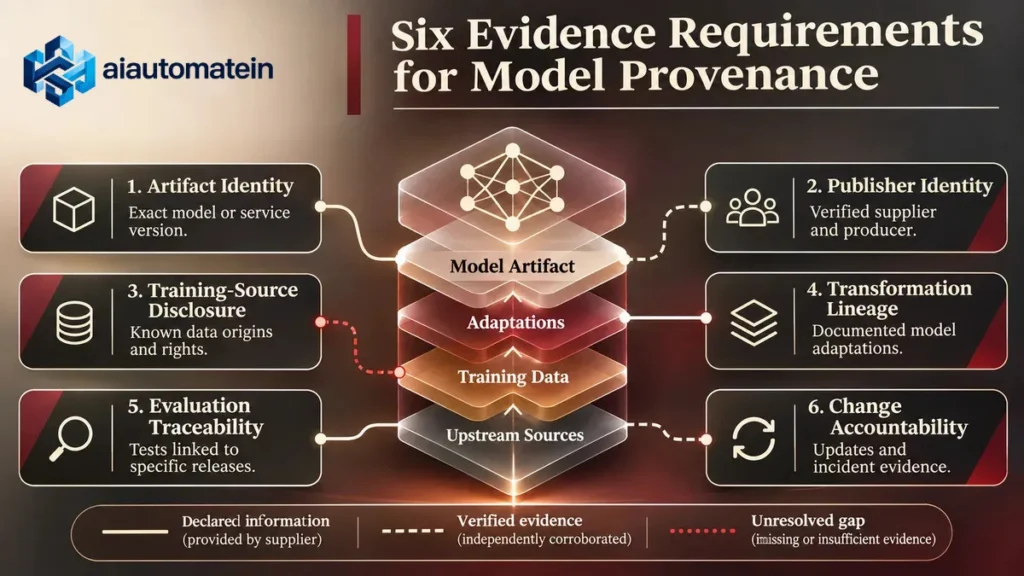
Six evidence requirements for model provenance
Artifact identity establishes the exact files or managed model version under evaluation.
Publisher and producer identity distinguishes the organization distributing the model from the parties that developed or adapted it.
Training-source disclosure describes relevant data origins and rights information, while identifying limitations in what can be substantiated.
Transformation lineage connects the delivered model to its known ancestors, adaptation steps and relevant software dependencies.
Evaluation traceability links performance and security testing to the exact artifact and configuration that was examined.
Change and incident accountability establishes how the supplier will identify affected releases, communicate material changes and support investigation after deployment.
These six requirements are an aiautomatein editorial framework synthesized from the standards and research discussed in this report. They are not a formal external certification scheme.
Their value lies in helping enterprises distinguish records that merely exist from evidence that supports a meaningful assurance decision.
What to watch through 2027
The immediate regulatory development concerns the implementation of training-content disclosure obligations under the EU AI Act. The quality of those summaries, the clarity of acknowledged information gaps and the consistency of disclosures across suppliers will influence how useful they become for downstream organizations.
The next technical development concerns model signing and lineage. The availability of open-source signing tools creates an opportunity for registries and deployment systems to verify model identity automatically.
The more difficult task is connecting those signed artifacts to transformation records, relevant datasets and evaluation evidence.
A third development concerns supplier procurement practices. Enterprises may begin distinguishing between models supported by minimal documentation and those accompanied by stronger, independently verifiable histories.
Meaningful progress would be measurable through the proportion of deployed models linked to exact source artifacts, the completeness of adaptation records and the ability to identify affected deployments when an upstream dependency changes.
These measures would be more informative than simply counting repositories with completed model cards.
A model can be thoroughly documented and still unsuitable for a particular application. But an organization unable to establish which model it deployed, where it came from and how it changed has limited ability to investigate its suitability at all.
Conclusion
AI model provenance is becoming an essential part of enterprise procurement because the systems being purchased increasingly depend on development histories that customers cannot inspect directly.
The industry has made progress in documenting models and datasets, standardizing component records and introducing cryptographic verification for published artifacts. Those mechanisms answer important questions about identity, integrity and declared lineage.
They do not automatically establish the completeness of training-data disclosures, the legitimacy of every upstream source or the behavioral safety of the final model.
The EU AI Act has strengthened expectations for documentation and training-content transparency, while research continues to identify limitations in tracing data through complex language-model development processes.
For enterprises, the procurement objective should be to determine how much of a supplier’s history can be substantiated and which gaps remain relevant to the intended application.
A model’s publisher, release identifier and signature may all be genuine. The evidence behind its training and adaptation may still be incomplete.
The model’s name tells a buyer what it is purchasing. Its provenance determines how much the buyer can establish about what it is actually receiving—and how prepared the organization will be when something upstream goes wrong.
Research and technical references
- Mitchell et al., Model Cards for Model Reporting, FAccT 2019
- Gebru et al., Datasheets for Datasets, Communications of the ACM, 2021
- Tracing the Data Trail: A Survey of Data Provenance, Transparency and Traceability in LLMs, January 2026, research preprint
- European Union, Regulation (EU) 2024/1689, Article 53 and related provisions
- European Commission, Guidelines on obligations for General-Purpose AI providers
- European Commission, Training-Content Summary Template and Guidance
- Hugging Face, Model Cards
- Hugging Face, Annotated Model Card Template
- CycloneDX, Version 1.7 JSON Specification
- SPDX, Version 3.0.1 AI Profile
- Sigstore, Taming the Wild West of ML: Practical Model Signing with Sigstore, April 2025
- NVIDIA, Bringing Verifiable Trust to AI Models: Model Signing in NGC
- Radanliev et al., Operationalising Artificial Intelligence Bills of Materials for Verifiable AI Provenance and Lifecycle Assurance, Frontiers in Computer Science, January 2026
- SLSA, Build Provenance Specification v1.2


