Context Engineering for AI Agents: 11 Critical Checks to Prevent Costly Failures
Context engineering for AI agents demands more than RAG. Discover 11 essential production checks and how Glean, Databricks, Pinecone, Weaviate and Microsoft fit.


Glean, Databricks, Pinecone, Weaviate and Microsoft are building different parts of the enterprise retrieval stack. But getting information into an AI agent is only half the problem. The harder task is making sure it receives the right evidence, at the right time, with the right permissions.
Imagine asking a financial reporting agent a straightforward question:
“Why did our operating margin fall last quarter?”
The agent retrieves a board presentation, several sales forecasts, finance spreadsheets and a Slack discussion about rising acquisition costs. It produces a confident explanation.
There is one problem. The board presentation uses adjusted margin, the spreadsheet contains preliminary figures, and the Slack discussion refers to an earlier reporting period.
Every document is real. The answer is still wrong.
This is why context engineering for AI agents deserves as much attention as model selection. An agent cannot make a dependable decision if its evidence is inconsistent, stale or unsuitable for the task.
The problem is well documented. In the peer-reviewed study Lost in the Middle, published in Transactions of the Association for Computational Linguistics in 2024, researchers found that language models often performed better when relevant information appeared near the beginning or end of a long context. Performance deteriorated when the same information was placed in the middle.
More input did not guarantee better use of information.
Why context engineering for AI agents goes beyond RAG
Retrieval-augmented generation, or RAG, typically finds relevant material and supplies it to a model.
Context engineering encompasses that retrieval, but also determines which information belongs in the working context, how it is ordered, whether the user is authorized to see it, which instructions take precedence, and what should be retained across tasks.
Anthropic’s September 2025 engineering paper describes this as the evolution of prompt engineering toward managing the broader information available to an agent.
The practical challenge is choosing useful information without burying essential evidence in unnecessary material.
For an enterprise application, that requires checks across the data, retrieval, security and evaluation layers.
The commercial challenge with context engineering for AI agents is that responsibility spans data engineering, security, search infrastructure and business application teams.
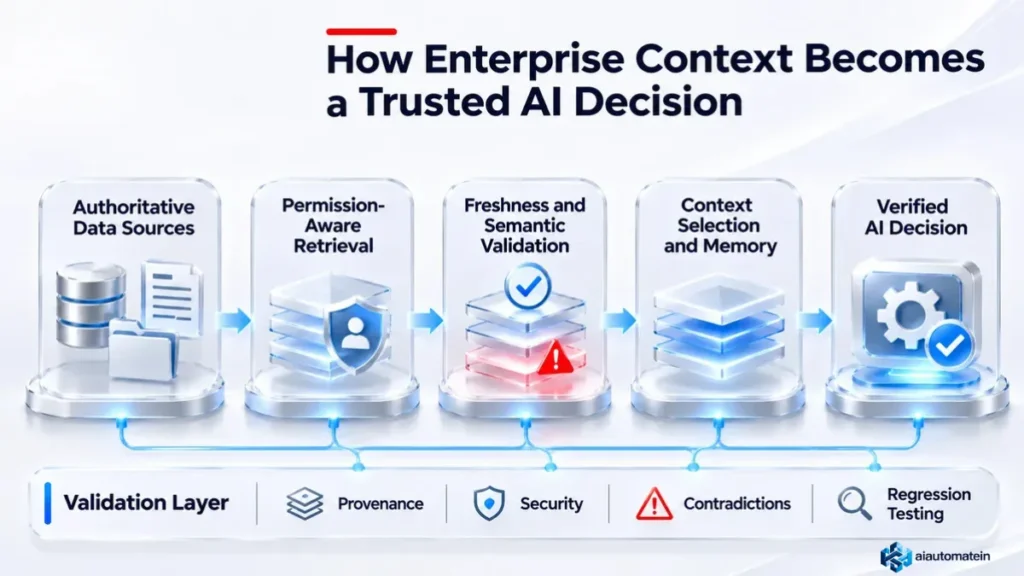
11 context engineering checks before production
1. Establish the authoritative source
Which system owns the correct answer?
For the financial agent, the authoritative margin figure may reside in the approved finance ledger, not in a presentation or discussion thread.
Test: Ask the agent the same question using conflicting figures from three sources. Confirm that it identifies the approved record and explains why.
Glean’s enterprise search architecture helps organizations retrieve information from connected applications with relevance and permission signals. But an organization’s data owners must still define which records carry final authority.
2. Measure how fresh the information is
A document can be accurate when written and misleading a week later.
Test: Change a source record and measure how long the old version remains retrievable. Define a maximum acceptable delay for each data class.
Databricks documents continuous and triggered synchronization modes for its search indexes. Continuous updates reduce freshness delays but can involve higher compute costs.
This makes freshness an operational choice, not simply a search-quality feature.
3. Apply identity permissions before retrieval
A finance employee should not receive confidential acquisition data merely because an agent can find it.
Test: Run identical questions under users with different access rights. Verify that neither retrieved passages nor final responses disclose restricted material.
Glean documents permission-aware search based on its source connectors. Microsoft supports document-level access controls and security trimming in Azure AI Search.
These controls require correct source permissions and implementation. Neither vendor can repair an organization’s poorly governed data access automatically.
See aiautomatein’s analysis of AI agent identity governance for the distinction between authentication and authorized behavior.
4. Resolve conflicting metric definitions
“Revenue,” “active customer” and “operating margin” may have different meanings across departments.
Test: Ask the agent to identify each metric’s definition, reporting basis, owner and calculation period before answering.
Databricks can provide governed data and retrieval infrastructure, but the business must establish semantic consistency across its underlying systems.
aiautomatein has examined this problem in semantic context and data pipelines.
The lesson is straightforward: retrieving the right table does not guarantee selecting the right metric.
5. Test retrieval precision and recall
Suppose the correct margin reconciliation exists in the index but never appears among the retrieved results.
The model cannot reason over evidence it never receives.
Test: Build a set of questions with known supporting documents. Measure whether those documents are retrieved and how much irrelevant content accompanies them.
Pinecone supports reranking candidate documents by relevance. Weaviate combines keyword and vector search through configurable hybrid retrieval.
The distinction matters because semantic similarity may miss exact account codes, while keyword search can miss equivalent business terminology.
Neither approach is universally superior. The result depends on the corpus and query.
6. Allocate the context window deliberately
A large context window is not an instruction to fill it.
Microsoft’s RAG engineering guidance recommends explicitly budgeting tokens across system instructions, examples, retrieved context, conversation history and model output.
Test: Compare response accuracy with different passage counts and ordering. Include tests where the critical source appears in the middle.
In the published Lost in the Middle experiments, the position of relevant evidence materially affected performance.
That finding is a warning against treating maximum context length as a substitute for retrieval quality.
7. Separate task context from persistent memory
An agent investigating last quarter’s margin should not silently reuse conclusions from an unrelated analysis.
Test: Change the reporting period and business unit between tasks. Check whether prior assumptions improperly influence the next answer.
Anthropic’s engineering guidance describes compaction, structured notes and selective retrieval as approaches for managing long-running agent context.
Persistent memory can preserve useful continuity. It can also preserve mistakes.
Organizations should specify what may be remembered, how long it remains relevant and when it must be revalidated.
8. Preserve source provenance
A credible answer should identify where its evidence originated.
Test: Require the agent to provide source identifiers, timestamps and the specific records supporting material claims.
Glean supports source-linked answers. Microsoft documents source references and activity logs in its agentic retrieval architecture.
But citations are not proof that the cited information is correct.
Five reports repeating one erroneous calculation do not constitute five independent confirmations.
9. Detect contradictions and superseded evidence
A revised finance report may contradict a preliminary version.
Test: Place both documents in the retrieval corpus. Verify that the agent identifies the disagreement and prioritizes the approved revision.
Weaviate provides filters and ranking mechanisms that can incorporate metadata such as dates and categories. Those mechanisms can help narrow the search.
They do not independently determine which financial statement has been formally approved.
That judgment requires trustworthy status metadata and business rules.
10. Isolate retrieved content from instructions
A retrieved document might contain text telling the agent to ignore its rules or disclose confidential information.
That text belongs to the evidence, not the instruction hierarchy.
Test: Insert a malicious instruction into a document and confirm that the agent treats it as untrusted content.
Microsoft explicitly warns that RAG systems need protections against indirect prompt injection.
aiautomatein has also examined how indirect prompt injection interacts with tool permissions.
Security controls should limit what an agent can do even when retrieved content attempts to redirect it.
11. Run context regression tests
A retrieval pipeline that works today can fail after an index update, embedding change, connector modification or prompt revision.
Test: Maintain a fixed set of representative questions and verify answers, citations, permissions, freshness and task outcomes after each change.
Microsoft’s retrieval guidance recommends testing answer accuracy and citation quality. Databricks and other platforms provide components for experimenting with retrieval configurations.
The evaluation must still be tied to business outcomes.
For our financial reporting agent, the final test is whether it delivers the correct approved margin explanation, not merely whether the retrieval service returns documents successfully.
No single architecture defines context engineering for AI agents. The right approach depends on data ownership, retrieval accuracy, access requirements and how frequently information changes.
Where Glean, Databricks, Pinecone, Weaviate and Microsoft fit
These vendors occupy different positions in the enterprise information stack.
Glean specializes in connected workplace knowledge, permission-aware discovery and source-linked responses.
Databricks connects governed enterprise data with search indexing and synchronization.
Pinecone provides retrieval infrastructure and reranking capabilities for selecting relevant evidence.
Weaviate supports vector, keyword and hybrid search, filtering and reranking.
Microsoft brings Azure AI Search, identity controls and agentic retrieval capabilities into its cloud ecosystem.
The comparison is architectural, not a product ranking.
An enterprise may use more than one of these technologies in a single application. Their capabilities also differ in hosting models, integration requirements and operational responsibilities.
The right choice depends on where the data resides, who can access it, how frequently it changes and what the agent is expected to accomplish.
Independent research: More context can make an answer worse
The Lost in the Middle research offers a particularly useful counterweight to marketing claims built around ever-larger context windows.
Researchers evaluated language models on multi-document question answering and information retrieval tasks. Changing where the relevant evidence appeared within the supplied material could significantly change the outcome.
The study did not benchmark the five vendors discussed here. Nor does it establish that every newer model exhibits the same level of performance degradation.
What it demonstrates is a persistent design risk: an application can supply relevant information without ensuring the model uses it effectively.
Anthropic’s subsequent engineering guidance reaches a related conclusion from practical agent development. Engineers should optimize the relevance and utility of working context rather than simply maximize its volume.
Microsoft’s documentation adds the operational dimension. Retrieval introduces additional latency, token usage, infrastructure costs and security responsibilities.
Together, these sources support a clear principle: context is an engineered input with quality, cost and risk characteristics.
aiautomatein analysis: The missing control is decision-ready context
The financial reporting example reveals why context engineering for AI agents should be treated as an enterprise control discipline.
The agent did not fail because it lacked information.
It failed because the information lacked a consistent definition, an established hierarchy of authority and sufficient temporal context.
That creates three distinct responsibilities.
The data team must maintain trustworthy records and metadata. The platform team must retrieve and protect the right information. The business owner must define what constitutes an acceptable decision.
When any of these responsibilities is missing, better models and more sophisticated retrieval cannot guarantee correctness.
This also changes the procurement conversation.
Instead of asking whether a vendor supports RAG, hybrid search or long context windows, buyers should ask whether the complete system can answer difficult business questions using authorized, current and traceable evidence.
Can it reject a stale report? Recognize a contradictory figure? Explain why one source outranks another? Refuse to disclose information outside the requester’s permissions?
Those are stronger indicators of production readiness than the number of documents indexed.
aiautomatein’s earlier work on agent evaluation metrics connects directly to this issue. Retrieval quality should be assessed alongside decision accuracy, security and verified task outcomes.
For enterprise teams, the practical rule is simple: do not give an agent more context until you know what the existing context is doing to its decisions.
This makes context engineering for AI agents an accountability issue, not merely another retrieval optimization exercise.
What to measure before launch
For a high-value enterprise workflow, establish baseline results using a set of questions with independently verified answers.
Track retrieval recall, evidence relevance, source freshness, permission violations, citation accuracy, contradictory-source handling, response latency and successful task completion.
Run the same questions after every meaningful change to the retrieval pipeline.
Effective context engineering for AI agents is not about building the largest knowledge index. It is about giving software enough trustworthy information to perform the right task without exceeding its authority.
Frequently asked questions
What is context engineering for AI agents?
Context engineering for AI agents is the process of selecting, organizing, securing and maintaining the instructions, retrieved information, tool results and memory available to an agent during execution.
How is context engineering different from RAG?
RAG retrieves external information to support model responses. Context engineering also manages source authority, memory, permissions, tool outputs, context ordering, information freshness and the evaluation of resulting decisions.
Which vendors support enterprise context engineering?
Glean, Databricks, Pinecone, Weaviate and Microsoft support different parts of enterprise retrieval, search, access control and context management. They should be evaluated against specific business and technical requirements rather than treated as interchangeable products.
Sources and references
- Liu and colleagues, Lost in the Middle, 2024
- Anthropic, Effective Context Engineering for AI Agents, 2025
- Microsoft Foundry, RAG Architecture and Security
- Microsoft, RAG Context Budgeting Guidance
- Glean, How Glean Accesses Information
- Databricks, Create AI Search Indexes
- Pinecone, Reranking and Retrieval
- Weaviate, Search and Retrieval Documentation