
Enterprise AI Cost Management: Why 59% of Executives Report Unexpected AI Spending
New Capgemini research finds 59% of executives faced unexpected AI costs. aiautomatein examines enterprise AI cost management, vendor approaches, and outcome-based ROI.


New Capgemini research exposes a widening gap between AI expenditure and verified business returns. IBM Apptio, CloudZero, Finout, Datadog, and Flexera represent different approaches to the financial and operational challenges.
Enterprise AI cost management has become a growing concern for corporate technology and finance leaders after new research found that 59% of surveyed executives experienced significantly higher AI expenditure than expected or budgeted.
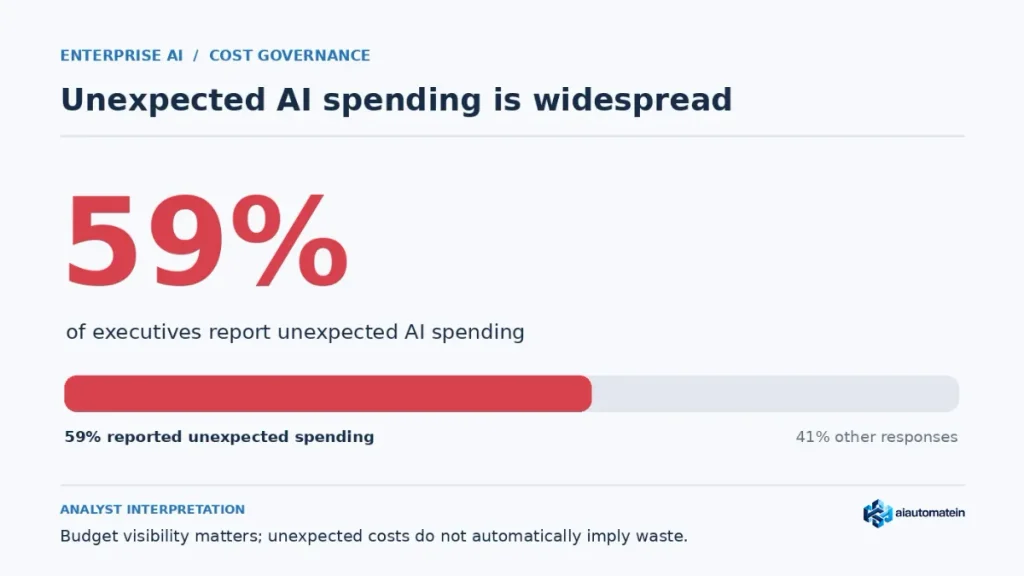
The November 12, 2026 findings from the Capgemini Research Institute indicate that organizations affected by cost overruns exceeded expectations by an average of 24%.
The research surveyed 500 senior executives from organizations generating more than $1 billion in annual revenue across ten countries and 13 industries.
It also found that 60% of organizations lack consistent enterprise-wide visibility into AI spending, while only 56% of executives are confident in forecasting future costs.
These findings point to a problem extending beyond the price of model inference: enterprises struggle to connect spending with the operational value AI systems actually deliver.
Why enterprise AI cost management is becoming a CFO priority
AI expenditure involves several cost categories.
The most visible are model API charges, cloud computing, storage, and software licenses.
Less visible expenses include data integration, human review, workflow retries, exception handling, security, monitoring, and maintenance.
Agentic AI makes the calculation more complex because completing one business request may involve multiple model calls, tool executions, retrieval operations, and human interventions.
Capgemini found that only about one-third of executives could confidently estimate indirect AI costs.
The research also reported that CFOs participate in major AI investment approvals at 52% of organizations, compared with 42% a year earlier.
That shift makes financial accountability a core requirement for enterprise AI deployment.
A company’s finance function needs to distinguish expenditure that enables experimentation from expenditure expected to generate measurable operating returns.
Both categories may be legitimate, but they require different success criteria.
Five vendors approaching enterprise AI economics from different directions
The enterprise AI cost management market includes technology business management platforms, cloud cost intelligence providers, and engineering observability systems.
These categories overlap, but they are not interchangeable.
IBM Apptio: Connecting AI spending to business value
IBM announced expanded Apptio capabilities on November 9, including AI consumption connectors, improved IBM Cloudability cost management, and AI Value & ROI functionality.
The company’s approach connects model spending with broader technology financial management, budgeting, forecasting, and business investment evaluation.
IBM Cloudability also supports AI unit economics and usage-based planning.
The relevant question for buyers is whether financial allocations can be connected to accepted business outcomes rather than merely reported by department or provider.
CloudZero: AI unit economics and cost attribution
CloudZero approaches cost visibility through usage attribution and unit economics.
For enterprise AI, this means examining the cost of serving a customer, completing a workflow, or supporting an application feature.
Unit economics becomes particularly useful when multiple customers or departments share infrastructure.
However, calculating cost per request does not establish whether the request achieved its intended result.
Organizations still require business outcome data.
Finout: Allocating shared infrastructure costs
Finout addresses challenges involving fragmented cloud spending and cost allocation across infrastructure and services.
That approach can help organizations attribute costs that do not naturally appear under one project or application.
For agentic workloads, shared vector databases, orchestration services, model gateways, and monitoring infrastructure can complicate allocation.
Cost attribution is therefore necessary before departments can be held accountable for the financial performance of deployed agents.
Datadog: Linking model activity with operational behavior
Datadog’s LLM observability capabilities examine traces, model interactions, application performance, and associated usage.
Engineering teams can use this kind of telemetry to investigate repeated model calls, expensive workflows, latency, or execution failures.
The value is operational diagnosis.
An application can become expensive because of an inefficient agent loop even when the underlying model’s per-token price remains unchanged.
Tracing identifies potential causes, but business value still needs independent measurement.
Flexera: Governing AI within broader IT expenditure
Flexera’s technology management approach offers another perspective: AI spending is increasingly part of an organization’s wider cloud, SaaS, and software portfolio.
Finance teams must determine whether additional AI tools create new capabilities or duplicate systems already purchased elsewhere.
The central evaluation concerns total portfolio value, contract obligations, usage, and financial accountability.
Unlike a specialist agent-observability platform, this perspective places AI within enterprise technology spending as a whole.
Where the Vendor Approaches Converge and Where They Do Not
These approaches address related but different measurement problems. Technology financial management can establish spending accountability; cloud cost intelligence can improve workload attribution; observability can expose inefficient model and agent execution; and broader IT governance can connect AI expenditure with enterprise budgets and procurement controls.
None of these capabilities, by itself, proves that an AI-generated outcome created measurable business value.
That distinction matters when enterprises evaluate vendors. The procurement question should not be limited to which platform provides the most comprehensive spending dashboard. It should include whether the organization can connect expenditure records to verified task completion, service quality and financial results.
The metric that changes the business case: Cost per successful outcome
Consider a hypothetical customer support agent.
It processes 100,000 requests during a reporting period and incurs $20,000 in model and infrastructure charges.
A superficial calculation suggests a cost of $0.20 per request.
But suppose only 70,000 requests are resolved satisfactorily, while the remaining requests require retries, human support, or additional intervention.
Direct technology cost per successful resolution becomes approximately $0.29 before accounting for human labor and other overhead.
If human review and remediation add another $15,000, the total measured cost per successful resolution rises to $0.50.
These figures are illustrative, not vendor benchmarks.
The difference is material. At $0.20 per request, the application may appear inexpensive. But when the denominator is restricted to 70,000 successful resolutions, the technology cost rises to approximately $0.29 per successful outcome. Including $15,000 in additional review and remediation expenses raises the measured cost to $0.50.
That is a 150% increase over the superficial per-request figure, without changing the model’s underlying price.
For enterprise procurement, I would treat cost per verified successful outcome as a more decision-useful metric than cost per inference alone. It captures more of the financial consequences of agent behavior, although additional costs such as implementation, compliance and supervision may still need to be included.
They show why the correct denominator matters.
As aiautomatein previously examined in its analysis of AI model routing and workload cost control, reducing inference cost is only useful when required quality and task completion are maintained.
An inexpensive model can produce expensive outcomes when errors, retries, and escalations increase.
Independent research: AI spending is visible, but verified value is not
Capgemini’s November 2026 research found that organizations able to estimate spending coverage could systematically track approximately 61% of AI expenditure, yet connect only 45% to verified business value.
Only around one in five organizations calculates what Capgemini calls AI Yield: the verified value generated by an AI-assisted outcome after accounting for the full cost of delivering it safely.
These results come from executive survey responses rather than audited company financial statements.
Nevertheless, they identify an important measurement gap.
Enterprise AI programs are often evaluated using adoption, usage, token consumption, or estimated employee time savings.
Those measures do not necessarily translate into lower operating expenses, increased revenue, or improved service quality.
An employee saving ten minutes on a task does not automatically create ten minutes of realized financial savings.
A business must determine whether that time was converted into additional productive capacity, improved delivery, lower costs, or another measurable benefit.
aiautomatein analysis: AI FinOps must become outcome-aware
The next competitive advantage in enterprise AI cost management will come from connecting financial telemetry with verified operational results.
Traditional cloud cost optimization can identify inefficient resources and unnecessary consumption.
Agentic systems require an additional layer.
The enterprise must know what the agent was expected to accomplish, whether the task succeeded, and what corrections were necessary.
A technically successful execution can still create an unsuccessful business outcome.
This distinction is central to aiautomatein’s reporting on enterprise AI observability and task outcomes.
Organizations should establish a common measurement system linking engineering traces, cost records, business transactions, and review decisions.
Without those connections, AI dashboards may accurately report spending while giving executives little evidence about the return on that spending.
Vendor tools can support parts of this process, but no cost platform should be assumed to independently verify business value without integration into authoritative outcome records.
What CFOs and CIOs should measure
A practical enterprise AI cost management framework should track full cost per successfully completed task, first-pass success rate, retry expenditure, human intervention, service quality, and realized financial benefit.
It should also distinguish experimentation budgets from production commitments.
Successful adoption should not be measured by eliminating every expensive AI tool.
It should be measured by identifying which technologies consistently create outcomes whose value justifies their total cost.
The Next Enterprise AI Cost Decision Is About Accountability
The next stage of enterprise AI cost management will require CFOs and CIOs to agree on what constitutes a financially successful AI workload. Infrastructure utilization, token consumption and model pricing are important inputs, but they cannot independently establish whether an application produces sufficient business value.
I see three priorities emerging.
First, enterprises need workload-level financial accountability. Each production AI application should have an identifiable business owner, a measurable operating cost and a defined outcome. Shared infrastructure expenses must be allocated consistently rather than disappearing into broad cloud or innovation budgets.
Second, agentic systems require execution-level cost visibility. A single business request may trigger multiple model calls, retrieval operations, tool executions, retries and human escalations. The cost of an individual inference is therefore an incomplete measure of the cost of completing the task.
Third, financial controls must influence deployment decisions. Organizations should establish thresholds for cost per successful outcome, escalation frequency and the business value of completed work. Applications that exceed those thresholds should be investigated, redesigned or scaled back before additional expenditure is committed.
The five vendors examined in this article approach different parts of that challenge. Their capabilities should be assessed against the organization’s actual measurement gaps, not treated as interchangeable solutions.
My conclusion is that the next competitive advantage in enterprise AI will not come simply from accessing cheaper models. It will come from knowing which AI workloads consistently deliver outcomes worth more than their fully allocated cost.
Frequently asked questions
What is enterprise AI cost management?
Enterprise AI cost management covers the measurement, allocation, forecasting, and optimization of spending on AI models, infrastructure, software, human oversight, and operational delivery.
Why can AI costs increase when model prices fall?
Cheaper inference can encourage more usage, longer workflows, additional agent calls, retries, and supporting infrastructure. Overall expenditure can rise even when the price of individual model requests declines.
Which vendors help organizations manage enterprise AI costs?
IBM Apptio, CloudZero, Finout, Datadog, and Flexera address different aspects of cost management, financial allocation, observability, and technology portfolio governance. Their capabilities should be assessed against specific enterprise requirements.
Sources and references
- Capgemini Research Institute — The Cost of Intelligence, November 2026
- FinOps Foundation — State of FinOps 2026
- FinOps Foundation — AI Spend Budget Busters
- CloudZero — AI Economics Pulse, November 2026
- IBM — Apptio Expands AI Cost Management Portfolio
- Finout — AI Cost Management
- Datadog — Agent Observability Cost Documentation
- Flexera — AI Cost Management Expansion