Once Software Can Plan and Act, Workflow Design Changes
Workflow design for autonomous AI agents shifts the focus from fixed paths to controlled outcomes. See how objectives, available actions, business state, evidence and commitment points let agents choose different routes without making the process ungovernable.

Introduction
A large customer order misses its planned ship date.
In a conventional workflow, the recovery paths are likely to have been designed in advance: check alternate inventory, escalate if stock is unavailable, request expedited freight, notify the account team, perhaps open a service-credit process.
An autonomous agent can approach the same disruption differently. It can inspect inventory across several locations, compare partial-shipment options, check carrier capacity, review contractual commitments and assemble a recovery sequence that nobody encoded as one predefined branch.
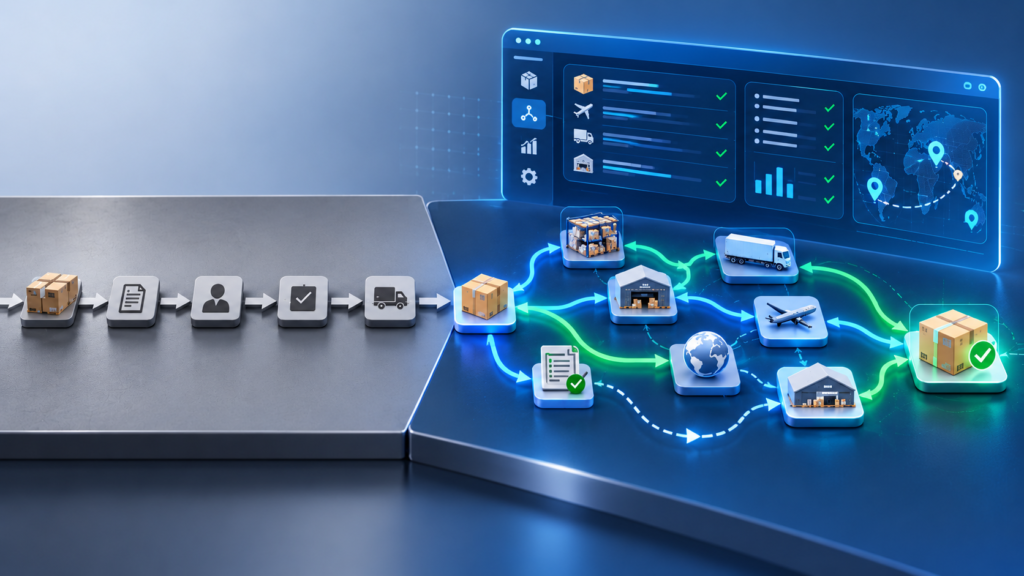
That capability changes workflow design for autonomous AI agents. The designer has to decide where runtime judgement is useful, what the agent may use to construct a route and which business facts or outcomes must remain explicit regardless of the route selected.
Workflow design starts to describe a space in which software can work, not only a path software must follow.
At a glance
- Traditional workflows specify much of the execution path before work starts; autonomous agents can determine parts of that path from the case at runtime.
- The design unit expands beyond steps and branches to objectives, usable evidence, available actions, business constraints and required outcomes.
- Consequential business actions need visible commitment points even when the preceding plan is assembled dynamically.
- Progress is easier to evaluate through business state and evidence than through predefined node position alone.
- Runtime path selection is most useful where several legitimate routes can lead to the same controlled business outcome.
Traditional workflows encode much of the route in advance
Enterprise workflow design has historically been path-oriented. A process designer identifies activities, decisions, transitions, exceptions and human tasks. Even when a rules engine or model influences a decision, the surrounding workflow usually knows what kind of branch follows.
That architecture remains useful because many business processes need predictable sequencing. Microsoft’s current Agent Framework workflow guidance frames the design choice around who should decide what happens next. When the developer needs to control the route, an explicit workflow graph defines it; when the model can select the next capability or subtask, more of that decision can sit with the agent.
Anthropic’s engineering guidance on effective agents makes a comparable architectural distinction: workflows orchestrate models and tools through predefined code paths, while agents dynamically direct their own process and tool usage.
A delayed order might be recoverable through another warehouse, a substitute product, split fulfillment, a different carrier, a revised delivery commitment or some combination of those actions. The right sequence depends on the evidence available for that particular order.
Trying to encode every combination in advance can make the process model complex because of path enumeration rather than business complexity. Allowing an agent to construct part of the route offers another design option where the case genuinely benefits from runtime judgement.
Define the job without defining every step
A path-generating workflow needs a precise description of the work.
“Resolve the delayed order” gives the agent too little. The workflow needs to establish what counts as resolution, which information matters, which business effects are acceptable and what evidence must exist when the task is complete.
For the order example, the task contract might establish that:
- the committed customer date should be preserved where feasible;
- inventory may be evaluated across approved fulfillment locations;
- partial shipment is permitted under defined commercial conditions;
- additional freight cost above a threshold needs another decision;
- a customer-facing commitment cannot change silently;
- the final plan must identify the selected inventory source and delivery route.
Several different action sequences could satisfy those conditions.
Microsoft’s Agent Harness documentation supports this style of long-running work through planning and todo capabilities that let an agent maintain and revise a plan during execution rather than requiring the developer to hardcode the entire sequence beforehand.
The workflow still supplies structure, but more of that structure sits in the description of the objective, constraints and completion evidence. Ambiguity in those elements matters more when software is allowed to fill in intermediate steps for itself.
Available actions form the workflow vocabulary
A conventional workflow often couples an activity to an implementation: after approval, call a particular API; after validation fails, create a particular task.
An autonomous agent works with capabilities it can select according to the current situation. In the order-recovery case, those might include checking inventory, obtaining freight options, reserving stock, calculating arrival dates, drafting a customer message or requesting a commercial decision.
The workflow-design question is whether those actions form a coherent vocabulary for completing the job.
An agent that can search inventory but cannot reserve it may repeatedly identify options it cannot advance. One that can reserve stock without seeing the contractual delivery commitment lacks information needed to choose safely. A poorly described tool can produce output that forces the agent to spend additional turns reconstructing business state.
AWS’s current Amazon Bedrock action-group documentation defines agent functions through their actions and required parameters, while Microsoft’s Agent Framework tools documentation describes function tools and other callable capabilities through which agents interact with external systems.
Those interfaces influence the workflow because they determine what the agent can perceive and what operations it can assemble into a plan. Authorization remains a separate control problem; at the workflow level, the concern is whether the capability set gives the agent meaningful, well-defined building blocks for the task.
Keep commitment points visible
Runtime planning is easiest to tolerate while the agent is exploring possibilities.
Comparing inventory locations, calculating arrival dates or requesting freight quotes changes little outside the working process. Reserving scarce stock, placing an expedited shipment, issuing a customer credit or changing a promised delivery date creates a business commitment.
A workflow can allow considerable discretion before that point while making the transition into committed enterprise state explicit.
The trigger might be confirmed evidence, a business rule, an external approval or a defined application boundary at which a proposed operation is actually executed. Microsoft’s Agent Framework tools guidance includes approval controls for tool execution, illustrating one implementation in which a model may select an operation while execution remains separately gated.
Human approval is only one implementation. The more general workflow requirement is that a consequential transition remains identifiable even when the route leading to it was generated dynamically.
Without that boundary, investigation, recommendation and execution can blur into one reasoning sequence. The enterprise then has a harder time identifying the point at which a flexible plan produced an irreversible or costly effect.
Express progress through business state
A predefined workflow has a convenient operational shorthand: which node is running?
That measure is less informative when two successful executions may use different actions in different orders. An agent can also complete many technically valid tool calls without materially advancing the business task.
For the delayed order, meaningful progress might mean that the delivery obligation has been verified, viable fulfillment options have been identified, one option has been selected, the necessary commitment has been made and the resulting fulfillment state has been recorded.
Different runs can take different routes between those conditions.
This makes business state and completion evidence useful anchors for autonomous work. Microsoft’s Agent Framework looping guidance requires completion conditions for repeated agent execution, reinforcing the practical need for a system to know when continued work is still justified.
The same information matters during handoff to a person. An operator needs to know what business condition has been reached, what evidence supports it and what remains unresolved. The number of model calls or tool invocations says much less.
Human involvement can follow the case state
Traditional workflow models often place human work at a fixed position: manager approval at step four, specialist review at step seven.
Variable execution paths make another arrangement possible. The agent can continue while the evidence is sufficient, choices remain reversible and the expected consequence stays within an accepted range. Human judgement enters when the case reaches a condition that warrants it.
Microsoft’s workflow guidance distinguishes model-driven tool approval, explicit workflow gates and human-in-the-loop decisions, which allows the application designer to choose where human authority sits rather than treating every interaction as the same kind of checkpoint.
A standard order delay might therefore complete without manual review. An unusually expensive recovery plan, contradictory contractual evidence or a commercially sensitive account could trigger one.
The important design decision is why human intervention occurs. Tying it to the condition of the case can be more durable than assuming every execution will reach the same numbered step.
Several legitimate routes can reach one controlled outcome
Suppose two delayed orders are ultimately recovered on time.
For the first, the agent transfers stock from another warehouse and keeps the original carrier. For the second, it leaves inventory in place, changes carrier and splits one line item after confirming that the contract permits it.
A traditional process model may represent those as separate branches. An autonomous workflow can treat them as two valid plans satisfying the same task contract.
That flexibility is valuable only where intermediate path selection benefits from judgement. If the correct next action is already stable, predictable and cheap to encode, asking a model to rediscover it introduces variability without much benefit.
Anthropic’s agent architecture guidance makes the same practical distinction: predefined workflows are effective where tasks can be decomposed reliably, while agents are better suited to work where the necessary steps cannot be predicted cleanly in advance.
A useful design test follows from that distinction: does runtime path selection improve the process?
Where every acceptable case should follow essentially the same sequence, explicit orchestration remains easier to reason about. Where cases legitimately demand different investigations or action sequences, an agent can reduce the need to model every combination beforehand.
Autonomous workflow design still has structure
Giving an agent discretion over the route does not require turning the business process into an unrestricted reasoning loop.
Structure can sit at several layers at once: explicit workflow machinery, task definition, action interfaces, business-state semantics, evidence requirements and commitment boundaries.
Microsoft presents workflows and model-directed composition as points on a spectrum rather than competing architectures. Its Agent Framework guidance shows model-selected subtasks and explicit graph-controlled execution coexisting within the same broader design approach.
Many enterprise processes are likely to use both.
An order-recovery agent might decide how to investigate a disruption and construct candidate recovery plans. Explicit workflow logic can still govern the accepted commercial commitment, fulfillment update and downstream notifications once a plan is chosen.
The strongest case for autonomy is therefore not maximum freedom. It is the ability to avoid brittle path enumeration in the parts of the process where case-specific judgement matters, while leaving important business outcomes explicit.
FAQs
How does an autonomous AI agent change workflow design?
An autonomous agent can select actions and construct parts of its execution path at runtime. Workflow design therefore has to define the objective, usable capabilities, evidence requirements, business states and commitment boundaries clearly enough that different routes can still produce a controlled outcome.
Is an agentic workflow the same as a traditional workflow with AI steps?
No. A traditional workflow can contain AI while retaining explicit control over the sequence. In a more autonomous agentic workflow, the model can choose some of the intermediate actions or subtasks required to reach the objective.
When should an AI agent choose the workflow path?
Runtime path selection is most useful when several legitimate routes exist and the appropriate sequence depends on information discovered during the task. When the route is stable and predictable, explicit workflow logic is usually easier to operate and test.
Should human approval stay at a fixed workflow step?
It does not have to. Human involvement can be triggered by case state or consequence—for example, a high-impact commitment, unusual cost or unresolved ambiguity—rather than always occurring at the same ordinal point.
How should progress be measured in an autonomous workflow?
Progress can be tied to meaningful business state and required evidence rather than predefined node position alone. Different runs may use different action sequences while reaching the same controlled intermediate or final condition.
Design for a route that can change
Conventional workflow design assumes that much of the route can be specified before execution starts. Autonomous agents make it possible for some of that route to be assembled from the circumstances of the case.
That flexibility is useful only when the surrounding design makes the variable path legible. The workflow still needs recognizable business states, enough evidence to establish progress, clear interfaces for available actions and visible boundaries around consequential commitments.
A well-designed autonomous workflow can therefore tolerate variation in how the work proceeds without becoming vague about what state the business must reach or which transitions carry material consequences.
The route can vary. The enterprise outcome still needs to be designed.