
Third Moment Research reports 10,000 agents running in parallel for 36-plus hours
Third Moment Research reports running 10,000 concurrent AI agents in extended research sessions using GPT-6 models, Codex orchestration and security testing.

An OpenAI customer case study details long-running quantitative research using GPT-6 models and Codex, including subagent recovery, faster backtesting and security checks for autonomous execution.
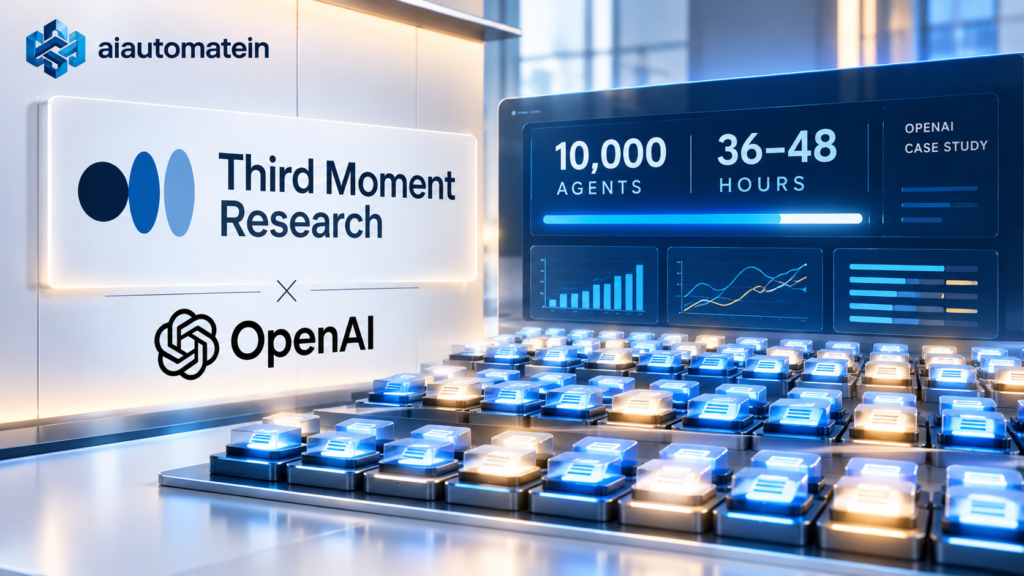
Third Moment Research says it runs 10,000 AI agents concurrently during research sessions lasting 36–48 hours, according to an OpenAI customer case study published on 14 October 2026. The startup uses Codex-based execution environments and GPT-family models for quantitative research, with an additional supervisory system for unfinished tasks and separate security testing before simulations begin.
In the official customer case study, OpenAI describes the system as a way to investigate and refine trading strategies through repeated experiments. The figures are supplied by the companies involved; the published account does not provide independent verification of agent counts, session durations or performance gains.
Codex supports long-running research environments
Agents work inside Docker-based research environments containing approximately a terabyte of data, documentation and code for training models, generating trading features and running simulations. OpenAI says GPT-6 Astra, GPT-6 Sol and GPT-6.1 Sol supply reasoning, while the Codex harness lets agents use tools, create plans and launch subagents. It can also compact earlier context as investigations continue.
Third Moment places Codex inside an outer harness powered by GPT-6 Sol or GPT-6.1 Sol. When a task stops prematurely, that supervisory layer reviews the recorded trajectory and can retry the work, terminate the job or refer it to a human.
The company says its agents pursue research questions through successive experiments, using results to select further tests. This includes quantitative-finance work, where findings are compared with a baseline trading system developed by its engineers. The case study does not establish live trading performance or financial returns.
Codex reduces one backtest from hours to minutes
One example in the case study concerns a backtest across a year of order-level US equity data. The original run took approximately three hours. Agents waiting for results repeatedly checked job status, using tokens and filling their available context with polling messages.
OpenAI reports that Codex identified caching and memory-packing changes that shortened this particular backtest to approximately three to five minutes. The reported improvement concerns that workload; it is not evidence of a comparable speedup across the company’s entire research operation or other organisations’ systems.
Security testing precedes plans for larger agent deployments
Third Moment also uses the Daybreak cybersecurity platform to test simulation environments before launching autonomous work. According to OpenAI, the checks examine whether agents can escape their assigned environments and reach the wider network. The account describes the testing approach but does not publish independent containment results or an incident history.
Third Moment plans to expand toward hundreds of thousands of collaborating subagents, but that scale remains a stated ambition rather than a documented deployment. For now, the reported 10,000-agent operation illustrates how lengthy, specialised research workloads are being run with retry controls and pre-run security testing.