One Enterprise Process Can Need RPA, a Workflow Engine and an AI Agent
RPA, workflow engines and AI agents solve different automation problems. See how enterprises can combine predictable execution, durable process state and contextual decision-making without blurring responsibility.

Introduction
An RPA bot can enter a refund into a legacy billing system perfectly without knowing whether the refund was approved, why the case reached it or what should happen after the posting succeeds.
By the time the transaction reaches the robot, the surrounding process may already have resolved information the robot does not need to reconsider.
Somewhere else, the case still has a status. An approval may have arrived yesterday. Another activity may be waiting for the transaction reference. If the original request was unusual, someone or something had to interpret the circumstances before deciding that a refund was appropriate in the first place.
These responsibilities are increasingly appearing inside the same enterprise automation environments, which makes them easy to collapse into one category.
Comparisons framed as RPA vs agentic automation often make the problem worse by treating robots, workflow engines and AI agents as successive generations of the same technology. In production, they can legitimately coexist because they are responsible for different parts of the work.
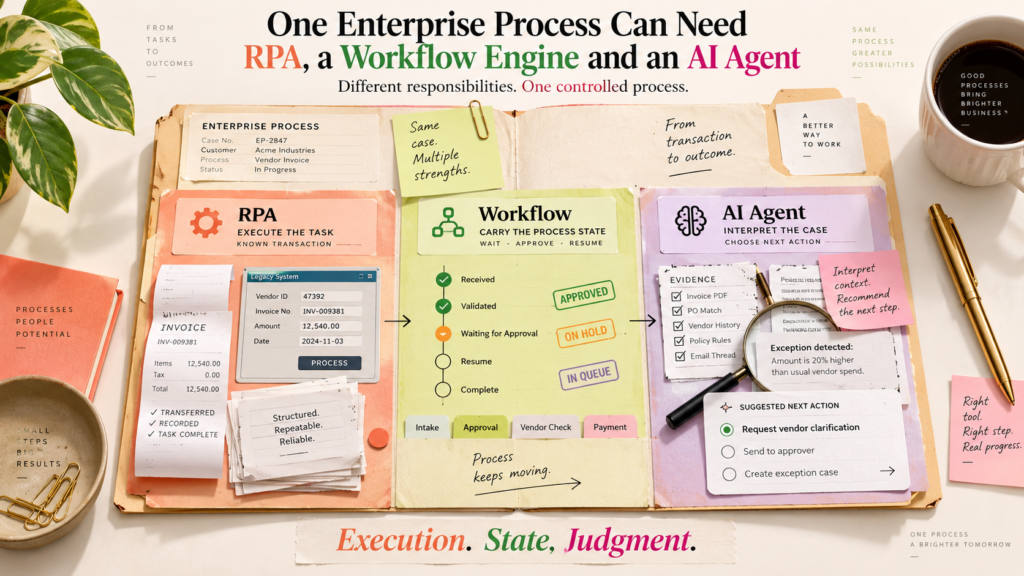
RPA is particularly useful once a required system action is known. Workflow technology carries the state of work across tasks, waits and external events. AI agents become useful where context affects which permitted action should be attempted next.
Current platforms increasingly reflect that combination. UiPath positions software robots alongside AI agents and uses Maestro to coordinate agents, robots and people across larger processes. Camunda 8.9 similarly allows non-deterministic agent activity to sit inside BPMN workflows containing deterministic logic and conventional process tasks.
A practical RPA, workflow and AI agent control model therefore starts with the responsibility being assigned rather than the newest technology available.
At a glance
- A robot can perform a transaction without owning the business case that produced it.
- Workflow engines preserve process state while work waits, resumes, branches or crosses systems.
- AI agents are useful where the next action depends on interpretation rather than a fully specified route.
- One enterprise process can use all three without making their responsibilities interchangeable.
- Different failure patterns require different evidence, testing and operational ownership.
The refund bot does not need to understand the refund
RPA solves an awkward enterprise problem unusually well: a transaction needs to happen inside an existing system, but redesigning or deeply integrating that system is not practical.
A robot can open an application, retrieve a record, move a file, enter data or complete a defined transaction. Modern RPA platforms extend those capabilities through APIs and other integrations, but predictable execution remains central to the technology’s usefulness.
UiPath’s current RPA overview describes robots as particularly suited to repetitive, rule-based work and now positions them alongside AI agents. Agents can contribute planning and adaptation; robots provide predictable execution against enterprise systems.
Return to the £180 customer credit.
By the time the robot receives the task, the important transaction fields can already be known: customer account, amount, credit code and approval reference. The billing system exposes no suitable transaction API, so the robot enters the data through the application’s existing interface and returns the transaction identifier.
The robot may technically have access to several other account functions, but those capabilities do not have to expand the responsibility assigned to this task. It can remain a narrow executor inside a much larger automated process.
That distinction becomes less obvious as RPA suites accumulate queues, AI, orchestration, business rules and human-task capabilities. A product can span the process without every component assuming responsibility for the process itself.
Waiting is part of the process
Many enterprise processes spend substantial periods doing nothing computationally.
A supplier-onboarding case waits for missing tax information. A customer dispute pauses while evidence is collected. An access request remains open until a manager responds. A regulatory review may return to the same case several times over several weeks.
Even during those inactive periods, the process still has to retain what has happened and recognise what would allow the case to continue.
The current formal BPMN 2.0.2 specification models business processes through activities, events, sequence flows, gateways and related process semantics. Implementations vary, but a running process can retain where the work stands even when no automation is actively changing a target system.
Temporal approaches the same class of problem through durable execution. Its current documentation describes workflows that preserve progress through crashes, network failures and infrastructure outages and can resume from recorded history rather than reconstructing the business process from scratch.
Consider an employee requesting access to a restricted application.
Employment status can be checked immediately. The manager may respond the next morning. A privileged role requires security approval after that. If the employee changes department before either approval arrives, the request may need to be reconsidered.
Eventually an API, script or robot can provision the account.
Before that moment, the important automation problem is remembering which request this is, what has already happened and whether it is still allowed to continue.
Not every next step can be designed in advance
Some cases resist clean branch conditions.
A customer complaint combines several issues in one message. A supplier submits incomplete documents that do not fit the normal exception codes. An investigation changes direction after a new source contradicts the previous evidence.
Camunda’s current agentic orchestration documentation places this kind of non-deterministic activity inside executable BPMN processes. In Camunda 8.9, an AI agent can inspect context and choose among available tools while deterministic rules and conventional process tasks remain part of the same workflow.
A warranty claim shows where that flexibility matters.
The customer submits photographs, equipment history and a description of an intermittent fault. The process can establish that technical investigation is required, but a small set of predefined fields may not determine which diagnostic source is useful first.
An agent can inspect the case and select an approved diagnostic action based on the available evidence.
Once that action has been identified, the rest of the process does not have to remain probabilistic. A conventional service can retrieve the diagnostic data. A workflow can wait for an engineer if the result crosses an escalation threshold. A robot can eventually update a legacy service application after the replacement decision is complete.
Turning every subsequent action into another agent decision would add autonomy without necessarily adding useful judgment.
One platform can hide several kinds of control
Automation products increasingly make architectural boundaries less visible because they can host several of them.
UiPath Studio supports robotic, API-based and agentic automation inside the same broader platform. Its Maestro orchestration layer coordinates agents, software robots and people across end-to-end processes.
Camunda can expose BPMN elements as tools an agent may choose to invoke. The decision and the deterministic activity can therefore appear inside one process model.
As these capabilities converge, the vendor name tells us less about how a particular piece of work is being controlled.
Inside one platform, a case can remain open for three days while waiting for approval. An agent can then interpret a new document. A deterministic rule calculates whether a threshold has been exceeded. A robot posts the approved change to another application.
Calling the whole arrangement “agentic automation” loses information, just as calling it an RPA process because a robot performs the final transaction would.
Architecture becomes easier to reason about when components are described by the responsibility they carry rather than by the product in which they happen to run.
Failures expose boundaries that architecture diagrams can hide
Suppose a valid account credit reaches the billing application, but the robot enters the value into the wrong field.
The decision can be correct and the surrounding case can be in the right state. The system interaction failed.
A different incident occurs when every automated task works as designed but provisioning begins before a required approval arrives. The individual executions may all be technically successful. The process advanced incorrectly.
An agent creates another failure mode. The tools are available, the process state is healthy and each API responds normally, but the agent chooses an inappropriate action because it misinterprets the case.
Each failure requires different evidence.
Testing a bounded robot task can concentrate on defined inputs, system interactions and resulting changes.
Long-running workflows require evidence around events, timers, waiting states, transitions and recovery.
Agent evaluation has to examine whether the software made an acceptable choice across realistic cases, including situations where every underlying tool functions correctly.
A single “automation succeeded” flag cannot capture all three.
This matters operationally because superficially similar failures can belong to different owners. Repairing the robot will not fix an incorrect process transition. Changing the process model will not improve an agent that selects the wrong diagnostic path.
The first useful incident question is often which part of the system made the commitment that turned out to be wrong?
Technology overlap should not turn into responsibility overlap
Separating these responsibilities does not require enterprises to buy three independent platforms.
One product may provide workflow state, agent capabilities and robotic execution. Another environment may combine a dedicated workflow engine with external agents and existing RPA.
The deployment choice can vary without changing the underlying responsibilities.
A stable screen-level automation does not become inappropriate merely because an AI agent is available. A process engine does not become redundant because a model can plan several steps. An agent does not need to reproduce deterministic workflow logic that the surrounding system already handles reliably.
A useful design review therefore asks where interpretation is genuinely required, where state has to survive across time or failure, and where a known action simply needs to be executed correctly. Different processes will draw those boundaries differently, and even within one process the answer can change from step to step.
FAQs: RPA, workflow engines and AI agents
What is the difference between RPA and workflow automation?
RPA commonly performs defined actions against applications, interfaces or APIs.
Workflow automation coordinates how work moves across activities and time, including what has completed, what is waiting and which conditions allow the process to continue.
An RPA automation can therefore operate as one task inside a larger workflow.
What is the difference between a workflow engine and an AI agent?
A workflow engine maintains and executes process state according to defined process logic.
An AI agent can interpret context and choose among permitted actions or tools at runtime where the correct next step cannot be completely specified in advance.
Modern orchestration platforms increasingly combine both.
Does agentic automation replace RPA?
Not automatically.
RPA remains useful where a known system action needs predictable execution, particularly where existing applications offer no practical integration route.
Current automation vendors increasingly position software robots as components that can work alongside AI agents rather than as technology that agents simply replace.
Can an AI agent call an RPA robot?
Yes.
An agent can determine that a system action is required and invoke an RPA automation capable of performing it.
The agent selects the action; the robot can still remain responsible only for its execution.
Why use a workflow engine if an AI agent can plan multiple steps?
Planning does not by itself provide all the guarantees required by a long-running business process.
Work may need to wait for external events, survive infrastructure failures, resume days later, prevent duplicate execution or maintain a durable record of which stage has been reached.
Workflow technology exists specifically to manage those conditions.
The process still needs to know who controls what
As automation platforms converge, it becomes increasingly easy to build one enterprise process containing robots, deterministic logic and AI agents without leaving a single vendor environment.
That convenience does not erase the distinctions between their responsibilities.
The process still has to know where its state lives. Its designers still have to decide which choices are fixed by policy and which can be made from context. When a system action finally occurs, a component still has to execute that action correctly.
Keeping those responsibilities visible makes the automation easier to test, investigate and change.
It also avoids redesigning an entire process around whichever automation technology currently receives the most attention.
One enterprise process can need RPA, a workflow engine and an AI agent precisely because each can be responsible for something different.