A Fallback Model Can Preserve Uptime and Change the Behavior You Tested
LLM fallback strategy can preserve service during model failure while changing the behavior the application was tested to deliver. See how fallback eligibility, serving-model identity, evaluation and degraded-mode controls keep recovery within an approved operating boundary.

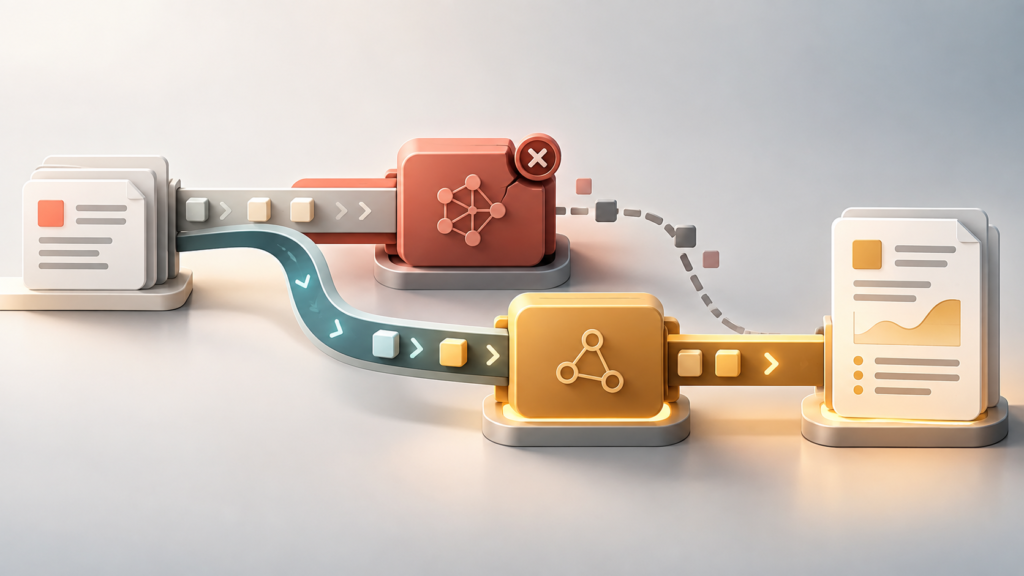
An LLM fallback strategy can keep a GenAI application available during model failure while quietly changing the behavior the business originally tested. Availability survives; the application contract may not.
A procurement assistant is generating a supplier-risk summary when the primary model hits a transient failure. The routing layer sends the request to another approved model, which returns an answer successfully.
The dashboard stays green. No user sees an outage. But the model that produced the answer is not the model on which the application team ran its acceptance tests.
That difference is easy to miss because fallback is usually designed as a reliability feature. In a GenAI application, it can also change the conditions under which the application was approved to operate.
An LLM fallback strategy changes more than the endpoint
Microsoft Foundry’s model router supports automatic failover. When the selected model encounters a transient problem, the request can be redirected to another eligible model without disrupting the application. Microsoft also allows teams to restrict the model subset used for routing and fallback.
The user still receives an answer, but the component interpreting the prompt, retrieved context, instructions and tools has changed.
Models inside an approved fallback pool can differ in reasoning behavior, context capacity, tool-use performance, structured-output reliability, safety characteristics and task-specific evaluation results. Microsoft’s model-router guidance advises teams to design for the smallest context window in the selected pool—or exclude models that do not meet the workload requirement.
The fallback path may therefore move the application into a different operating envelope.
The tested application may no longer be the running application
Suppose the procurement assistant was evaluated against 300 historical supplier cases. The team tested factual completeness, source use, risk classification and the format of the final recommendation.
Those results describe a particular application configuration.
If production falls back to another model, the prompt may be unchanged, retrieval may be unchanged and every downstream integration may remain healthy.
The component interpreting all of that context has changed.
A conventional availability metric can still report success because the request returned HTTP 200 and the workflow completed. That says very little about whether the fallback response still meets the acceptance criteria that mattered to the business.
Microsoft’s model-router monitoring guidance explains how applications can identify the serving model and, when optional preview metadata is enabled and available, inspect ordered routing attempts, including failed attempts followed by successful fallback. The model transition can therefore be recorded at the request level rather than disappearing behind a successful response.
For enterprise GenAI, serving-model identity belongs in quality telemetry as well as infrastructure telemetry.
Fallback eligibility should come from task requirements
A substitute model may be capable of answering a request without being suitable for every task handled by the primary model. Fallback pools should therefore reflect the workload rather than simply the set of models currently available.
A low-consequence summarization task may tolerate a broad fallback set. A workflow that generates a customer-facing compliance explanation, produces structured data for another system or chooses tools may need much tighter eligibility.
Microsoft’s model-subset controls allow organizations to restrict which models participate in routing and fallback, including for compliance and capability reasons. New models are not automatically added to a chosen subset.
Fallback membership should be earned against the workload.
A model that performs well on general benchmarks may still fail the application’s requirements for context length, output structure, instruction adherence, tool behavior or task-specific accuracy.
Provider failover preserves more than model fallback
There is an important difference between moving the same model elsewhere and replacing the model itself.
OpenRouter separates provider failover from model fallback. Provider failover moves the same model to another provider. Model fallback sends the request to another model when the primary cannot serve it.
The first event can preserve more of the application’s tested behavioral assumptions, although deployment and provider differences still matter. The second substitutes the component responsible for generating the result.
Both may appear to the application as successful recovery, which makes the distinction worth recording explicitly. The runtime needs to know whether service was restored by another instance of the same model or by a different model altogether.
Degraded mode should be an explicit application state
AWS’s Agentic AI Lens describes fallback chains that preserve service when a primary model or agent becomes unavailable and warns against silently returning lower-quality results. Its guidance recommends communicating degradation when recovery reduces capability.
That has a direct application-design consequence. A fallback response may remain useful while requiring a different operating rule.
A customer-support assistant could continue drafting responses but require human review before sending. A research application could answer while withholding a high-confidence label. A workflow that normally allows automatic execution could stop at recommendation until the preferred model returns.
The fallback has therefore changed more than model identity. It has changed what the surrounding workflow should permit. This is where degraded mode becomes operational rather than cosmetic.
The fallback path needs its own evaluation record
Fallback testing is often treated as an infrastructure exercise: disable the primary dependency and confirm that traffic moves.
For a GenAI application, the substitute path also has to prove that it can perform the task within an acceptable boundary. The evaluation record should therefore connect model identity to the application behaviors that were tested.
Microsoft’s model-router evaluation guidance recommends testing representative workload categories, setting workload-specific acceptance criteria and examining quality differences that aggregate results might conceal.
If a fallback model is approved for supplier summarization but not autonomous tool use, runtime policy should reflect that. If it supports shorter context, the application may need to reduce or reject requests outside that envelope. If its task evaluation is materially weaker, review requirements can increase.
AWS recommends testing fallback and recovery under realistic failure conditions rather than discovering combined degradation during an actual production incident.
The important question becomes:
What is the application still allowed to do after failover works?
That question belongs in the same design process as fallback selection.
A green service can still be running under a different contract
Automatic fallback is valuable because model outages and capacity failures should not automatically take an enterprise application offline.
The production record should show which model actually served the request. The fallback set should be constrained by task requirements, and evaluation should cover the substitute path. Where behavior is materially degraded, workflow permissions can change with it.
Otherwise, an organization may preserve uninterrupted service while operating a version of the application that was never approved to behave the same way.
The service stayed up. The behavioral contract changed.