
When context engineering becomes application architecture
Enterprise context engineering architecture turns context assembly into a governed application subsystem. See how required state, retrieved evidence, memory lifetimes, compaction and context testing determine what a model actually knows when making a business decision.

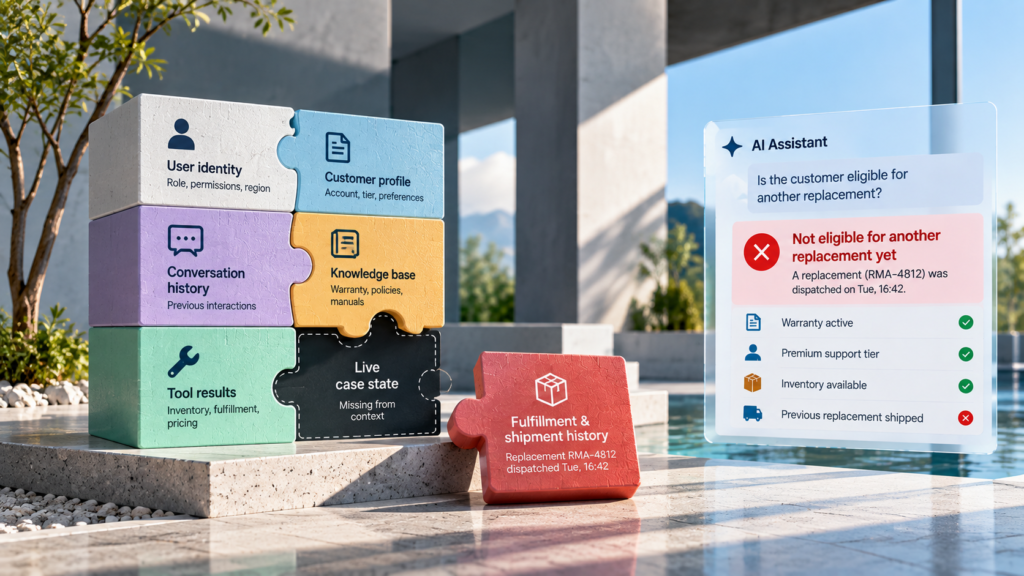
Enterprise context engineering architecture begins when an application has to decide, for every model call, which instructions, identity, case state, memory, retrieved evidence and tool results belong in the model’s working state. Once those choices affect business behavior, context becomes an application subsystem with its own contracts, lifetimes, failure modes and tests.
At 14:07, a support representative asks an internal assistant whether a customer qualifies for another hardware replacement. The warranty is active, the customer is on the premium support tier, and inventory is available. The assistant answers yes and prepares the information needed for shipment.
There is one problem. A replacement for the same serial number was dispatched the previous afternoon.
That event exists in the service platform. It was recorded correctly. Nobody deleted it. The model has not hallucinated a shipment rule, and the warranty retrieval returned the right document. The missing fact never reached the model.
The application had assembled context from the customer profile, the warranty knowledge base and a summary of the recent conversation. The summarization step retained the fault history and troubleshooting work but compressed away the prior replacement event. The live case-state lookup was not part of the context builder for this request.
Every component can appear healthy while the assembled context is incomplete. The production question is therefore more specific:
What information did the application make available for this decision in the first place?
Context is assembled before the model sees the task
Prompt engineering traditionally concentrates on instructions sent to the model. Context engineering has a wider surface.
Anthropic describes context engineering as curating the full state available during inference, including system instructions, tools, external data and message history. It also treats the context window as finite working space whose contents have to be selected rather than simply filled.
A business application might assemble a single inference from a system instruction, user identity, account attributes, current case status, retrieved documents, a conversation summary, long-term memory, tool results and temporary instructions created earlier in the workflow.
Those inputs differ in reliability, scope and lifetime. Some are application configuration. Some are current business state. Some are retrieved because they appear relevant. Some were remembered from an earlier interaction. Others are summaries of information that once existed in fuller form.
The model reasons over whatever package the application constructs.
Relevant context and required context are different classes of input
The support case exposes a failure that retrieval quality alone cannot solve. The warranty document is relevant and successfully retrieved. The previous replacement is not merely useful background. It is required case state for deciding whether another replacement can proceed.
If the application leaves that fact to semantic retrieval, conversation recall or model inference, a mandatory business condition has been converted into a relevance contest.
A stronger design separates information that may be discovered from information that must be present.
The customer’s current case identifier might always be injected. The fulfillment system might always be queried before a replacement decision. The user’s role could arrive from authenticated application state. A product manual can still enter through retrieval because only a subset of it may matter to the question.
OpenAI’s guidance on short-term context management describes both sides of the pressure: carrying excessive history can introduce distraction and inefficiency, while retaining too little can make the system lose useful continuity. Techniques such as trimming and compression remain necessary even as context windows grow.
Anthropic similarly warns about context pollution and favors retaining high-signal information rather than filling the available window indiscriminately.
The application therefore needs rules about which inputs may compete for context and which ones cannot safely be optional.
Different context belongs on different clocks
The information assembled for one inference also has different lifetimes.
A preferred language may remain useful across dozens of sessions. A customer’s current escalation status may change during the present case. A shipping quote may be valid only for the current turn. A tool result may need to influence the next reasoning step without becoming permanent memory.
Current platforms increasingly expose these distinctions directly.
Amazon Bedrock’s session model separates conversation history, session attributes and prompt-session attributes. Session attributes can persist across a session, while prompt-session attributes can be scoped more narrowly. Bedrock can also attach knowledge-base configuration and tool results to session state.
Microsoft Foundry distinguishes short-term conversation context from managed long-term memory, with separate memory patterns for user profiles, conversation summaries and procedures.
A stable preference should not be treated like live transaction state. A one-turn calculation should not quietly become a permanent customer fact. A case status that can change outside the conversation should not survive indefinitely because it once appeared in chat history.
The context builder needs to know both what a piece of information means and how long the application is willing to trust it.
Compaction creates a new representation of state
Long-running conversations eventually make full-history retention expensive, noisy or impractical.
Both Anthropic and OpenAI describe compression or compaction as ways to carry useful information forward while reducing the amount of raw history occupying the model’s context.
Consider a support conversation that originally contains:
Replacement RMA-4812 dispatched Tuesday at 16:42.
After several troubleshooting exchanges, the session is compacted into:
Customer experienced repeated hardware failures. Troubleshooting completed. Warranty remains active. Customer is requesting replacement support.
The summary is perfectly readable. It has also discarded the event that changes the next decision.
Some facts deserve structured survival.
An open transaction identifier, prior approval, completed shipment, unresolved exception or current workflow state can be carried as explicit application data while the surrounding conversation is summarized aggressively.
Compaction can then preserve continuity without becoming the sole database for consequential workflow state.
The context builder needs ownership, not just retrieval connectors
Context often accumulates incrementally. A team adds customer-profile retrieval. Another adds conversation memory. A product group introduces a knowledge base. Security injects identity attributes. An agent framework begins returning tool state. Later, a summarizer appears because sessions have become too long.
Each addition can make sense locally while the combined context path becomes a shared application dependency.
Someone has to define which sources are mandatory, when they are refreshed, what their scopes are, which information may be compressed and what happens when a required source is unavailable.
AWS, for example, treats prompts as managed assets with variables, variants and saved versions.
But the same prompt version can behave differently when an application changes memory retrieval, search filters, session attributes, tool-state injection or compaction policy.
The support assistant can therefore regress without a single word of the system instruction changing because the state delivered around that instruction has changed.
A larger context window does not remove the selection problem
More context capacity helps with long documents and extended conversations. It does not make every available token equally valuable.
Anthropic’s prompt-engineering documentation describes structured handling of prompt inputs, while its context-engineering guidance emphasizes deliberate organization of information, just-in-time retrieval and progressive disclosure. Information is loaded as needed instead of preloaded merely because it might become useful.
That creates two practical classes of context. One establishes the minimum state the model needs to reason safely about the task. The other can be acquired as the reasoning path develops.
In the replacement workflow, customer identity, active case, previous replacement state and the representative’s authority belong in the first class. Detailed engineering manuals, old troubleshooting notes or warehouse information may be loaded when the task requires them.
The context window then becomes a managed working space rather than a storage destination.
A failed answer should be reconstructable as a context packet
When the support assistant proposes the second replacement, debugging requires more than the model name and final prompt text. The team needs to reconstruct the state presented to the model.
Which customer record was injected? Which case version? Was the prior shipment state queried? Which memories were returned? Had the conversation already been compacted? Which knowledge documents entered the request? What tool results were still in scope, and which context-building rules were running?
A useful trace does not necessarily require unrestricted copies of every sensitive input. Depending on the application, it may record identifiers, versions, hashes, timestamps, policy names and references to protected source data.
Otherwise, two calls that look identical at the API layer can conceal materially different application states.
That same reconstruction capability matters for regression testing. A system-prompt test cannot detect every failure introduced by context composition.
Context tests need to exercise the seams
A context-aware evaluation set can hold the user question constant while changing the state around it.
The replacement request can be tested when no prior replacement exists, then with a prior shipment in structured case state, and then after conversation compaction. Further tests can combine an old summary with current live case state, introduce a knowledge-base failure or make the required business-state service unavailable.
The application should prove that mandatory context survives the paths through which production requests actually travel.
The expected behavior is not simply that the answer remains well written. If current shipment state is unavailable, the safer outcome may be to withhold the replacement decision rather than continue with whatever context remains.
A model cannot reliably compensate for required information that the surrounding application neither supplied nor represented as missing.
The replacement decision changes when the context boundary is explicit
Return to the support case at 14:07.
The revised application still retrieves the warranty material. It still preserves a compact conversation summary, and long-term customer preferences remain available through memory. But replacement eligibility now begins with a small set of mandatory case inputs.
The current service case is loaded directly. The fulfillment system reports that replacement RMA-4812 shipped the previous afternoon. The authenticated representative identity establishes what actions may be proposed. The knowledge layer supplies the relevant warranty terms, while the conversation summary adds useful history without carrying responsibility for the shipment state.
The model receives a smaller but more deliberate representation of the case.
Its answer changes. A second replacement cannot be initiated from the current state; the existing shipment has to be checked or an exception path opened.
No new model was required. The warranty document did not change. The prompt did not need to become a miniature workflow engine.
The application became explicit about which facts could be retrieved when useful, which state had to be present every time, which information could persist and which state needed to be read again.
Once those decisions determine what the model is allowed to know about a live business task, context engineering has become application architecture.