Document AI Can Extract the Right Data From the Wrong Document Version
Document version validation AI separates extraction accuracy from document authority. See how current, superseded, amended and draft source states can be checked before extracted values enter downstream systems, while version status remains attached to provenance.

Document version validation matters because extraction quality says nothing about whether the document being read is still authoritative. A document AI system can return every field correctly from a superseded agreement, form or statement and still send obsolete information into the business process.
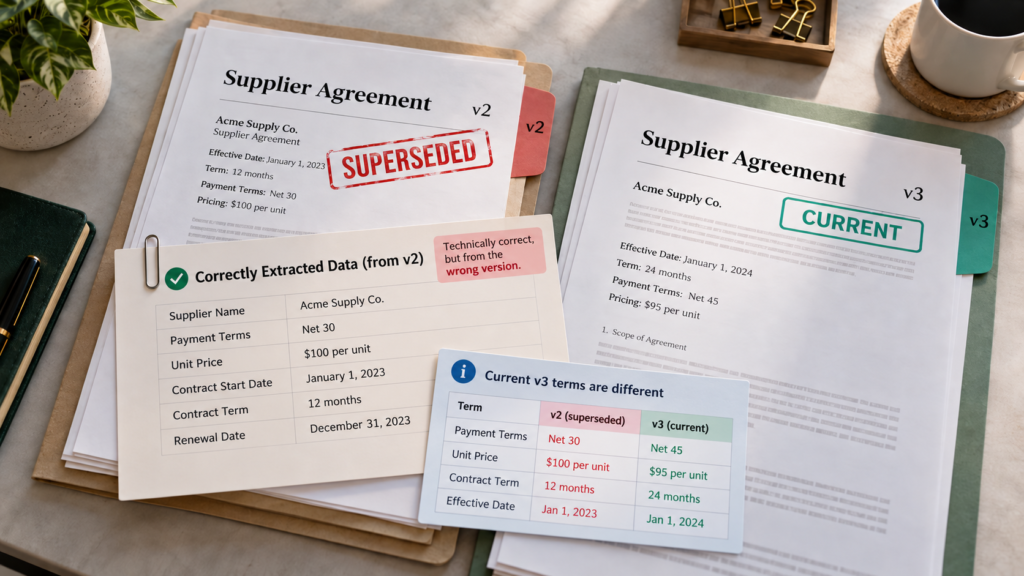
A supplier agreement arrives in a procurement workflow. The document is signed, the names match the supplier record, and payment terms, renewal dates and pricing are extracted cleanly.
The system has no obvious reason to distrust the page. There is just one problem: a newer agreement replaced it three weeks ago.
The older document is not corrupted, incomplete or difficult to interpret. Its content may be perfectly clear. The failure sits in the document’s status: the workflow has treated a valid document as the valid document.
Document version validation begins outside the extraction result
Document AI evaluates what appears on the page. A field can be found correctly, a table can be reconstructed accurately, and a classifier can identify the document type with high confidence.
Whether the document still governs the case is a separate question.
Document-management systems already treat version as a property distinct from content. SharePoint maintains version history and allows an earlier version to be restored as current. Google Drive similarly supports managing earlier file versions after newer ones are uploaded.
That distinction matters once document data begins feeding automated decisions.
Imagine that an older supplier agreement specifies Net 30 payment terms while its replacement specifies Net 45. If the earlier agreement reaches the processor, extracting “Net 30” may be technically correct.
The business process still needs to know whether that agreement remains operative before the term is accepted downstream.
A superseded document can look entirely healthy to the processor
Some document workflows already make supersession explicit.
Thomson Reuters SurePrep includes a review step for potentially duplicate source documents. A reviewer can mark one copy as superseded, after which data from that document is excluded from the tax return.
The control sits at the source level: deciding which document is allowed to contribute data.
The same problem appears in other enterprise workflows.
An employee may upload an amended contract while the original remains in the case folder. A customer may submit a revised application after correcting an earlier declaration, while a supplier may replace banking instructions. A policy endorsement may alter terms contained in the original policy.
The older document can remain legible, signed and internally consistent throughout. What changes is its standing in the process.
Version authority cannot be inferred from document quality
A newer document is not always obvious from its appearance.
The filename may not contain “final.” A revision number may sit in a footer that the extraction schema does not capture. Two documents may have different creation dates while the older one remains operative because the later draft was never approved.
A signature may not settle the issue either. An executed amendment, replacement form or later approved document can change part of what an earlier signed document says.
This makes version authority a business-state question.
The answer may come from a document-management system, contract repository, case record, approval workflow or another system responsible for lifecycle state.
For example, SharePoint supports document approval states that distinguish documents awaiting approval from those approved for use. The existence of a newer file does not, by itself, establish that it has become the authoritative version.
The IDP layer can contribute dates, revision identifiers, signatures and document relationships, but the page itself may not contain enough information to establish authority.
A reliable process therefore needs a source of authority outside the extraction result.
The wrong version can contaminate a correct workflow
The consequence becomes harder to spot when extracted values move automatically into downstream systems.
Suppose an AI-enabled document workflow reads an old supplier instruction and writes the extracted bank details into a vendor-review queue. The field values match the source exactly.
Later controls may see a properly formatted bank account accompanied by a clean extraction record. What may no longer be visible is whether those values came from the document the organisation intended to recognise.
The same problem appears in less dramatic fields.
An obsolete insurance certificate can carry an expired coverage period. A superseded pricing schedule can contain rates that were once valid. An earlier application can preserve a declaration the customer subsequently corrected.
Once information is separated from its source and written into a structured system, that context can become harder to recover. A reviewer may see the extracted term without realising that a later document exists elsewhere in the case.
The version decision therefore belongs close to ingestion, while the relationship between source document, lifecycle status and extracted values is still intact.
Document workflows need an authoritative-source state
“Processed” is not enough to describe a document that may have competing versions.
A workflow may need to know whether a document is current, superseded, draft, replaced, amended, pending approval or otherwise restricted from contributing authoritative data.
Extracted values should not automatically acquire more authority than their source document possessed.
Where multiple candidate documents exist, the workflow can resolve their status before allowing values into a downstream decision. In some cases, that status may come directly from the source repository. In others, metadata, effective dates, approval state or human review may be required.
Thomson Reuters’ treatment of superseded source documents shows the practical value of this separation: the document remains visible for review while its data is prevented from flowing into the tax return once it has been classified as superseded.
A document can therefore remain part of the evidence record without remaining an active source of business facts.
Extraction provenance should include version status
Traditional extraction provenance often answers which document supplied a field and where on the page the value appeared.
Google Cloud Document AI’s document representation, for example, supports text anchors and page anchors that associate extracted entities with their source content and location.
Version-aware processing adds another question:
What was the authority state of that source when the value was accepted?
That information matters when a downstream value is challenged.
If a payment term is wrong, the organisation should be able to determine whether the processor misread the current agreement or accurately read an agreement that should already have been superseded.
The operational response depends on that distinction: one problem sits in extraction; the other in document lifecycle control.
A strong document workflow needs to preserve enough context to tell them apart.
Authority has to survive the handoff into structured data
As document AI becomes more capable, correctly processed documents will increasingly look safe to pass downstream without intervention.
The greater risk is that source status disappears once the extracted value enters another system.
If version authority is lost at that handoff, downstream users may inherit a clean structured value with no practical indication that the source should no longer have been active.
Preserving version status alongside provenance keeps the document’s lifecycle context attached to the facts it produced.
Document AI can tell you what a document says.
Before the business acts on it, the surrounding system also needs to know whether that document still gets to speak.