
How enterprises decide which work stays deterministic when agents arrive
Deterministic automation vs AI agents is rarely an either-or choice. See where runtime judgment adds value, where fixed controls should remain, and how enterprises can draw the boundary inside one production process.

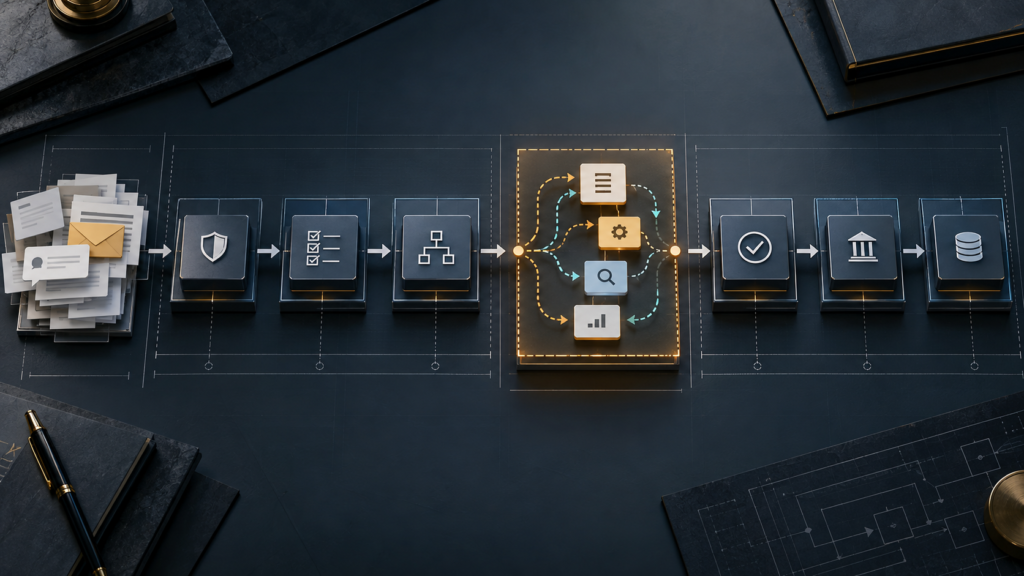
The choice between deterministic automation and AI agents rarely applies to an entire enterprise process. The harder design decision is identifying the few places where runtime judgment creates enough value to justify variability—and the many places where the process still needs an answer that software can reproduce exactly.
The demo lasts eleven minutes.
A business customer has emailed an operations team with what looks like a simple account-change request. Billing should move to a German subsidiary. Existing service users should remain active. Paper invoices should stop. Future invoices need a different purchase-order reference.
The agent reads the message, checks the customer record, recognises that several changes are bundled together, identifies information that is missing and proposes what should happen next.
It is markedly better than the existing intake form.
Someone in the review asks the question that usually follows a good agent demonstration:
Why not let it handle the whole process?
The process map on the screen contains far more than interpretation. The requester has to be authorised to change the account. The subsidiary has to exist in the customer master. Some changes require approval. Certain account states block amendments entirely. A new billing relationship cannot be committed until mandatory fields pass validation. Downstream systems expect specific status values once the change is complete.
The agent has improved one difficult part of the work.
The design team now has to decide how much of everything around it should change as well.
The process does not become agentic all at once
The phrase deterministic automation vs AI agents suggests a technology choice: select one approach or the other.
A production process gives the team a more granular problem.
At one point, software is interpreting an ambiguous request. At the next, it is checking whether the requester has authority. Later it may need to decide which missing information to ask for, calculate whether an approval threshold has been crossed, update a system of record and issue confirmation.
Those tasks do not have the same tolerance for variability.
Current orchestration products increasingly reflect this mixed architecture. Camunda describes its agentic orchestration model as using agents for non-deterministic parts of a process while deterministic rule sets, human work and BPMN-based execution continue around them.
UiPath Maestro Case goes further by making the choice explicit at runtime: deterministic rules can handle known paths first, with an agent invoked only when the rules do not resolve the situation. Its Case Manager Agent also offers an agent-led mode, but UiPath identifies rules-first as the recommended default for well-modelled paths because it is more predictable, less costly and easier to audit. The agent capability was still in Public Preview as of September 2026.
The design meeting therefore has to identify where a different runtime path is genuinely useful and where predictable execution remains part of the process requirement.
Variability earns its place when the path is genuinely hard to specify
The customer email is a good candidate.
A rules engine can recognise an address_change transaction code if somebody has already supplied that code. It struggles more when a customer writes that billing should move to another subsidiary while delivery locations, users and contractual relationships remain unchanged.
The agent can interpret the message, inspect permitted context and determine that the request contains several related intentions rather than one standard amendment.
A second customer may express the same objective differently. A third may omit the legal entity entirely. Another may ask for something that does not fit any existing category.
Trying to enumerate every linguistic variation and every sequence of clarification questions can create more rule logic than useful process control.
Once the intended new legal entity has been identified, however, checking whether that entity exists in an approved customer-master record may have an exact answer. Model reasoning adds little to a lookup whose valid result is already defined by authoritative data.
AWS security guidance for agentic systems states the principle unusually plainly: use deterministic execution logic unless AI is needed, and reserve AI functionality for work where it adds capability that coded logic does not provide.
Known paths still carry maintenance costs, and some business decisions genuinely depend on context. The point is to connect runtime variability to a capability the process could not obtain reliably from fixed logic.
Variation should have a job.
If allowing different reasoning paths does not improve interpretation, planning, prioritisation or another task that cannot be specified reliably beforehand, the process is taking on probabilistic behaviour without receiving much in return.
A judgment step can still be surrounded by fixed conditions
The design team moves to the next box.
The agent has determined that the customer’s request involves a billing-entity change and a purchase-order update. It can gather account information, identify which records are relevant and prepare a proposed change plan.
Before anything is written back, several conditions remain non-negotiable.
The requesting user must have the appropriate relationship to the customer account. Mandatory master-data fields must be present. The proposed entity identifier must correspond to an existing record. An approval may be required above a defined commercial threshold. The final update has to produce the status and identifiers expected by downstream systems.
Their value lies precisely in reproducibility: a second execution against the same validated state should not invent a different interpretation of whether the transaction is permitted.
This boundary is increasingly visible in agent architecture outside conventional RPA platforms as well. In a September 2026 AWS implementation pattern for airline disruption management, agents generate rebooking and compensation proposals, while deterministic steps validate bookability and entitlement before those proposals can affect operational systems. The agent tasks themselves do not write to the reservation system or issue payments.
The airline case and the customer-master amendment share the same engineering concern. Reasoning expands the set of situations the system can handle; fixed execution conditions stop that wider reasoning surface from silently altering facts the enterprise has already decided must be exact.
The hardest boundary sits between choosing an action and committing it
The agent in the account-change process could be given a tool that updates the customer master directly.
Technically, that may be straightforward.
The process team asks a different question: does the ability to determine a sensible next action imply the authority to make the resulting state change without another control?
An agent that determines which knowledge article to send, which internal queue should receive a request or which non-binding follow-up question to ask may be operating in a space where an imperfect choice can be corrected cheaply.
Changing a legal billing entity is harder to unwind. So is cancelling an account, releasing money, granting access, recording a regulated status or committing inventory that another process will immediately consume.
Reversibility, downstream coupling and the cost of detecting a plausible mistake all affect how much freedom is sensible at a given point.
NIST’s AI Risk Management Framework makes the broader governance requirement explicit: organizations should specify the scope and context in which an AI system is being used and define human oversight according to organizational policy and the risks of the application.
The agent can therefore have enough discretion to resolve uncertainty without automatically inheriting discretion over every consequential action that follows.
Known process knowledge does not become more intelligent when moved into a prompt
During the review, the team finds a branch that has been deterministic for years.
If the account is in a particular suspended state, no billing amendment can proceed until another team resolves the suspension.
One proposal is to place that policy in the agent instructions and let the agent decide whether to continue.
Nothing in the process requires semantic judgment at that point. The state is explicit. The policy is explicit. The permitted result is explicit.
Moving the condition into natural-language instructions would make an established process constraint dependent on model interpretation without giving the business a new capability.
Agents can still contribute to policy-heavy work by retrieving relevant policy, interpreting unstructured evidence and helping determine which provisions apply to unusual circumstances.
An explicit condition that already maps a known state to a known outcome presents a different problem. Converting it into prose for a model simply changes how the condition is executed.
The arrival of an agent should therefore force a closer look at why each deterministic step exists. Some workflow constraints were created because older automation could not cope with ambiguity. Others are deterministic because the business deliberately wants the same result whenever the same condition occurs.
Agentic territory can shrink as the organisation learns
Several weeks after deployment, the operations team notices a pattern.
A class of requests that initially reached the agent as ambiguous exceptions is not especially ambiguous anymore. Customers use different words, but almost all of the cases resolve into three known amendment types once two account attributes are checked.
The organization can leave those cases with the agent.
It can also convert what it has learned into a more predictable route.
UiPath’s rules-first model captures one version of this operating pattern: known cases can be resolved without invoking the agent, while uncovered situations fall through to reasoning. Its guidance also allows organizations to move toward agent-led operation where a case type is sufficiently dynamic and experience supports that choice.
Repeated runtime judgment may reveal a pattern stable enough to encode. A new regulation can turn a previously contextual decision into a fixed control. Better source data can eliminate the ambiguity that originally justified model reasoning.
Movement can occur in the other direction too. A process that looked deterministic on the whiteboard may prove much more variable when real cases arrive.
The deterministic-agent boundary is therefore part of process maintenance, revisited as the organization learns more about the work rather than fixed permanently during initial implementation.
The production diagram has fewer agent steps than the demo suggested
The team returns to the original customer request.
The agent still reads the email.
It identifies the separate intentions inside it, retrieves relevant account context, determines what information is missing and proposes the sequence of work required to resolve the request.
Several boxes around that reasoning remain unchanged.
Identity and authority checks still execute against defined data. Explicit account-state restrictions still apply. Approval requirements remain inspectable. Structured validations run before the master record changes. The final system update uses known transactions and produces known completion states.
That design gives the agent less territory than the demonstration initially appeared to justify.
It also gives the enterprise a clearer reason for every piece of territory the agent keeps.
Current platforms can increasingly mix agents, rules, APIs, robots and humans inside the same process, so the engineering ability to insert an agent is becoming the easier part. UiPath’s generally available Maestro Flow, released in September 2026, is one recent example of platforms bringing those worker types onto a common orchestration surface.
Production design still has to resolve a decision the platform cannot make on the enterprise’s behalf.
For each decision point, the team has to know whether a different runtime answer is useful, tolerable and observable—or whether the enterprise already knows exactly what should happen.
On the final process map, most of the boxes remain where they were.
The agent appears at the places where the path genuinely cannot be settled in advance, and where the business has deliberately decided that the freedom to choose is worth having.