Data, Infrastructure & AI Platforms

AI observability has to connect system health with task quality

MLOps observability task quality connects technical health with evidence about whether AI behaviour remains acceptable. See how traces, configuration identity, task cohorts and production evaluation can reveal where groundedness, adherence or tool-use quality deteriorates even while latency and availability remain healthy.


Evaluation pipelines are the release gate GenAI never used to need

GenAI evaluation pipeline release gate places repeatable evidence between a behavioural change and production promotion. It tests models, prompts, retrieval, tools and agent configurations against stable datasets, evaluators, baselines and must-pass criteria before a candidate can replace the current version.

Multi-model estates make lifecycle management a portfolio problem

Multi model lifecycle management enterprise turns model lifecycle control into a portfolio problem. See how dependencies, ownership, provider retirements, fine-tuned variants and migration plans help enterprises manage many production models across different lifecycle clocks.

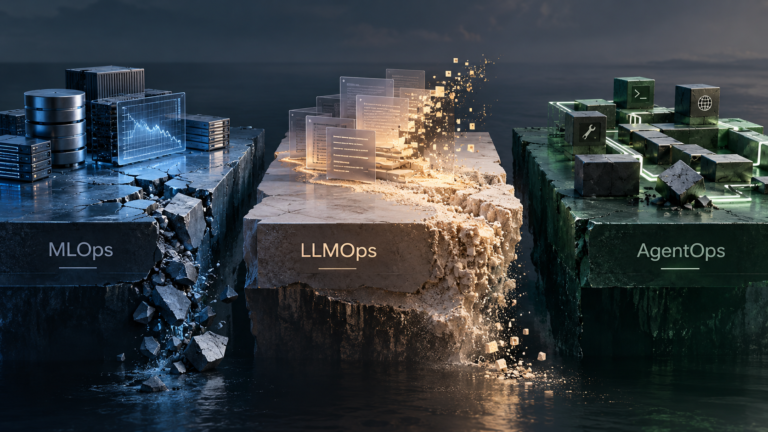
MLOps, LLMOps and AgentOps belong to different failure surfaces

MLOps vs LLMOps vs AgentOps failure surfaces reveal different places where production AI can break. Compare model and data lifecycle failures, prompt and retrieval problems, and agent execution failures involving tool choice, task state and orchestration.

Production AI has outgrown the old MLOps boundary

Modern MLOps generative agentic AI expands production discipline beyond the model lifecycle. It brings prompts, retrieval configuration, tools, orchestration, evaluation baselines and execution traces into the versioning, testing, release and recovery boundary.

The expensive part of AI data infrastructure is increasingly context delivery

AI data infrastructure context delivery cost captures the work required to keep enterprise information current, searchable and available to models and agents. See how indexing, embeddings, refresh, retrieval, caching, storage and low-latency serving can become a persistent part of AI application economics.

Bad data becomes an operational incident when an agent can act on it

AI agent data quality incident begins when incorrect data moves beyond the data platform and causes software to change business state. See how execution authority, action exposure, detection time and downstream recovery change data-quality severity when agents can act.

Agents make real-time data a dependency rather than a nice-to-have

Real time data pipelines for AI agents connect software to continuously changing business state. See how streaming agents, live context serving, freshness evidence, execution-time revalidation and recovery controls help ensure consequential actions reflect the state that actually existed when the agent acted.