Data, Infrastructure & AI Platforms

Inside a data-contract failure that reaches an AI agent

Data contract failure AI systems can happen even when pipelines, schemas and APIs remain healthy. See how silent changes in field meaning, business definitions and consumer assumptions can reach an AI agent without triggering a conventional technical failure.


What an enterprise AI gateway sees that the model never does

Enterprise AI gateway request lifecycle shows what happens around a model call before the model sees a token and after it returns a response. It traces identity checks, policy decisions, quotas, routing, backend authentication, response inspection and telemetry across the full transaction.

Designing one AI policy for workloads that must run in different jurisdictions

Sovereign AI cross border policy enforcement keeps one enterprise policy consistent while infrastructure varies by jurisdiction. See how workload classification, processing scope, model approval, retention, routing and feature controls can resolve differently across regions without changing the underlying governance standard.

Data, analytics and AI platforms are converging around semantics and agents

Converged data analytics AI platform semantics make governed business meaning reusable across dashboards, SQL, conversational analytics and AI agents. See how shared metrics, semantic models and ontologies are becoming platform dependencies while execution engines and permissions remain distinct.

The AI gateway gives platform teams a common enforcement point

Enterprise AI gateway enforcement point gives platform teams a governed boundary where common controls can be inherited across model, tool and agent traffic. See how enforcement coverage, caller context, distributed gateways and workload-specific policy determine whether shared controls actually reach production.

Inference optimisation is now a platform economics problem

AI inference optimization platform economics examines how serving architecture changes the cost of production AI. See how batching, KV-cache pressure, context reuse, quantisation, scheduling and workload shape determine how much useful inference shared infrastructure can deliver.

Hybrid AI makes workload placement part of platform design

Hybrid AI platform workload placement separates the logical workload from its physical deployment. See how target profiles, accelerator capacity, data locality, connectivity and service availability determine where the same AI workload can actually run.

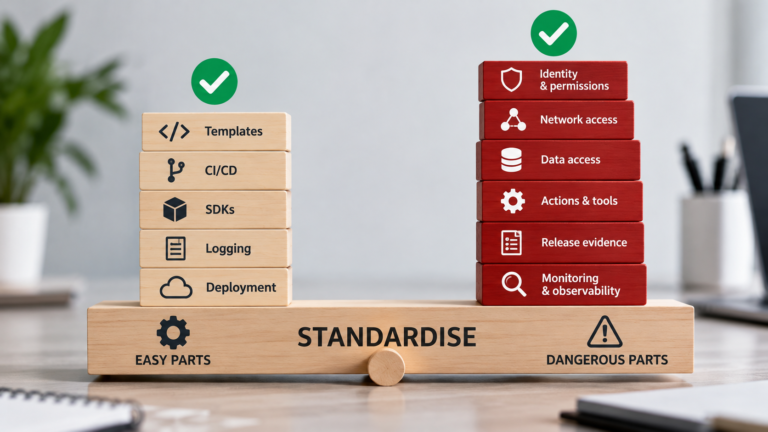
AI platform engineering should standardise the dangerous parts, not just the easy ones

AI platform engineering governance standards should focus on the production properties where inconsistent choices create enterprise risk. See how workload identity, network posture, consequential resource access, release evidence and traceability can become platform invariants while models, frameworks and application design remain flexible.