The Production Gap Begins Where the AI Pilot Ends
AI pilot to production deployment framework explains what changes when a promising AI experiment becomes a live enterprise service. See how real data, integrations, scale, ownership, monitoring, controlled releases and support determine whether pilot performance survives production.


Introduction
An internal contract assistant passes its pilot after 200 carefully selected agreements and a month of testing with five legal users. Answer quality is good enough to justify a production discussion.
The next meeting is about a different system.
Production will mean thousands of employees, live contract repositories, changing source documents, identity and entitlement rules, multiple jurisdictions, peak traffic, incident support, audit records and a requirement to keep working as models, data and application dependencies change.
None of those questions invalidate the pilot. They expose what the pilot was never designed to prove.
A successful pilot establishes that an AI capability can work inside a bounded environment. AI pilot to production deployment requires the enterprise to turn that capability into a service that can survive real users, real dependencies and ongoing change.
That is where the production gap begins.
At a glance
- A pilot proves a bounded hypothesis; production has to sustain an operating service.
- Real users introduce variation in data, permissions, demand, behavior and failure conditions that controlled tests deliberately limit.
- Production architecture includes the dependencies around the model: identity, enterprise data, APIs, monitoring, release systems and support processes.
- Ownership becomes concrete once somebody must respond to quality degradation, dependency failures, access problems or rising cost.
- Moving beyond the pilot means preserving useful AI behavior while the surrounding environment keeps changing.
A pilot is intentionally smaller than the system the enterprise will operate
The narrowness of a pilot is usually useful. Teams constrain the user group, reduce the number of integrations, select representative examples and keep technical variables manageable so they can answer an early question: is this idea worth pursuing?
Microsoft’s current agent-development lifecycle separates experimentation from build, deployment and operational steady state. Experimentation tests hypotheses and technology choices; build develops the full solution architecture; deployment moves the system into production; steady state introduces continuous monitoring and adjustment. Microsoft also warns that proof-of-concept work grounded in synthetic or limited test data can behave differently in production.
That makes pilot success evidence about a deliberately narrower object. It may prove that retrieval works against one document set, that users find the experience useful or that a model can complete a task at an acceptable quality level.
The same experiment does not establish that the complete service will remain dependable under production load, permissions, data changes, integration failures and software releases.
Production changes what is being tested
The central shift is from “can the AI perform the task?” to “can the enterprise keep the complete service performing the task under real operating conditions?”
AWS describes its generative AI lifecycle across development, integration, deployment and continuous improvement, with production concerns extending into application integration, operational health, observability and lifecycle management.
That broader unit of evaluation changes the engineering problem. A model may still return a high-quality answer while the service around it fails because authentication is unavailable. Retrieval can be accurate while an upstream data pipeline is several hours stale. A tool call can be logically correct but exceed the user’s authority. An evaluation suite can pass while latency under real demand makes the application unusable.
All are production failures even though the underlying model has not suddenly become worse.
Real data removes assumptions that made the pilot manageable
Pilot data is often cleaner than production data because somebody has already decided what belongs in the experiment.
A contract assistant in production encounters scanned appendices, missing exhibits, duplicate versions, expired agreements and documents the current user is not entitled to see. A customer-support application meets incomplete account data, contradictory knowledge articles, regional policies and records written long before an AI system was expected to consume them.
Production therefore turns data quality into an operating-context problem. The application needs to know where information came from, whether it is current, which user may access it and what to do when the evidence needed for an answer is incomplete.
Those properties may have been handled manually during a pilot because the experimenters already understood the data. At scale, that understanding has to be represented in the service.
Deloitte’s 2026 State of AI in the Enterprise reflects the same transition pressure: organizations expect substantially more AI projects to reach production, while operational readiness across areas such as infrastructure, data and talent still trails strategic ambition.
Integration turns model behavior into dependency behavior
A pilot can sometimes avoid difficult enterprise integration by using copied data, a small knowledge base or manually triggered actions. Production usually cannot.
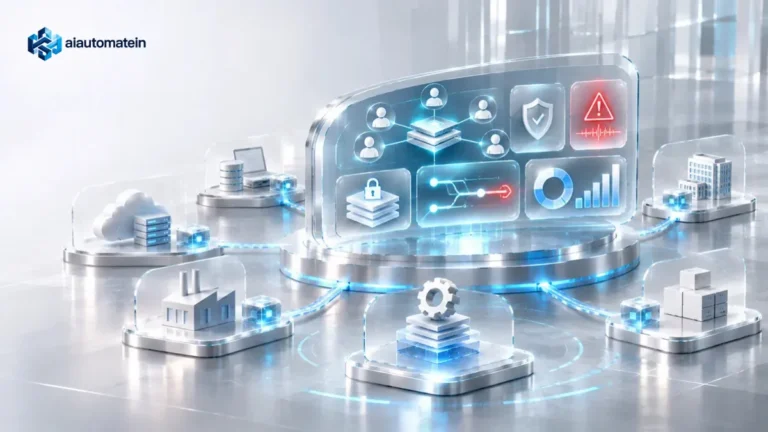
The system may depend on identity services to establish the caller, a CRM to retrieve customer state, a document platform for evidence, an ERP application for transaction data and an enterprise API to complete an action. It may also rely on a model provider, vector store, content filter, observability service and several network paths.
Failure therefore becomes partly a property of those interfaces. If a CRM request times out, the AI system must distinguish unavailable information from an empty customer record. If retrieval returns no evidence, the application should not silently interpret that as proof that no relevant document exists. If a tool changes its schema, a model may keep producing structurally valid calls for an interface that no longer accepts them.
The production service inherits the reliability characteristics of systems the pilot may have treated as stable. An AI deployment is consequently better understood as an application dependency graph than as a model endpoint behind a user interface.
Scale exposes constraints a small pilot may never encounter
A five-person pilot can appear fast because its users seldom compete for the same capacity. Production traffic introduces a much wider distribution of demand and request shape.
Usage may concentrate at the start of a working day, after a product launch or during a reporting deadline. Some requests consume a few hundred tokens; others include large documents, retrieval results or several tool calls. One user submits a single request while another process generates hundreds.
AWS’s guidance on monitoring and managing operational health treats system overload and monitoring across application layers as production concerns. At scale, teams can encounter provider quotas, retrieval saturation, queue growth, memory pressure, API throttling, longer tail latency and rapidly increasing inference cost—conditions that had little chance to appear in a small pilot.
None of this means the pilot should carry full enterprise-scale infrastructure from day one. It means its performance measurements remain conditional on the environment in which they were produced.
Production makes ownership part of the technical reality
During a pilot, the people who built the application are usually nearby. A strange response can be investigated directly, a prompt can be changed quickly, and a bad source document often has a known owner.
That informal arrangement weakens as the application becomes a service. A user may report a bad answer through a service desk rather than to the AI team. An information owner controls the source data. Infrastructure teams operate the runtime. Security controls access. The business function decides whether an output is acceptable enough to use.
Failures therefore need routes to people who have both the information and authority to respond. If retrieval quality degrades, somebody owns the evidence source. If access is wrong, somebody owns the entitlement. If the model provider changes behavior, somebody owns the production response.
Every production dependency eventually needs an owner when it behaves differently from the assumption made during the pilot.
Monitoring begins when behavior can change without a deployment
Traditional software monitoring often asks whether a service is available, fast and free of errors. AI systems create another problem because technically healthy infrastructure can keep returning responses while application quality deteriorates.
A knowledge source changes. User traffic moves into a task class barely represented during testing. Retrieval begins favoring different documents. The model provider changes part of the serving environment. HTTP responses remain successful even though the behavior users depend on has shifted.
NIST’s March 2026 report, Challenges to the Monitoring of Deployed AI Systems, separates deployed-AI monitoring into Functionality Monitoring, Operational Monitoring, Human Factors Monitoring, Security Monitoring, Compliance Monitoring and Large-Scale Impacts Monitoring. It also identifies barriers such as detecting performance degradation, fragmented logging across distributed infrastructure and scaling human monitoring alongside rapid rollout.
For the pilot-to-production transition, the practical consequence is straightforward: evaluation can no longer exist only before approval. Production needs continuing evidence that assumptions established during testing are still holding under live conditions.
A production AI system needs a controlled way to change
A pilot is normally optimized for learning quickly. Production still has to learn, but it now has users who depend on existing behavior.
A prompt edit, retrieval change, model upgrade or tool modification can change results even when application code barely moves. AI systems therefore need versioned artifacts and repeatable promotion paths rather than direct edits to live configurations.
AWS’s Generative AI Lens lifecycle-management guidance covers infrastructure as code, CI/CD, environment management, version control and governance for reproducible AI application changes. Its guidance on GenAIOps similarly treats automated deployment and lifecycle management as part of moving models and applications reliably from development into production.
Going live is therefore the beginning of a maintenance obligation rather than the end of deployment work. The enterprise has created a service that will need to change repeatedly while preserving behavior users already rely on.
Supportability is a production requirement even when the model works
An AI pilot is commonly judged by whether it produces useful results. Production users experience a wider system: availability, permissions, data freshness, latency, understandable failures, recoverability and the response they receive when something stops working.
A technically impressive AI capability can therefore become a poor enterprise service without any dramatic model failure.
AWS’s Generative AI Lens operational-excellence guidance treats comprehensive observability, automated lifecycle management and operational controls as properties of the full workload. Monitoring extends from foundation models through application behavior and user interactions, while rate limits, tracing and repeatable deployment processes help keep the workload stable.
The pilot-to-production gap is partly the distance between useful when it works and supportable when something around it does not.
Production exposes the permanent cost of the application
Pilots often concentrate spending into a short experimental period; production turns that temporary spend into recurring obligations.
Inference has to be funded. Retrieval infrastructure stays online. Logs are stored. Monitoring runs continuously. Evaluation is repeated. Security and compliance controls require maintenance. People handle incidents, access requests and changes to upstream systems.
Normal usage can also make the economics look different from the pilot. A demonstration built around short prompts and a few internal users says little about the monthly cost of large documents, retrieval, multi-step execution or thousands of production users.
The core deployment issue is broader than any individual inference or routing decision. Once the AI capability becomes an enterprise service, its recurring operating costs become part of the architecture and funding model.
Production users change the system too
The first production users are not simply a larger version of the pilot group.
Pilot participants are often selected because they understand the use case, tolerate rough edges and provide detailed feedback. A broader population brings different skills, expectations and ways of asking for work. Employees may discover uses the design team did not anticipate, trust the system too much, ignore it entirely, move its output into another process or build workarounds around a limitation.
NIST’s AI Risk Management Framework 1.0 treats deployment as involving system integration, organizational context, users and affected stakeholders, while measurement and management continue as the AI system operates.
Production adoption is therefore an organizational change as well as a technical release. A pilot can demonstrate that a selected group will use the system; production reveals what happens when the system becomes part of normal work.
The pilot-to-production gap is visible in the questions that change
The transition becomes easier to reason about when teams notice that the questions themselves are different.
| Pilot question | Production question |
|---|---|
| Can the model perform the task? | Can the complete service keep performing it under real operating conditions? |
| Is answer quality acceptable on the evaluation set? | Can quality degradation be detected after data, users or dependencies change? |
| Can the application retrieve the right information? | Can it retrieve current, permitted information from live enterprise systems? |
| Does the integration work? | What happens when the dependency is slow, unavailable or changes its contract? |
| Is the response fast enough? | Does latency remain acceptable across real traffic and request sizes? |
| Can users access the pilot? | Do identity, entitlements and separation-of-duty rules survive at scale? |
| Can the team update the system? | Can prompts, models, data and code change through a controlled release path? |
| Did the pilot team resolve issues? | Who owns incidents, quality failures, source problems and user support in steady state? |
| Is the experiment affordable? | What does the service cost when normal usage, monitoring and support are included? |
This is not a production-readiness checklist. It shows that the object under examination changes: the pilot tests whether an AI capability deserves further investment, while production tests whether the enterprise can operate that capability as a service.
Scaling statistics make more sense through this lens
Enterprise surveys continue to show movement from experimentation toward broader AI deployment, but they also show that the transition is incomplete.
McKinsey’s 2026 State of AI survey reports that 44% of organizations are scaling AI across the enterprise, up from 38% a year earlier. Deloitte’s 2026 State of AI in the Enterprise says the number of companies with at least 40% of their AI projects in production is expected to double within six months.
Those figures are easier to interpret when production is treated as a different operating state rather than simply the final stage of a successful experiment. Moving more projects into production means assuming responsibility for live data, dependencies, monitoring, support, recurring cost and organizational use—not merely deploying more capable models.
Production starts when the assumptions stop being protected
A pilot gives an enterprise permission to believe that an AI capability may be useful.
Production removes many of the protections that made that belief easy to test. Users become less predictable. Data changes. Dependencies fail. Demand spikes. Permissions matter. Costs become recurring. Models and prompts change. Somebody has to investigate incidents after the original project team has moved on.
That does not diminish the value of the pilot. It clarifies its job.
The pilot proves possibility under bounded conditions. Production begins when the enterprise accepts responsibility for keeping that possibility useful after those conditions disappear.