Ant Group LingSante Open Models bring 150 million users into a crucial medical AI debate
Ant Group introduced its LingSante medical AI model family on November 23, 2026, expanding open-weight healthcare AI through two specialized models and additional systems for health prediction and safety.

Medical AI developers are increasingly moving beyond general-purpose conversational models toward systems specialized for clinical reasoning, health information, and multimodal interpretation. As those capabilities reach consumer applications, their commercial significance is becoming inseparable from questions about safety, evaluation quality, and the limits of automated medical advice.
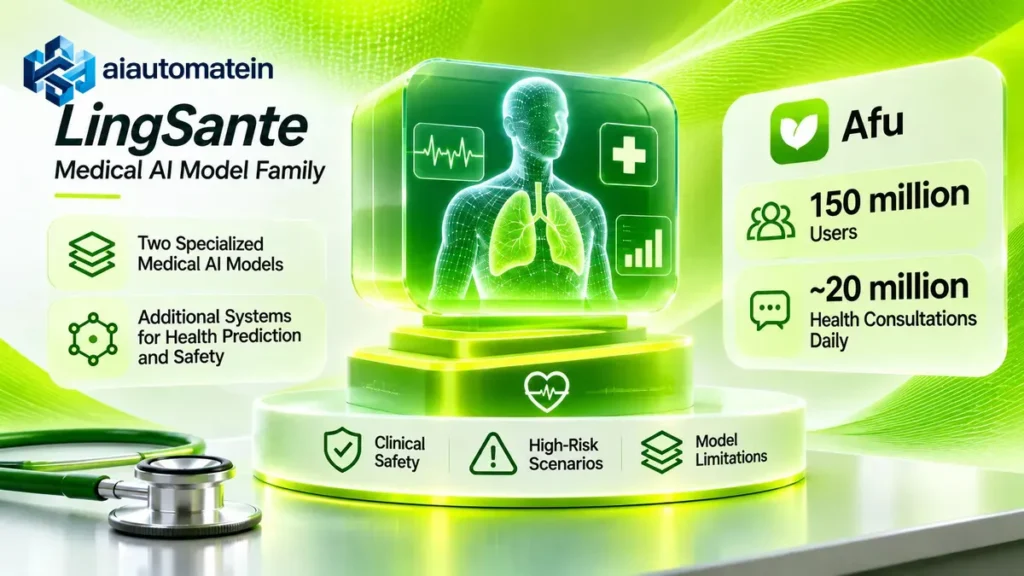
Ant Group announced Ant Group LingSante Open Models on November 23, 2026, introducing an open-weight medical AI family associated with its Afu health application. The company says Afu serves 150 million users and handles nearly 20 million health consultations daily, while the new model lineup includes specialized systems for multimodal understanding, medical reasoning, risk prediction, and safety assessment.
Two Core Models Address Different Medical Workloads
The initial open-weight release includes LingSante-3.1-air-VL and LingSante-3.1-flash, with different architectures and intended applications. Ant Group describes the former as a multimodal model suitable for personal health applications and smaller institutions, while positioning the latter as a larger reasoning system for more complex medical workflows.
LingSante-3.1-air-VL contains 124 billion total parameters, with approximately 5.5 billion activated per token. It supports text, image, and video inputs and is designed for tasks involving medical reports, skin-related information, nutrition assessment, and other multimodal health content.
LingSante-3.1-flash contains 560 billion total parameters, with approximately 25 billion activated per token and a context window of up to one million tokens. Its stated capabilities include medical knowledge retrieval, complex case analysis, and extended workflows requiring information from multiple sources.
These model sizes describe architectural capacity rather than guaranteed clinical accuracy. A larger parameter count or longer context window does not independently establish that a system can identify dangerous symptoms, select appropriate treatment, or handle uncertainty safely.
Open Weights Could Expand Medical AI Research
Ant Group says it will make the LingSante model weights available in phases, beginning with the two core releases. The company is distributing them through Hugging Face, providing researchers and developers with access to model artifacts that may support testing, adaptation, and application development.
Open-weight distribution can make model evaluation more accessible because independent teams can investigate performance within their own environments. However, the practical scope of reuse depends on licensing, documentation, computing requirements, training-data disclosures, and the restrictions associated with particular deployments.
For smaller healthcare technology organizations, the availability of specialized models could reduce dependence on exclusively proprietary APIs. Yet the computing resources required to deploy very large models may still be substantial, and local hosting does not automatically resolve clinical safety or privacy requirements.
A Safety Model and a Risk Prediction System Extend the Family
Beyond the two core models, Ant Group describes LingSante-Pulse as a health prediction system designed to assess risks associated with more than 150 conditions. The company says the model combines multiple health signals rather than relying on a single piece of information.
Risk prediction is different from clinical diagnosis, and that distinction becomes important when predictions are presented to consumers. A model identifying elevated risk may generate useful questions for medical evaluation, but its output cannot be interpreted reliably without understanding calibration, the population used for validation, and the consequences of false positives and false negatives.
The company also introduced LingSante-MedGuard, which is intended to address safety, regulatory, and bioethical concerns. Its existence indicates that Ant Group recognizes the need for dedicated safety mechanisms, although the announcement does not independently establish how effectively those mechanisms detect harmful outputs.
Video Consultations Create a More Demanding Safety Environment
Ant Group also describes LingSante-Live, a multimodal agent supporting real-time health conversations through video. The system is integrated into Afu and is intended to help users communicate symptoms, examine health-related information, and receive personalized guidance.
Video interaction can supply contextual information absent from ordinary text conversations, but it also creates additional sources of uncertainty. Lighting, image quality, camera position, environmental conditions, and the user’s ability to describe symptoms can affect how reliably a system interprets what it sees.
For consumer-facing health AI, the critical question is whether the application recognizes when available information is inadequate for a responsible conclusion. Appropriate escalation, refusal, and referral to qualified healthcare professionals can be as important as producing a fluent answer.
Independent Clinical Research Shows Why Benchmark Scores Are Insufficient
A study published in npj Digital Medicine developed the Clinical Safety-Effectiveness Dual-Track Benchmark to evaluate medical language models across 30 criteria. The researchers used 2,069 open-ended clinical questions developed and reviewed by 32 specialist physicians, covering 26 departments and scenarios involving potentially consequential medical decisions.
Across six evaluated models, the study reported an average combined score of 57.2%, with safety performance averaging 54.7% and effectiveness averaging 62.3%. The researchers also observed a 13.3% performance decline in high-risk scenarios, highlighting the limitations of assessments based primarily on conventional medical question-answering accuracy.
These findings do not measure LingSante directly, but they provide a relevant independent warning about interpreting medical AI benchmarks. Strong performance on familiar questions does not necessarily demonstrate that a model will handle uncertain symptoms, medication safety, or complex patient circumstances reliably.
A separate 2026 Nature research article on dynamic red-teaming of healthcare language models examines safety under changing real-world conditions. Its evaluation framework addresses issues including robustness, privacy, fairness, and factual reliability, reinforcing the need to test medical models beyond static examination-style datasets.
InclusionMed Introduces Another Evaluation Framework
Ant Group says it is participating with researchers from 29 institutions in developing InclusionMed, an open evaluation platform for medical and health AI. The company identifies organizations including Stanford University, Harvard University, and Peking Union Medical College among the participating institutions.
According to Ant Group, LingSante-3.1-flash placed first among open-source medical and health models in InclusionMed’s inaugural rankings. This is a reported result from the company’s announcement, and independent assessment would require examining the benchmark methodology, participating models, scoring procedures, and reproducibility of the evaluation.
Medical AI benchmarks can produce substantially different rankings depending on the types of questions and outcomes they measure. A system performing well on medical knowledge retrieval may not achieve comparable results in patient communication, diagnosis, or treatment decision support.
Scale Creates an Additional Governance Obligation
The reported 150 million Afu users and nearly 20 million daily health consultations suggest substantial consumer exposure to the broader application ecosystem. Those figures do not establish how many users have interacted with each newly released LingSante model or how many conversations involve clinically consequential decisions.
Large-scale deployment can provide information about recurring user needs and common interaction patterns. It can also increase the consequences of systematic errors if misleading guidance is repeatedly delivered across a large population.
Organizations building on Ant Group LingSante Open Models should therefore consider privacy, incident reporting, escalation procedures, and the boundaries between general health information and regulated medical services. The appropriate safeguards will vary depending on the application, jurisdiction, user population, and degree of clinical involvement.
What Healthcare AI Developers Should Examine
The release expands access to specialized medical AI capabilities and provides another option for organizations evaluating open-weight systems. Its significance is particularly evident in applications requiring multilingual interaction, multimodal information processing, or integration with localized healthcare infrastructure.
However, model accessibility should not be confused with clinical readiness. Healthcare developers need task-specific validation, reliable escalation procedures, well-defined human oversight, and clear evidence of performance in the environments where the technology will operate.
The larger test for Ant Group LingSante Open Models will be whether independent researchers can reproduce the company’s performance claims and establish which medical applications the models can support safely. Adoption scale and architectural sophistication are relevant, but patient safety and clinical validity remain the more consequential measures of success.
What evidence should medical AI providers publish before their models reach patients? aiautomatein invites clinicians, healthcare AI researchers, and technology developers to submit independent benchmarking results, implementation evidence, and expert perspectives on clinical model evaluation. Contribute medical AI research or request an editorial conversation.
Original sources and independent research
- Ant Group — LingSante Medical AI Model Family, November 23, 2026
- LingSante-3.1-air-VL — Model repository
- LingSante-3.1-flash — Model repository
- Clinical Safety-Effectiveness Dual-Track Benchmark — npj Digital Medicine
- Dynamic Red-Teaming for Healthcare Language Models — Nature