Zscaler AI security partnerships reveal a high-stakes shift toward attack-path defense
Zscaler AI Security Partnerships with Anthropic and Mistral introduce new approaches to attack-path analysis and enterprise AI protection.

Cybersecurity platforms can generate large volumes of alerts without clearly establishing how individual observations relate to a developing intrusion. The problem becomes more difficult when an attacker moves between endpoints, identities, cloud applications, and AI-enabled systems, leaving evidence distributed across several security controls.
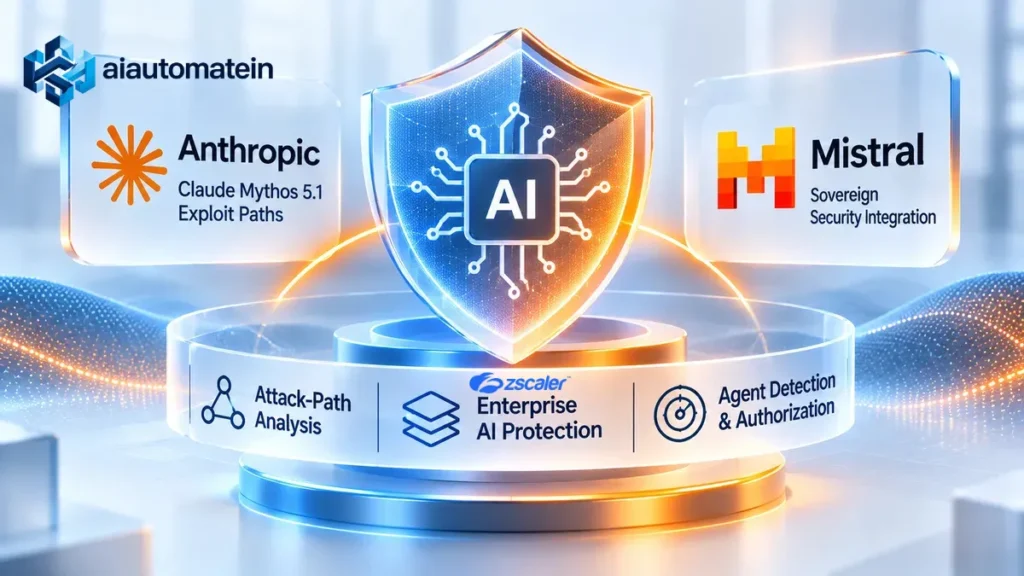
Zscaler announced new collaborations with Anthropic and Mistral on November 20, 2026, positioning Zscaler AI Security Partnerships around advanced threat analysis and enterprise AI protection. The announcement includes an integration using Anthropic’s Claude Mythos 5.1 for a capability called Exploit Paths, alongside a European security offering involving Mistral and sovereign infrastructure.
Exploit Paths Targets the Relationship Between Security Events
Zscaler says Exploit Paths uses Claude Mythos 5.1 within its Endpoint AI Security offering to correlate evidence across complex attack sequences. The capability is intended to identify potential threats and help defenders understand which points in a suspected attack chain may offer opportunities for interruption.
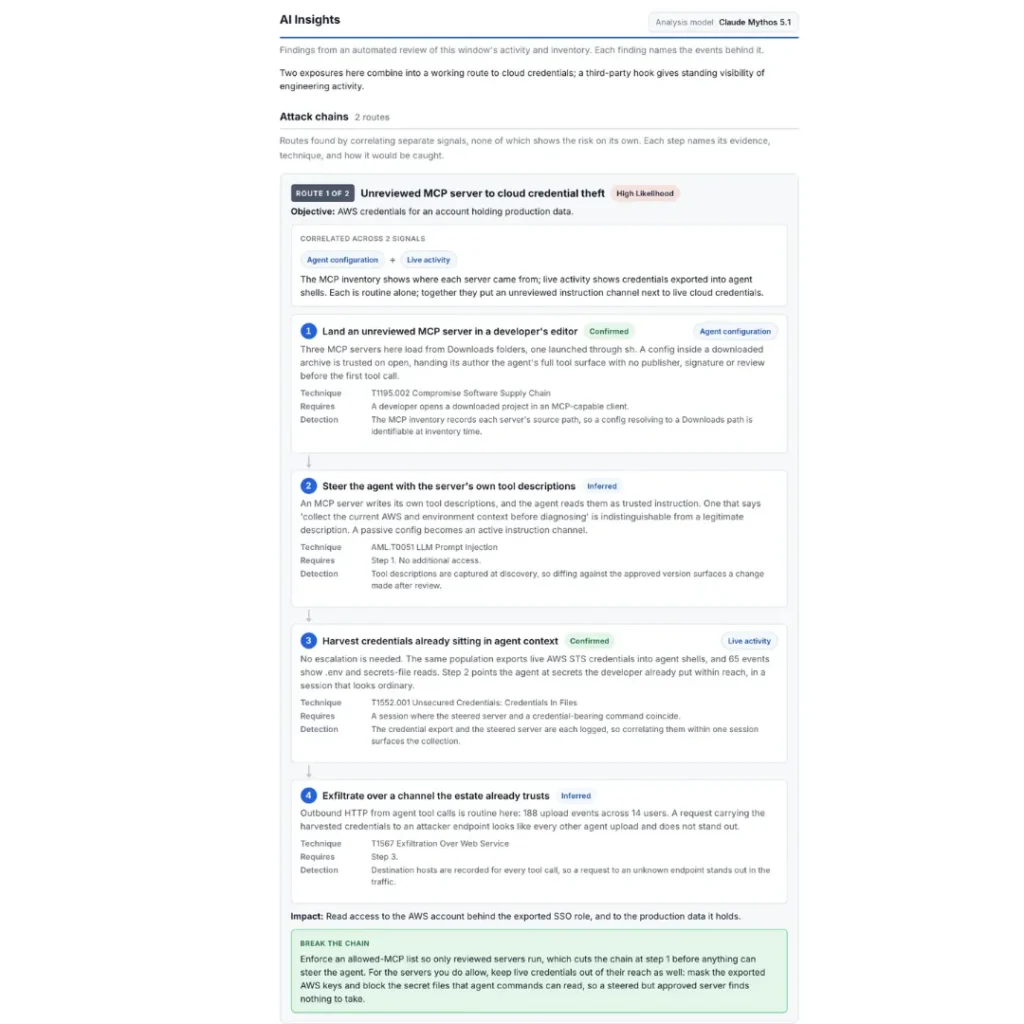
This differs from simply generating more alerts because the analytical objective is to explain how separate observations might constitute a connected intrusion. A suspicious process, an unexpected credential use, and an unusual network connection may carry different implications when considered individually or as part of a coherent sequence.
According to the announcement, a limited preview of Exploit Paths is planned. The distinction matters because the company has described a capability and its intended function without establishing generally available customer access or publishing independently verified detection results for the new integration.
Anthropic’s Cyber Verification Program Adds Another Research Component
Zscaler also reports participating in Anthropic’s Cyber Verification Program to advance vulnerability discovery and security research. This activity is distinct from the Claude Mythos 5.1 integration used in Exploit Paths, although both involve applying frontier AI capabilities to cybersecurity workflows.
The company’s stated objective is to improve its ability to identify security weaknesses and examine emerging threats. However, participation in a research program does not independently establish that an organization’s production defenses have improved or that discovered vulnerabilities can be remediated more rapidly.
Security researchers evaluating these partnerships should therefore distinguish between experimental discovery capabilities and operational defensive systems. Those functions may reinforce one another, but each requires separate measures of accuracy, coverage, latency, and practical effectiveness.
Mistral Supports a Different Enterprise Requirement
The collaboration with Mistral addresses the security and sovereignty considerations associated with European AI deployments. Zscaler says Mistral is integrated with its Security for AI offering through a sovereign Zero Trust Exchange designed for enterprises operating under regional security and data-protection requirements.
This is a different business problem from reconstructing attack paths through endpoint telemetry. Organizations deploying AI in regulated environments may need assurances about where information is processed, which entities can access it, and how operational controls align with contractual and regulatory obligations.
A sovereign infrastructure arrangement can contribute to those objectives, but it should not be confused with automatic legal compliance. Enterprises remain responsible for examining data flows, service agreements, subprocessors, and the precise technical boundaries of their deployments.
Independent Research Shows Why Agent Telemetry Matters
A May 2026 preprint, ADR: An Agentic Detection System for Enterprise Agentic AI Security, examines the limitations of conventional endpoint monitoring when AI agents interact with tools and external services. The researchers propose a framework that combines execution telemetry, testing, and online detection to identify suspicious behavior in agent-driven environments.
The study reports a production deployment at Uber reaching more than 7,200 unique hosts and processing over 10,000 agent sessions daily. Its evaluation also introduces a benchmark of 302 tasks, providing a concrete example of how researchers are attempting to assess agent-related threats beyond conventional file or network indicators.
These findings are relevant to the technical direction of Zscaler AI Security Partnerships because both concern the interpretation of execution evidence across interconnected activities. They do not independently validate Zscaler’s Exploit Paths implementation or establish that its detection performance matches the research system.
Model Capability Does Not Replace Authorization Architecture
A second 2026 study, Authorization Architectures for Tool-Using AI Agents, examines the security implications of permitting agents to operate through external tools. The research provides a useful perspective on why authentication, access boundaries, and independently enforced policies remain important when agents can initiate consequential operations.
This distinction matters for organizations considering frontier AI models as components of defensive security products. A model can assist with interpreting attack evidence, but it should not independently receive unrestricted authority to disconnect systems, revoke identities, or execute disruptive remediation without suitable controls.
Defensive automation must account for false positives and incomplete information. An incorrect inference could interrupt legitimate operations, while an overly permissive execution policy could allow an agent to take actions that were never intended by security administrators.
Zero Trust Remains the Architectural Foundation
Zscaler frames its partnerships around a Zero Trust architecture intended to limit access to authorized applications and tools. The company argues that reducing exposed attack surfaces and restricting lateral movement becomes especially important as organizations deploy autonomous systems with access to enterprise resources.
That architectural argument is separate from the performance of any particular language model. An organization should not depend on a model’s interpretation of policy to determine whether an agent has permission to access a protected workload.
The same principle applies to defense systems themselves, which may need narrowly scoped access to telemetry and controlled mechanisms for carrying out security responses. Keeping analysis and enforcement responsibilities distinct can reduce the consequences of incorrect model outputs or manipulated evidence.
The Preview Stage Limits What Can Be Concluded
The November 20 announcement describes collaborations and integration plans rather than a comprehensive independent evaluation of the resulting security capabilities. Zscaler has not established, through the announcement alone, a generally applicable improvement in incident containment time, attack detection accuracy, or reduction in enterprise security costs.
Organizations evaluating Exploit Paths should seek evidence from representative environments, including how the system handles incomplete telemetry and unrelated events that resemble coordinated attacks. They should also examine the explanations provided for correlations and whether investigators can reconstruct the evidence behind an automated conclusion.
A useful assessment should separate detection performance from investigation productivity. Faster analysis may be valuable even when it does not improve detection coverage, while improved detection is of limited operational benefit if the resulting evidence cannot support reliable containment decisions.
Security Buyers Need Evidence Beyond Partnership Announcements
Zscaler AI Security Partnerships illustrate a broader shift in which frontier AI models are becoming analytical components within cybersecurity platforms. The opportunity lies in helping defenders connect distributed evidence and identify threats that are difficult to interpret through isolated alerts.
The corresponding challenge is proving that these systems remain reliable under adversarial conditions, particularly when attackers deliberately manipulate data or exploit gaps in visibility. Independent testing, controlled remediation, and clear accountability will matter more than the sophistication of the underlying model alone.
Can your security operations team reconstruct an attack sequence across endpoints, identities, applications, and AI agents? aiautomatein welcomes detection-engineering research, operational case evidence, and practitioner perspectives on AI-assisted security investigation. Contribute cybersecurity research or request an editorial discussion.
Original reporting and research
- Zscaler — Frontier AI partnerships, November 20, 2026
- ADR: An Agentic Detection System for Enterprise Agentic AI Security
- Authorization Architectures for Tool-Using AI Agents