AI Agent Identity Governance: Alarming 79%–2% Gap Exposes Critical Security Risks
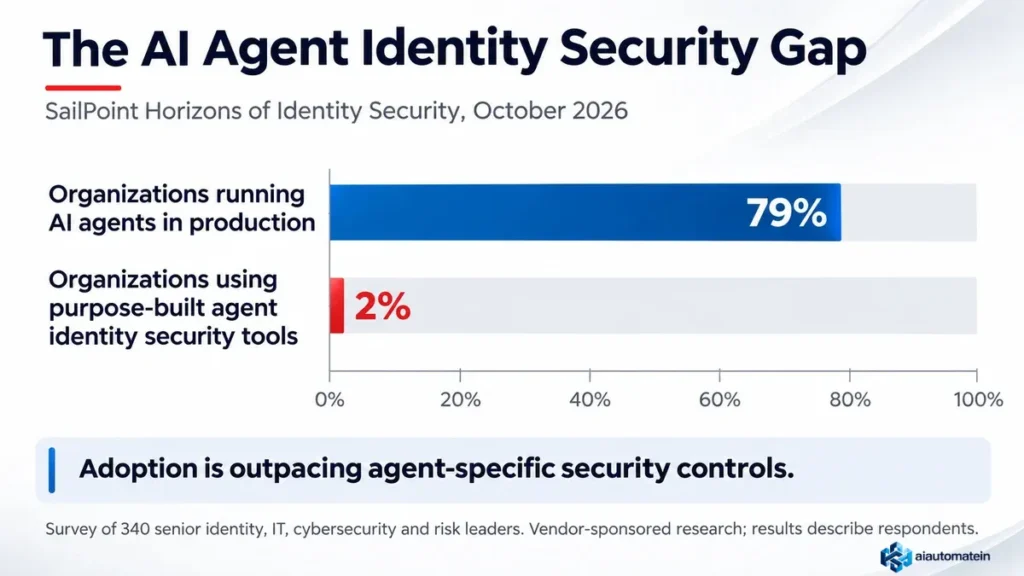
SailPoint reports that 79% of surveyed organizations deploy AI agents, yet just 2% use purpose-built identity controls. We examine the critical security gap and five vendor approaches.


New research finds that enterprise agent deployment is far ahead of purpose-built identity protection. Microsoft, Okta, SailPoint, IBM and Aembit are approaching the problem from different directions, but authentication alone cannot establish whether an agent’s actions remain legitimate.
AI agent identity governance is becoming a critical enterprise security concern after new SailPoint research found that 79% of surveyed organizations run AI agents in production, while only 2% use identity security tools specifically designed to govern them.
The findings, published October 6, 2026, come from SailPoint’s fifth annual Horizons of Identity Security report, based on a global survey of 340 senior identity, IT, cybersecurity and risk leaders.
The research identifies a substantial difference between how quickly organizations deploy autonomous software and how effectively they control its access.
SailPoint also found that 85% of respondents continue to rely on legacy identity tools not designed for agentic identities, while only 15% can provision non-human access in real time.
These are survey findings, not independently measured breach rates. Nevertheless, they expose a growing governance challenge.
An AI agent may hold valid credentials, execute legitimate instructions and still perform actions outside the authority its business owner intended to delegate.
Why AI agent identity governance is falling behind deployment
Traditional identity and access management was built primarily around employees, applications and service accounts.
Employees typically have defined roles, managers and periodic access reviews. AI agents can be created dynamically, invoke multiple tools and continue acting without human approval at every stage.
An agent may retrieve customer information, consult another agent, request additional permissions and update a business system within one workflow.
Each individual operation might be technically authorized. The combined sequence may exceed the original task.
This creates a problem beyond conventional authentication.
Security teams must establish who owns the agent, whose authority it uses, which resources it can access, how long access remains valid and whether its behavior matches the assigned task.
SailPoint’s research found that 54% of surveyed organizations were at the lowest maturity level for agent identity management. Only 43% reported mature processes for agentic access.
The distinction between an identity existing and an identity being effectively governed is becoming fundamental.
Independent research: The visibility and accountability gap
SailPoint’s findings reveal another important divide between organizational confidence and operating readiness.
While 80% of surveyed leaders believed their tooling gap was moderate or smaller, only 15% reported the ability to provision non-human access in real time.
Similarly, 57% expressed confidence in meeting regulatory requirements, but only 43% felt prepared to produce verifiable evidence during an AI-related audit.
These figures do not establish that the organizations are noncompliant.
They indicate that perceived preparedness may exceed the availability of timely identity controls and audit evidence.
The implications extend to agent lifecycle management, credential rotation, access approvals and the ability to deactivate abandoned or compromised agents.
In aiautomatein’s earlier analysis of non-human identity access control, this challenge emerges at the boundary between traditional workload identities and software capable of making context-dependent decisions.
A service account proves that a technical identity exists. It does not establish that every action taken through that account is appropriate.
Five vendor approaches to AI agent identity governance
Enterprise vendors are developing agent-specific controls, but their approaches address different layers of the identity problem.
Microsoft: Agent identity and accountable sponsorship
Microsoft Entra Agent ID introduces identity constructs designed specifically for AI agents.
Its architecture distinguishes technical owners from business sponsors. Sponsors are responsible for the agent’s purpose, lifecycle and access decisions, while owners manage technical configuration and operations.
Microsoft also supports access packages, approvals, expiration and access reviews for agent identities.
This addresses an important business question: who remains accountable when an agent’s original developer leaves the organization?
However, enterprises must still establish appropriate permissions and ensure that connected applications enforce them.
Okta: Governing agent-to-application connections
Okta’s Agent SSO, generally available since August 2026, brings Cross App Access into its core single sign-on offering.
For supported connections, agents receive managed identities and short-lived tokens instead of relying on static credentials.
The broader Okta for AI Agents offering extends discovery, ownership, access certifications and lifecycle management to additional agent environments.
Ric Smith, President of Products and Technology at Okta, summarized the problem in the company’s August announcement:
“Granting them access to enterprise systems shouldn’t require trading away security or visibility.”
Cross App Access supports administrator-governed connections. Its coverage must be distinguished from broader discovery and governance features offered through a separate subscription.
SailPoint: Identity discovery and lifecycle governance
SailPoint approaches the problem through enterprise identity governance, including the discovery and management of non-human identities and agent-related access.
Its Horizons research places particular emphasis on visibility, ownership, lifecycle controls and the limitations of periodic manual reviews.
Wendy Wu, SailPoint’s Chief Marketing Officer, argued in the October announcement:
“You cannot bridge this gap by asking human-speed tools to work faster.”
The argument is commercially relevant, but it comes from a vendor whose business includes identity governance.
Buyers should examine which agent frameworks, identity repositories and access pathways are actually covered rather than assume universal visibility.
IBM: Credentials, authority and runtime observability
IBM is extending its HashiCorp Vault identity-security approach following the acquisition of AuthMind.
Vault provides credential and secrets management, while AuthMind contributes identity activity observability intended to reveal how agents use access across applications and resources.
IBM describes five areas of agent security: registration, delegated authority, authorization, action auditing and revocation.
The distinction is important because granting a credential and monitoring its subsequent use solve different problems.
As aiautomatein reported in its IBM–AuthMind identity security analysis, the effectiveness of the combined approach will depend on how visibility translates into actionable controls.
IBM has not established that every planned integration is already generally available.
Aembit: Workload identity and just-in-time access
Aembit focuses on authenticating non-human workloads and controlling access to resources.
Its documentation describes a blended identity model that evaluates both the requesting agent and the human user on whose behalf it acts.
For supported integrations, Aembit can issue short-lived credentials, isolate backend secrets and enforce access policies through its MCP gateway.
This may reduce reliance on long-lived credentials embedded in applications.
However, implementation depends on integration coverage, workload identity assurance and the policies applied to downstream systems.
These five approaches are complementary in some environments and competitive in others. None should be treated as a verified universal solution to agent security.
aiautomatein analysis: Identity without purpose-bound authority is insufficient
The most dangerous agent identity failure may be an action performed through valid credentials after the business justification for that action has changed.
Consider a hypothetical finance agent authorized to review invoices and prepare payment recommendations.
Its permissions might allow access to invoice records, supplier information and an accounts-payable application.
If the agent interprets untrusted content as an instruction to change a supplier account, ordinary authentication controls may not determine whether that change falls within its authorized task.
The problem is not simply identifying the agent.
It is connecting identity, delegated authority, transaction context and the permitted outcome.
This is why AI agent permissions, memory and identity governance must be examined together.
An agent may retain context from one task while receiving authority for another. Permissions that were appropriate earlier may become excessive.
Enterprises therefore need controls that evaluate authority at consequential execution points rather than treating successful initial authentication as lasting approval.
Microsoft’s business sponsorship model addresses accountability. Okta emphasizes governed connections. SailPoint focuses on identity governance. IBM extends visibility into runtime behavior. Aembit concentrates on workload access enforcement.
The unresolved challenge is coordinating these functions across heterogeneous environments.
A complete audit trail must establish which agent acted, for whom, under which authority, using which tools, and with what resulting business impact.
What CISOs should measure before scaling agents
A practical AI agent identity governance program should begin with a complete inventory of active agents and their accountable business owners.
It should then measure the share of agents with named sponsors, the percentage using short-lived credentials, excessive permission rates, time to revoke access, and the completeness of action-level audit records.
Security teams should also test whether an agent can perform a prohibited action despite possessing otherwise valid credentials.
The goal is not to slow every workflow through manual approval.
It is to apply additional scrutiny where delegated actions create material financial, privacy, security or operational consequences.
The strongest measure of maturity is whether organizations can identify an agent, explain its authority and interrupt inappropriate behavior before consequential damage occurs.
Frequently asked questions
What is AI agent identity governance?
AI agent identity governance is the management of agent identities, ownership, delegated permissions, access reviews, activity monitoring and deactivation throughout the agent lifecycle. It helps organizations establish who is accountable for autonomous software and which actions it may perform.
Why are traditional identity tools insufficient for AI agents?
Traditional identity tools may authenticate agents but lack complete visibility into dynamic delegation, multi-tool activity, rapidly changing permissions and task-specific authority. Purpose-built or extended controls seek to address these gaps.
Which vendors offer AI agent identity governance capabilities?
Microsoft, Okta, SailPoint, IBM and Aembit provide different identity, authorization, governance or runtime-security capabilities. Buyers should assess their requirements against each product’s documented scope, availability and integration coverage.
Sources and references
- SailPoint — Horizons of Identity Security 2026–2027 findings
- Microsoft — Entra Agent ID documentation
- Okta — Agent SSO announcement, August 2026
- IBM — Agent identity security and AuthMind acquisition
- Aembit — AI agent identity and access documentation
- aiautomatein — IBM and AuthMind identity security analysis