
Headcount Is a Lagging Measure of Finance AI ROI
Finance AI value extends beyond workforce reductions. Explore how released capacity, faster cash collection, shorter reporting cycles, avoided hiring and better financial controls contribute to a more credible AI investment case.

Introduction
Microsoft says its Global Collections operation now saves hundreds of thousands of hours annually through AI-assisted finance workflows.
That number sounds like an obvious ROI headline. It is not the most interesting one.
In its June 2026 Global Collections case study, Microsoft also reported a 40% reduction in call-preparation time, 2x growth in automatic cash applications, 2.5x faster customer inquiry resolution, and 98% of payments being applied within 48 hours. The team says it tracks dollars collected and hours worked together when assessing productivity.
That measurement choice gets closer to the real business case.
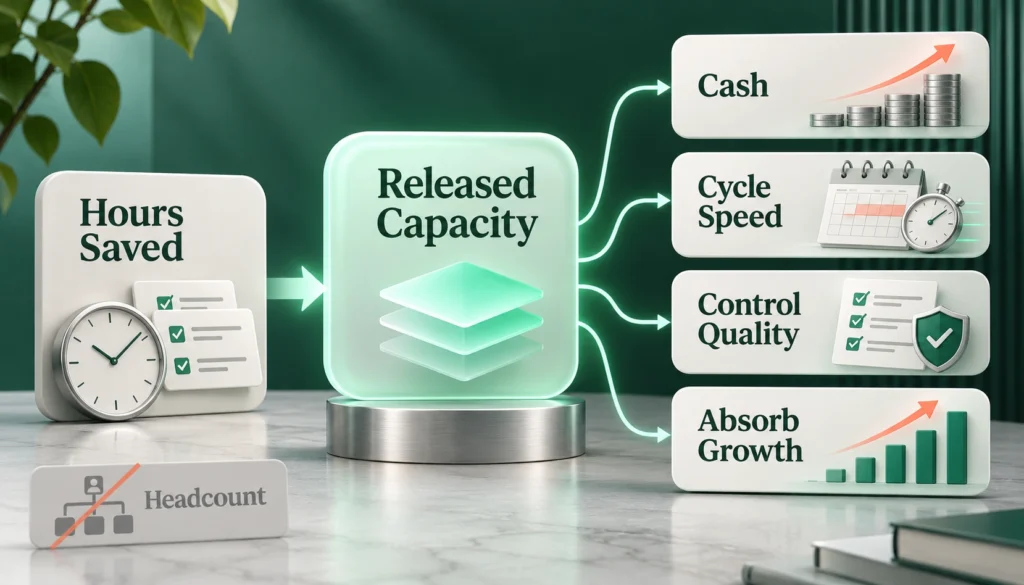
If finance AI saves 100,000 hours but payroll does not change, those hours have not disappeared financially. They have created capacity, and the return depends on what happens to that capacity next.
It may allow collections teams to work higher-value accounts sooner, help reconciliation differences surface before period end, shorten a forecast cycle, increase review coverage, absorb transaction growth without new hiring, or give finance teams time to investigate risks that previously sat below the attention threshold.
Those outcomes can create substantial economic value without removing a single person from the organization.
That is why finance AI ROI beyond headcount savings needs a different measurement discipline.
The business case should trace the path from time released → work changed → finance outcome changed → value captured.
Skipping directly from “hours saved” to “FTE reduction” removes the part of the argument that finance actually needs to understand.
At a glance
- Hours saved measure released capacity; they do not automatically equal payroll savings.
- Finance AI creates economic value when released capacity changes throughput, cash, cycle time, quality or required future staffing.
- Headcount reduction is one possible way to capture value, not the default definition of ROI.
- Finance should pair productivity measures with an operating or financial outcome.
- Technology, integration, review, monitoring and governance costs still belong in the net business case.
Hours saved belong in the business case
There is nothing wrong with measuring time. In fact, it is one of the cleanest ways to establish whether an AI workflow is removing work.
Oracle’s current Monitoring and Evaluation guidance reflects this. Its Business Value Dashboard estimates time and cost savings from eligible production usage using per-interaction estimates supplied by the agent author. Test and debug executions are excluded, and authorized users can revise those estimates as better operational evidence becomes available.
That is useful instrumentation.
If a reconciliation assistant removes six minutes from a task completed 50,000 times a year, finance should know it.
The problem begins when the calculation quietly assumes that six minutes multiplied across annual volume is equivalent to payroll removed from the P&L. In many cases, the employee is still there, the close still needs the same accounting team, collections still require case managers and planning still carries the same fixed organization cost.
What changed is the amount of work those people can perform within the same period.
That is a capacity gain. Capacity becomes economic value only when the business does something with it.
The missing step is capacity conversion
A finance AI business case needs to explain how released capacity is converted.
Consider an analyst who spends less time preparing reconciliations.
The freed time could disappear into ordinary workload. It could reduce overtime during close, allow the team to reconcile more frequently during the month, absorb higher transaction volume without another hire, or give analysts enough time to investigate difficult cases that previously received limited review.
The technology has produced the same initial result—less manual effort—but the business value varies depending on where that capacity goes.
Microsoft’s collections programme illustrates this well. AI support is used to prioritize cases, assemble customer context, route work, draft responses and automate parts of cash application. Microsoft reports that payment-matching accuracy increased from 40% to 90%, customer inquiries were resolved faster and more payments were applied automatically.
Microsoft Finance’s September 2026 AI transformation case study makes the capacity point even more directly. Its Treasury organization says it looks beyond productivity toward capacity gaps where AI can cover valuable work teams previously lacked capacity to reach.
That is the step an FTE-only business case misses.
Released capacity has to land somewhere economically useful.
Cycle time can create value before the cost base changes
Finance contains several processes where timing has economic value independent of staffing levels.
A close completed sooner gives management access to finalized information earlier. A reconciliation difference identified during the period is easier to investigate than one discovered during a compressed period-end window. A faster forecast refresh can allow management to act while changed assumptions still matter. A collections process that resolves disputes sooner can affect when cash becomes available.
Oracle’s AI Playbook for Financial Excellence illustrates the breadth of these measures. Oracle reports a sub-10-workday close, 20% faster forecast cycles, 70% touchless invoice entry and 200,000 employee hours saved annually on expense reporting.
Oracle presents these as outcomes of its wider finance transformation using cloud applications, intelligent automation and embedded AI—not as isolated causal effects from one AI feature.
The measurement mix is still instructive. Hours saved sit beside cycle speed, touchless processing and process throughput.
A finance AI programme should be evaluated in the same way.
If a system saves 20,000 hours and the forecast process remains exactly as slow, the close remains exactly as late and the same volume of finance work gets completed, the business should ask where the released capacity actually went.
Cash can dominate the labor calculation
Collections makes the weakness of a headcount-first model particularly visible.
Suppose an AI workflow saves two hours of preparation per collector each week. Those hours have an identifiable labor value.
But if the same workflow also helps the team prioritize higher-risk accounts earlier, apply payments faster and resolve disputes sooner, the cash effect may be more important than the labor calculation.
Microsoft’s Global Collections team explicitly says it measures cycle time, throughput, dollars collected and hours worked when evaluating its AI-assisted process. Its 2026 case study connects AI use with faster case preparation, higher automatic cash application and quicker inquiry resolution, while cautioning that its reported metrics are internal, directional figures from the period studied rather than guarantees of future performance.
That is closer to how finance should think about ROI.
The labor metric explains what capacity was released. The collections metric explains whether that capacity changed the economic outcome.
Those are different questions.
Some saved capacity should remain inside finance
There is another reason immediate headcount reduction can be the wrong target.
Finance organizations do not have a fixed amount of useful work.
If reconciliation preparation takes less time, the benefit may be better review rather than fewer accountants. If reporting commentary drafts itself more quickly, controllers may spend more time challenging unsupported explanations. If forecast preparation becomes less mechanical, FP&A may refresh scenarios more frequently when assumptions move. If collections teams spend less time finding customer context, they may spend more time resolving cases that affect meaningful cash balances.
In each case, the organization intentionally consumes some of the released capacity.
That is not a failure to realize the AI benefit. It may be the benefit.
Finance has historically rationed judgment because people spend so much time assembling information, moving data, preparing files and checking routine conditions. Removing some of that work creates an opportunity to spend human attention differently.
A business case that counts value only when somebody leaves the payroll can make that investment look economically weak precisely when the organization is using the technology well.
Growth without proportional hiring is a real financial outcome
Headcount does not have to fall for labor economics to improve.
A finance team may process 20% more invoices, customers, entities or transactions while keeping staffing flat. It may absorb an acquisition without recreating the same support structure in every business unit, avoid temporary labor during close, leave vacancies unfilled, or handle a larger revenue base without expanding finance cost at the same rate.
Those are capacity economics.
They are harder to show than a direct redundancy line in a business case because they depend on a counterfactual:
What would staffing have been without the AI-enabled process?
That does not make the benefit less legitimate. It means the assumption needs evidence.
Historical volume-to-staffing ratios, transaction growth, prior hiring patterns and known capacity thresholds can help finance estimate whether avoided hiring is credible.
A business case should distinguish that from a fictional saving where the model assumes an employee disappears simply because software removed several hours of work.
Control quality creates value, but finance should resist invented dollars
AI can also change the amount and quality of review finance can perform.
Oracle describes PwC firms using Oracle Cloud ERP as able to apply embedded predictive, generative and agentic AI capabilities to help increase productivity, improve financial controls, align financial and operational planning and simplify global reporting. PwC is also using Oracle’s Document IO agent in finance processes.
Those outcomes matter, but they are easy to abuse in an ROI spreadsheet.
A stronger control environment does not automatically justify assigning an arbitrary dollar value to “risk reduction.”
Finance should first measure the operational evidence.
Did reconciliation differences remain unresolved for less time? Did review coverage increase? Did post-close corrections fall? Did analysts trace exceptions faster? Did more high-risk transactions receive attention?
If the organization has a credible expected-loss model, some control improvements may eventually be translated into financial risk reduction. Where it does not, the benefit should remain a clearly stated operational or risk outcome instead of being forced into a fabricated cash number simply to improve the ROI percentage.
That makes the business case more defensible, not less ambitious.
The cost side also changes with AI
A serious finance AI business case cannot stop at gross benefit.
AI introduces operating costs that traditional automation models may not have captured in the same way: model or platform charges, integration work, data preparation, testing, evaluation, human review, monitoring, access-control administration and ongoing process redesign.
Oracle’s AI Agent Studio separates monitoring, evaluation and value estimation, while its agent-monitoring documentation exposes session completion status, token use, detailed execution traces, tool calls and step duration.
An agent can therefore look productive in a usage dashboard while still being uneconomic if the review burden is high or if substantial manual intervention is required to maintain acceptable output quality.
The same principle applies to control-heavy finance processes. If an AI workflow removes 5,000 preparation hours but introduces 3,000 hours of validation, remediation and oversight, the business case needs the net effect.
Exception-handling economics are one part of that cost picture. The broader finance-AI question is what the complete operating model costs once the capability is genuinely in production.
Pair the capacity metric with the outcome it is meant to change
The most useful finance AI business cases tend to have two measurements working together.
One tells finance what effort changed. The other tells finance why that matters.
In collections, preparation hours might be paired with dollars collected, cash-application speed or case-resolution time.
In close, manual effort might sit beside close readiness or time to resolve accounting differences.
In planning, model-preparation time might be paired with forecast-cycle duration or the number of scenarios finance can refresh when conditions move.
In reporting, drafting time might be paired with review corrections, evidence retrieval time or reporting-cycle completion.
These are not universal KPI prescriptions. The pairing depends on the use case.
The principle is that a productivity measure needs a destination.
Microsoft’s collections measurement model is revealing for exactly this reason: hours worked are evaluated alongside dollars collected and process throughput rather than treated as the entire result.
That produces a much more credible answer to the CFO’s question:
What changed economically because the work became easier?
Headcount belongs at the end of the argument
Finance AI may eventually change staffing.
Some organizations will need fewer contractors. Some roles will shrink through attrition. Some teams will absorb growth without replacing every departure. Some work may disappear entirely.
Those are legitimate outcomes, but they should emerge from the operating evidence rather than being inserted as the assumption that makes the investment case work.
If a finance AI proposal needs ten FTE reductions on day one to clear the hurdle rate, yet no credible operating plan explains which work disappears, which responsibilities move and how the remaining process will run, the ROI model is doing more work than the technology.
A stronger business case begins with the process.
Identify the capacity released. Show what finance can now do earlier, more often or at greater scale. Measure the financial, operating or control outcome that changes. Then decide how much of that value appears as cash savings, avoided future cost, higher throughput, working-capital improvement or better finance performance.
Headcount can be one result of that chain. It should not substitute for it.
Finance AI ROI has to survive contact with the finance outcome
Finance teams are well equipped to demand a better standard from AI investment cases because they already know the difference between an accounting entry and an economic event.
The same discipline should apply here.
Hours saved are evidence that work changed.
Cost avoided is evidence that capacity was financially captured.
Faster cash, shorter cycles, higher throughput or better control performance show that the operating result changed.
Those measures should not be collapsed into one convenient number before the causal path is understood.
Finance AI has created capacity when it saves time. It has created ROI when finance can show what that capacity changed.