
Runtime AI Governance: Controls at the Execution Boundary
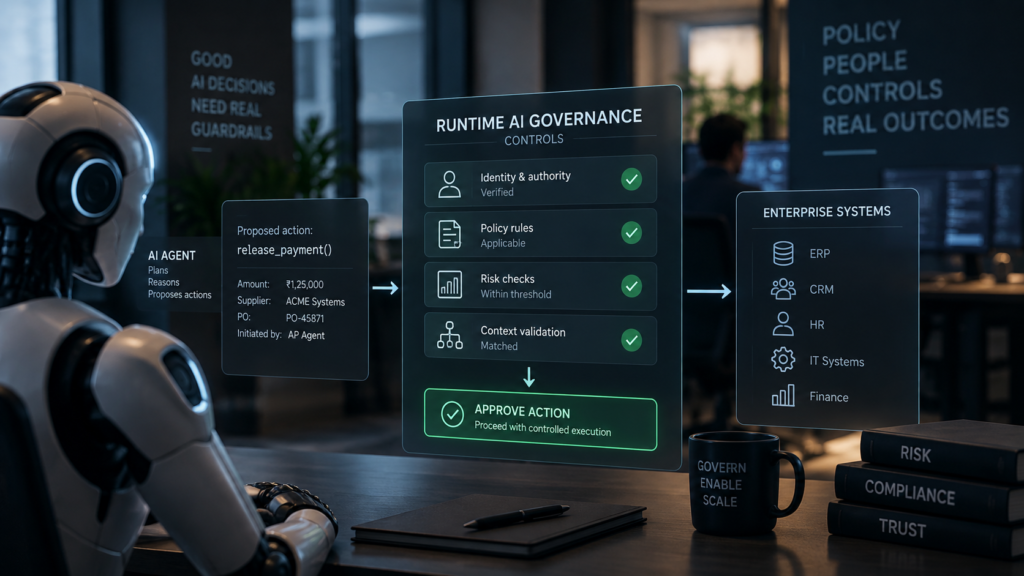
Runtime AI governance controls apply policy at the point where an AI-generated plan becomes an external action. See how identity, delegated authority, task context, transaction parameters and approval thresholds can be evaluated before tools change money, access, data or production state.

Introduction
A tool-using AI system can cross an important enterprise boundary in a fraction of a second. A model selects an API, constructs the parameters, and passes the request to a system that can release a payment, change an account, send customer communication, alter production infrastructure, or disclose protected data.
Once that request reaches the target system, conventional AI oversight may already be too late. The relevant control has to operate earlier, while the action can still be challenged, constrained, routed for approval, or denied.
This requirement is becoming more visible as enterprises adopt agents and tool protocols. Model Context Protocol (MCP), for example, gives AI systems a consistent way to discover and invoke tools, but Microsoft notes that the protocol itself does not provide a built-in checkpoint for evaluating policy before a call executes.
Traditional AI governance still matters. Use-case approval, model risk, data controls, testing, documentation, accountability, and periodic review all remain part of a credible programme. NIST’s AI Risk Management Framework treats risk management as an activity spanning the design, development, use, and evaluation of AI systems rather than as a single deployment gate.
Tool-using systems add a more immediate requirement. An approved model inside an approved application can propose an operation that exceeds the authority available for that task. Runtime AI governance controls deal with that execution layer: they evaluate a proposed action against identity, delegated authority, business context, and policy before the action changes enterprise state.
At a glance
- Runtime governance applies policy before an AI-generated action creates an external effect.
- Tool access is rarely enough to establish authority; the operation, parameters, task, identity, and current business conditions may all affect the decision.
- Deterministic authorization is more defensible than asking a probabilistic model to police consequential transactions through instructions alone.
- Human approval works best around explicit authority thresholds rather than as a universal step in every automated workflow.
- Observability and enforcement serve different operational purposes, but their evidence should meet in the same audit trail.
Why tool-using AI changes the governance problem
Many enterprise controls assume that application behaviour is substantially determined by code.
A conventional finance application may expose a fixed sequence for processing an invoice. Engineers know which services will be called, where approval is required, what data is touched, and which role can perform each step. Even when the workflow is complicated, the execution path is usually bounded by application logic.
An AI-driven workflow can be less predictable. The system may select tools according to the task, retrieve additional information, create intermediate steps, delegate work, or revise its plan after receiving new data. That variability is useful—it is part of the reason agents can handle more open-ended work—but it places more pressure on the controls surrounding the action itself.
Consider a supplier workflow. Reading a vendor record, comparing an invoice with a purchase order, placing the invoice on hold, changing payment details, and releasing funds may all sit within the same broad process. The risk attached to each operation is very different.
That difference cannot be left entirely to the model’s interpretation of a system prompt.
A prompt can tell an agent that high-value payments require approval. An authorization layer can evaluate the proposed payment against the amount, account, initiating identity, approval state, supplier status, and applicable policy before the ERP accepts it. The latter provides an independently testable control.
OWASP’s Agent Control Standard, published in September 2026, formalises this type of architecture through middleware hooks that expose agent behaviour for inspection and allow declarative policies to be enforced at runtime.
Put policy evaluation between reasoning and execution
Runtime control does not require a policy engine to understand every token or reasoning step. It needs a reliable interception point before a consequential operation is committed.
Take an agent that prepares a payment request. By the time the request reaches an enforcement layer, much of the reasoning may already be complete: the agent has matched the invoice, checked the purchase order, reviewed the supplier record, and selected the payment function.
The governance layer can concentrate on a narrower decision:
Is this specific operation authorised under the current conditions?
The answer may depend on the software identity, initiating user, supplier, account, transaction value, recent changes to master data, requested API operation, approval limits, and whether required sign-off has already been recorded.
The model can produce the proposed action and its parameters. A separate policy component evaluates whether the enterprise permits the action to continue.
That division is useful for more than security. It also makes the control testable. Teams can verify, for example, that a ₹5 lakh payment without approval is rejected, that a lower-value routine payment proceeds, and that a supplier bank-account change is routed differently regardless of transaction value.
Microsoft’s 2026 Agent Governance Toolkit uses this type of execution-path control, intercepting agent actions before they run and evaluating policy independently of the model. Its broader design also covers machine identity, execution controls, audit evidence, and emergency termination.
The specific implementation will vary by platform. The architectural requirement is more durable: consequential actions need a policy decision point outside the model’s own reasoning loop.
Delegated authority needs task-level context
Enterprise identity systems can tell an application who or what is authenticated. Agentic workflows often require a narrower answer: what is this software authorised to do for this task?
A service identity may have access to supplier records, invoices, purchase orders, and payment services because the application supports several finance processes. During a reconciliation task, however, only part of that access may be relevant. Changing supplier banking information would fall outside the work that was delegated even though the underlying service account technically has access.
That gap between technical entitlement and task authority is likely to become more important as agents reuse the same tools across many workflows.
Useful delegation context can include the initiating user, assigned task, business object, permitted actions, applicable value limits, and duration of the authority. In a multi-agent workflow, those constraints can follow the delegated subtask rather than allowing downstream agents to inherit the full permission set of the parent process.
Temporary access deserves particular attention. Month-end reconciliation, incident response, contract review, or one-off administrative work often requires elevated access for a defined period. Machine identities can accumulate stale authority just as human accounts do, but agentic systems may exercise that authority at machine speed and without the visual cues that often alert a human user.
For security and IAM teams, much of this is familiar territory: least privilege, delegated access, short-lived credentials, privileged-action controls, and policy decision points are established disciplines. The design challenge is carrying enough business context into those systems for them to evaluate machine-generated actions accurately.
Tool permissions are too coarse for transaction control
A list of available tools tells us what an application can call. It says little about which calls are acceptable in a particular business situation.
A customer-service agent might have access to functions such as:
get_customer_record()
calculate_refund()
issue_refund()
update_account()
send_message()
At the function level, access may look straightforward. Production policy quickly becomes more specific.
A routine refund below a defined amount may be eligible for automatic execution after the account passes normal checks. A larger refund can require supervisor approval. An address change may be permitted after identity verification, while a change to payment instructions may be excluded from the service workflow completely.
The parameters are part of the risk.
Infrastructure automation presents the same issue. Giving an AI system access to a deployment interface does not imply equal authority across development, staging, and production, nor does it make every configuration change acceptable. Target environment, resource type, command, expected blast radius, maintenance window, and rollback capability can all affect the decision.
Tool-level allowlists help, but many production transactions require a finer control layer. Production governance may need to inspect the requested operation in enough detail to apply business policy before execution.
Centralising that logic also reduces the amount of control language scattered across prompts, individual agents, and bespoke application code. Security, platform, risk, and application teams can test the policy directly rather than inferring whether the model will interpret an instruction consistently.
Human approval belongs at authority thresholds
Human review is easy to add and difficult to scale.
Early deployments often compensate for uncertainty by asking a person to approve many agent actions. That can be appropriate while teams learn how a system behaves, but approval loses value when every routine operation produces the same interrupt. Review fatigue is already familiar in security operations, financial control, and clinical systems; agentic workflows can reproduce the same problem quickly.
A stronger operating model ties human intervention to authority and consequence.
A routine customer credit with complete supporting evidence may sit within an automated limit. A larger credit goes to a supervisor. A supplier bank-account change requires independent verification. A privileged infrastructure action may remain outside autonomous authority entirely.
The threshold can incorporate more than transaction value. Data sensitivity, reversibility, customer impact, regulatory status, novelty, privilege level, and quality of supporting evidence may all affect the approval route.
This creates room for selective autonomy without turning human oversight into a ceremonial click.
It also gives operations teams something measurable. If 40% of otherwise routine transactions are being escalated, the organisation can examine why. Perhaps the policy is too restrictive; perhaps the data feeding the decision is weak; perhaps the process contains more exceptions than expected. Runtime controls reveal those frictions instead of hiding them inside manual workarounds.
Connect enforcement decisions to operational evidence
A trace can show what the system did. For governance purposes, teams may also need to know what the system was prevented from doing, under which rule, and on whose authority.
That makes enforcement data valuable beyond the immediate allow-or-deny decision.
For a consequential transaction, a useful evidence record can include the requesting identity, delegated task, proposed operation, parameters, relevant risk attributes, policy identifier, policy version, authorization result, approval or override, and downstream outcome.
Policy versioning becomes important when the conditions behind an authorization decision change. Transaction limits change. Vendor classifications are revised. A jurisdiction introduces a new restriction. A data source is reclassified. A model or tool is temporarily suspended. Months later, an audit or incident investigation needs to reconstruct the conditions that applied at the time.
A versioned decision record makes that possible without relying solely on a model transcript and whichever policy document happens to be current during the investigation.
The same evidence supports operational tuning. Security teams can examine repeated denial patterns. Business owners can see where legitimate workflows hit unnecessary controls. Risk teams can test whether the policies designed for high-impact actions are actually being invoked. Internal audit gains evidence of control operation rather than only evidence that a control was documented.
Observability remains essential—model calls, retrieval activity, latency, errors, tool usage, handoffs, and task results all help reconstruct system behaviour. Runtime enforcement adds the record of whether a proposed external action was permitted to proceed. The audit trail is strongest when both views can be connected.
Define ownership across existing control functions
No single team owns all of the disciplines required for runtime governance.
Security teams already manage identity, access, privileged operations, secrets, and many enforcement mechanisms. Risk and compliance teams define obligations, tolerance levels, evidence requirements, and exceptions. Platform teams determine where gateways, policy services, identity, telemetry, and orchestration live. Application teams understand the process and its failure modes. Business owners decide which actions can be delegated and which remain reserved for human authority.
AI governance has to work across that landscape.
Creating a separate governance bureaucracy around agents would duplicate controls that already exist elsewhere and, worse, separate policy from the teams capable of enforcing it. A more practical model starts by mapping agent behaviour into existing control domains.
A finance agent that can release payment belongs partly in AI governance, but also in payment controls, IAM, segregation of duties, fraud monitoring, and financial audit. An infrastructure agent touches AI governance, privileged access management, change control, incident response, and production reliability.
The AI-specific work lies in the gaps: machine-generated plans, delegated agent identity, variable execution paths, model-mediated tool selection, memory, and the evidence needed to reconstruct autonomous decisions.
Ownership therefore tends to be federated. The governance function sets the policy model and accountability framework; established control owners continue to enforce the business and technical rules within their domains.
Start with actions that change money, access, data, or production state
Trying to place sophisticated runtime controls around every generated response is rarely the best starting point.
The higher-value exercise is to identify actions that create material external effects:
- payments and refunds;
- account creation or deletion;
- permission and entitlement changes;
- modifications to regulated records;
- customer or employee communications;
- sensitive-data transfers;
- contract or filing submissions;
- production infrastructure changes;
- deletion or irreversible modification of enterprise data.
For each action, teams can define the permitted actor, delegated scope, business conditions, parameter constraints, approval threshold, evidence requirement, and rollback option.
Some organisations will discover that the control already exists but the agent bypasses it. Others will find that the application has inherited a broad service identity because no task-level authorization model was designed. In a few cases, the process itself may lack a clear authority boundary even before AI is introduced.
That makes this exercise useful beyond agent security. It exposes where enterprise policy exists only as convention, manual knowledge, or documentation rather than as an enforceable rule.
A practical test is whether an unauthorised request can be stopped before the target system commits the change. If the answer is no, the organisation may have excellent monitoring and still lack effective control over execution.
FAQs: runtime AI governance controls
What are runtime AI governance controls?
Runtime AI governance controls are policy checks applied while an AI-enabled workflow is executing. They can evaluate identity, delegated authority, task context, requested operation, parameters, data scope, and other risk attributes before an external action proceeds.
Their purpose is to turn governance requirements into enforceable decisions at the point where an AI-generated plan could affect another system.
How are runtime controls different from AI observability?
AI observability records and analyses system behaviour, including model calls, retrieval activity, tool use, errors, latency, and task outcomes.
Runtime controls can intervene before an external operation completes. Depending on policy, they may permit the action, deny it, narrow its scope, or route it for additional approval.
Production systems generally benefit from both capabilities and from linking their evidence.
Can system prompts enforce enterprise AI governance policies?
System prompts can guide expected behaviour, but consequential enterprise controls should not depend solely on the model interpreting those instructions correctly.
Payments, privileged operations, regulated-data access, account changes, and production actions are better backed by deterministic mechanisms outside the model that can evaluate policy independently.
Where should runtime AI controls sit in an enterprise architecture?
The location depends on the platform and workflow. Enforcement can sit in agent middleware, an API or tool gateway, a service proxy, an authorization layer, or another component integrated with the orchestration path.
The architectural requirement is straightforward: the external action should not be able to bypass the point at which policy is evaluated.
Which AI actions should require human approval?
Human approval is most useful for actions where the organisation has chosen not to delegate full authority.
Typical criteria include financial value, irreversibility, privilege level, data sensitivity, regulatory impact, unusual transaction context, or weak supporting evidence. Low-risk, routine actions can remain automated where policy allows.
Put authority checks on the path to action
Enterprise AI governance has spent considerable effort on inventories, model assessments, data policies, evaluation, documentation, and accountability. Tool-using systems add another control surface: the transaction path itself.
That path is where abstract policy encounters a specific identity, task, customer, payment, database record, production resource, or API call.
For actions with material consequences, governance is strongest when the enterprise can answer several questions before execution: Who delegated this authority? What exactly was permitted? Which conditions apply now? Which policy made the decision? What evidence will remain afterward?
Those are familiar questions in payments, privileged access, financial control, and regulated operations. Agentic systems are forcing organisations to answer them for software that can select its own next step.
The organisations that handle this well will not necessarily be those that constrain AI most aggressively. They will be the ones that define authority precisely enough for machines to use it—and enforce those boundaries before a proposed action becomes an enterprise fact.