
Enterprise GenAI Evaluation: Measure the Decision, Not the Prose

Introduction
Fluency is one of the least informative metrics once a GenAI system starts influencing a business decision.
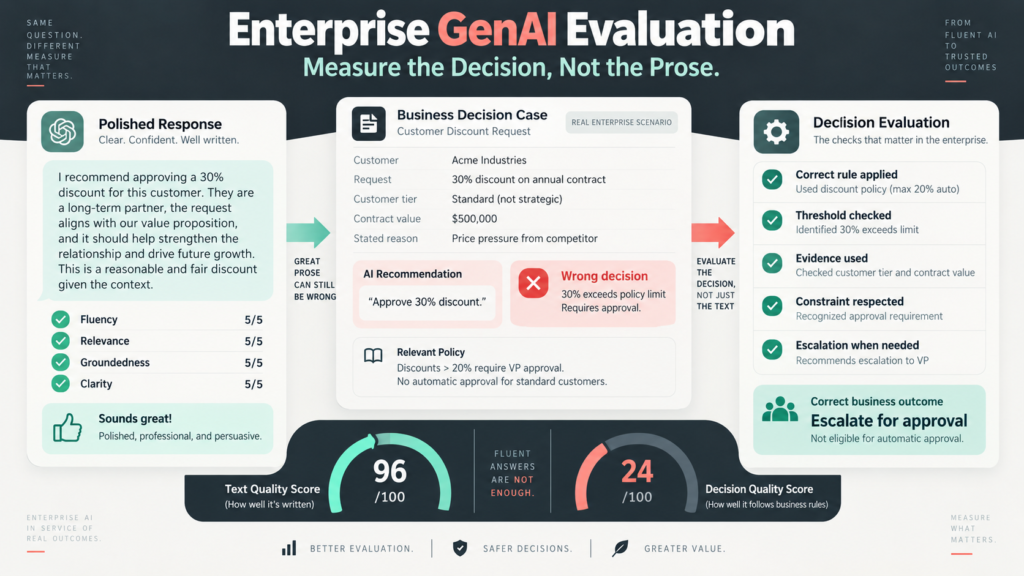
Consider an AI assistant reviewing a proposed customer discount. Its response is concise, grammatically clean and supported by information from the deal record. It explains the recommendation clearly.
It can still approve the wrong discount.
Perhaps it applied the threshold for a three-year contract to a one-year renewal. Perhaps it used the right policy but failed to account for the minimum margin. Perhaps the case required commercial approval rather than an automated recommendation.
None of those failures necessarily makes the prose look poor.
That is the central problem in enterprise GenAI decision evaluation. Metrics such as fluency, coherence, relevance and groundedness tell teams useful things about an output, but business-critical applications eventually need another question answered: did the system reach an acceptable decision under the conditions that governed the case?
Current evaluation platforms are already broadening beyond text quality. Microsoft’s evaluator documentation distinguishes measures such as groundedness, relevance and response completeness from task completion, task adherence and tool-use evaluation.
Google’s Gen AI evaluation service supports task-specific rubrics, while OpenAI provides deterministic checks, model-based graders and combinations of multiple graders.
The useful enterprise scorecard begins with what the system was expected to decide or accomplish, then selects metrics capable of testing that expectation.
At a glance
- Fluent, relevant and well-grounded output can still produce the wrong business decision.
- Evaluation criteria should originate in the task, governing rules and material failure modes rather than a generic list of LLM metrics.
- High-severity errors need separate treatment; averages can hide rare failures that make a system unsuitable for production use.
- Abstention, escalation and requests for additional information can be correct outcomes when the evidence is insufficient.
- LLM judges scale evaluation, but their scoring should be checked against human judgments on the cases that matter most.
Response quality stops short of business quality
A response that is incoherent, irrelevant or unsupported by its source material is clearly problematic, which is why text-oriented metrics remain useful. Microsoft Foundry includes evaluators for coherence, groundedness, response completeness, fluency and relevance. Its agent evaluation layer adds measures such as task completion, task adherence and tool-call accuracy.
Return to the discount assistant. Assume the system correctly retrieves the customer’s annual contract value, the current discount policy and the proposed commercial terms. Its answer cites those inputs accurately and explains why a 20% discount is justified.
The problem is that the policy permits only 10% for that transaction type without additional approval.
Groundedness may still be high because the response relies on supplied material. Fluency and relevance can also score well. The failure lies in how the rules were applied to the case.
A business evaluator therefore needs to know whether the recommended discount was permissible, not merely whether the paragraph defending it was well written.
Evaluation criteria start with the business decision
Useful evaluation criteria can usually be found in the operating process before they are found in an AI evaluation library.
A GenAI system preparing a sales proposal may need to select approved products, apply current pricing, respect discount limits and identify clauses requiring legal review. A service assistant may need to classify a case correctly, follow entitlement rules and escalate certain exceptions. A document-review application may need to identify specific obligations without inventing ones that are absent.
Google’s current Gen AI evaluation service treats rubrics as testable criteria and supports adaptive rubrics that can vary with the individual prompt. Its documentation compares them to unit tests: each response can be tested against requirements relevant to that task rather than receiving one undifferentiated quality score.
For an enterprise application, some criteria can be deterministic. Did the proposed discount exceed an allowed threshold? Was the selected product available in the customer’s region? Did the system return the required JSON schema?
Other criteria require judgment: whether the recommendation interpreted the evidence correctly, whether the explanation contained enough information for the employee reviewing it, or whether the response recognised material ambiguity instead of resolving it speculatively.
Evaluation becomes more useful when the metric is chosen because the task requires it, not because the platform happens to expose it.
Groundedness covers evidence, not rule application
Groundedness deserves particular care because it is sometimes treated as a proxy for reliability.
Microsoft defines groundedness around whether a generated response remains supported by the supplied context. Its RAG evaluation documentation treats groundedness, relevance and response completeness as separate dimensions.
Suppose a warranty application receives a current policy stating that one product family has three years of coverage and another has five. The customer’s record identifies the product correctly. The AI cites both documents and concludes that the claim is eligible.
Every factual statement in its explanation may be traceable to source material. If the model applied the five-year rule to the three-year product family, however, the decision remains wrong.
The evaluation needs both kinds of evidence: whether the answer stayed within the source material and whether the governing rule was correctly applied to the case.
Groundedness is therefore valuable evidence about source use. Decision-oriented applications often need another task-specific criterion for what the model did with that evidence.
Critical errors need their own denominator
A system can perform well across a test set and still fail an enterprise deployment criterion.
Suppose a contract-analysis application passes 97% of its evaluation cases. That number means little until the failed 3% are examined.
Missing an optional formatting preference is not equivalent to failing to identify an unlimited-liability clause. A pricing assistant choosing a slightly suboptimal bundle is not equivalent to offering terms below the company’s approved margin floor.
For high-consequence applications, the evaluation set should preserve error severity. Some failures may reduce an overall quality score. Others can constitute a hard failure regardless of average performance.
NIST’s AI Risk Management Framework takes a similar risk-oriented approach to measurement. Its Measure guidance says measurement approaches should follow identified risks and begin with the most significant ones, rather than assuming one metric is sufficient for every use case.
A team can still track aggregate accuracy or average rubric scores, but critical cases deserve their own denominator: prohibited decisions, unsupported commitments, privacy failures, missed escalations or other outcomes the business cannot accept simply because the rest of the benchmark performed well.
Abstention can be a successful result
Enterprise AI applications are frequently evaluated as though every input should produce a substantive answer. Real business processes also contain cases where the correct behaviour is to stop.
The available evidence may conflict. A required document may be missing. The request may fall outside policy. A human may hold the decision right. The system may not have enough information to distinguish two materially different outcomes.
Consider a customer-credit assistant given current revenue, payment history and requested terms but no recent credit assessment, even though policy requires one above a defined exposure. Generating a plausible recommendation is worse than identifying the missing evidence. The expected result may be an escalation or a request for the missing assessment.
Microsoft’s task-adherence evaluator tests whether an agent follows assigned rules, procedures and constraints, while task-completion evaluation addresses whether the requested task was actually completed. Taken together, these ideas matter because enterprise completion does not always mean taking the requested action. It may mean refusing to proceed when the action is not sufficiently supported or permitted.
Evaluation datasets containing only straightforward, answerable cases never test that boundary.
Reference answers work differently for open business decisions
Some tasks have a single correct output: a classifier may have a known label, a calculation an exact result, or a structured extraction task a reference set of fields against which the generated result can be compared.
Enterprise GenAI also handles tasks where several outputs may be acceptable. Two analysts can write different but equally valid explanations. Several recommendations might satisfy the commercial constraints. A summary can use different wording without losing required information.
Exact text matching performs poorly in those settings.
OpenAI’s grader framework illustrates the available range: deterministic string checks and text-similarity graders can be used where reference matching is meaningful, while model-based score or label graders can assess qualitative criteria. Multiple graders can also be combined.
Google likewise supports pointwise and pairwise model-based evaluation in addition to computation-based metrics. Its guidance starts with the evaluation goal and the criteria relevant to the specific application.
For decision-oriented evaluation, a reference case can describe the acceptable outcome rather than dictate one canonical paragraph.
A discount case might specify the maximum permitted discount, whether approval is required and which evidence must be considered. The generated explanation can vary considerably while those decision conditions remain fixed.
Pairwise testing answers a different question from acceptance
Pairwise evaluation is useful when comparing prompts, models or application versions. It asks which of two responses performs better under a defined criterion.
Google’s evaluation service supports pairwise metrics in which a judge model compares a candidate response with a baseline response.
Suppose system A recommends an unauthorised 18% discount and system B recommends 15%. A judge may reasonably prefer system B. Neither satisfies a 10% policy ceiling.
A/B improvement and acceptance testing therefore serve different purposes. Pairwise evaluation can identify the stronger alternative, while an absolute business criterion determines whether either response is acceptable.
The same issue applies to tone, completeness and readability. A new model can outperform the baseline on all three while regressing on the decision criterion the application exists to satisfy.
Calibrating LLM judges against human judgment
Human evaluation becomes expensive as test sets and application variants grow, which makes model-based judges attractive for broader evaluation. A judge can still misunderstand an ambiguous rubric, favour particular writing styles, miss domain-specific errors or disagree systematically with the people who own the business decision.
Google’s guidance for evaluating judge models explicitly uses human ratings as ground truth and compares pointwise scores or pairwise choices from the judge against those human judgments.
A general-purpose judge may recognise whether an answer is coherent. It cannot be assumed to know whether a non-standard payment term requires treasury approval, whether a service case meets an entitlement rule or which contractual exception the organisation treats as material unless that information is represented in the rubric and evidence.
Human review is most valuable while those criteria are being defined, for cases that remain genuinely ambiguous and where the consequence of a wrong evaluation is high.
Once the rubric has demonstrated acceptable agreement with human reviewers, automated judging can carry much more of the routine evaluation workload.
Production failures belong in the regression set
A benchmark built before launch describes what the team anticipated.
Production eventually reveals what it missed.
Users phrase requests differently from test designers. Documents arrive incomplete. Policy combinations appear that were uncommon in historical data. New products, customer types and operational exceptions create cases the original evaluation set did not represent.
Once a material production failure has been understood, a representative version can be added to the evaluation corpus so later changes are tested against it.
The purpose is not to accumulate every unusual prompt ever observed. The evaluation set should grow around failures that reveal a reusable requirement, boundary or risk.
A new model version may improve average quality while reopening an error that was solved six months earlier. Retaining the case turns an operational lesson into a regression test.
NIST’s AI RMF calls for AI systems to be tested before deployment and regularly while operating, and its Measure guidance specifically addresses monitoring production behaviour, comparing production performance with pre-deployment testing, and collecting operational cases for testing and monitoring.
Over time, the benchmark becomes more representative of the conditions under which the application is actually expected to perform.
FAQs: enterprise GenAI decision evaluation
What should enterprises measure when evaluating GenAI?
The metrics depend on the application.
Common response-quality measures include groundedness, relevance, coherence, completeness and instruction following. Applications influencing business decisions should also test task-specific outcomes such as correct rule application, constraint adherence, acceptable recommendations, escalation behaviour and critical error rates.
Is groundedness enough to evaluate an enterprise GenAI system?
No.
Groundedness tests whether the response is supported by supplied evidence. A system can use real evidence and still interpret it incorrectly or apply the wrong rule to the case.
Groundedness is valuable, but decision-oriented applications usually need additional task-specific criteria.
What is the difference between LLM evaluation and business decision evaluation?
LLM evaluation often measures characteristics of generated outputs, such as fluency, relevance or factual support.
Business decision evaluation asks whether the AI’s recommendation, classification, action or conclusion satisfies the rules and outcomes of the underlying business process.
The two overlap but are not interchangeable.
Should enterprises use LLMs as judges?
LLM judges can scale qualitative evaluation and are useful for criteria that are difficult to express as deterministic checks.
Their scores should be validated against human judgments for the relevant use case, particularly where domain rules or high-consequence decisions are involved.
How should critical GenAI failures be scored?
Critical failures should often be tracked separately rather than absorbed into an average quality score.
If a particular outcome is prohibited or creates material risk, teams can define it as a hard failure and measure its frequency independently of broader quality metrics.
How often should GenAI evaluation datasets be updated?
They should evolve when production use exposes recurring failure modes, new operating conditions or changed business requirements.
Adding representative regression cases helps ensure that later prompt, model or application changes do not reintroduce previously understood failures.
The metric has to reach the consequence
Enterprise GenAI evaluation gets more useful as it moves closer to the reason the application exists.
Fluency tells a team whether the language reads well. Groundedness tests whether claims remain connected to evidence. Task adherence checks whether instructions and constraints were respected. Each answers a legitimate question.
The business still needs to know whether the recommendation, classification or action was acceptable.
For some applications, that means an exact answer. For others, several outcomes may be valid within defined boundaries. In high-consequence cases, refusing to decide may itself be the expected result.
An evaluation system should be able to tell those states apart.
A polished answer is not the unit of success when the system is being trusted with a decision. The decision is.