
MCP and A2A Enterprise Interoperability: Connecting Tools, Agents and Trust Domains
MCP A2A enterprise interoperability lets one business task move across tools, agents and trust domains without assuming shared authority. See how discovery, credentials, identity, protocol versions and delegation evidence keep interoperable agent workflows governable.

Introduction
Once MCP and A2A are both present, a single business task may traverse a client, several tool servers, a remote agent, its own tools and more than one identity domain before it completes.
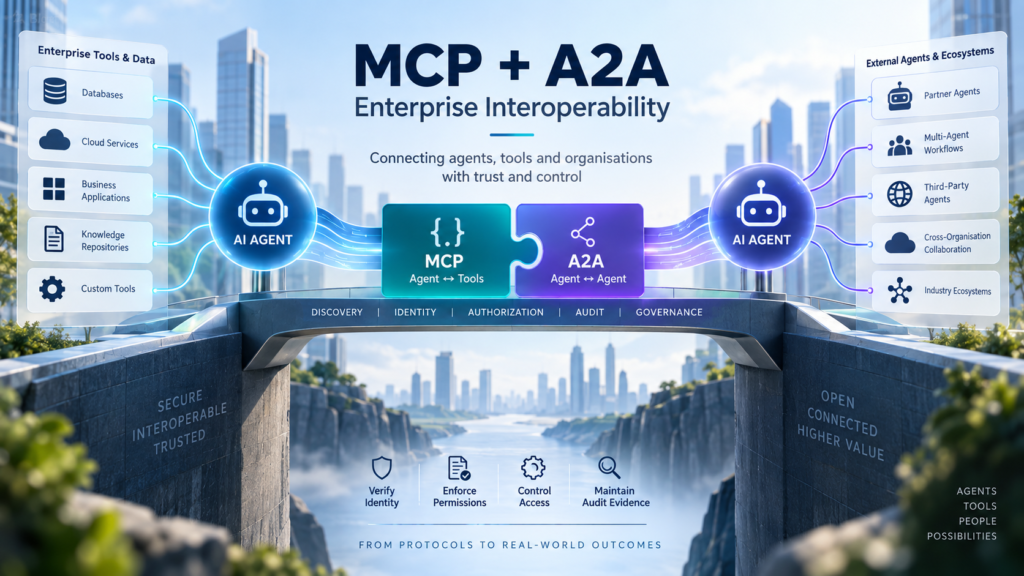
The Model Context Protocol (MCP) and Agent2Agent (A2A) standardise different parts of that path. MCP provides a common interface between AI applications and tools, resources or external systems. A2A supports communication between independent agents that may use different frameworks, vendors and internal architectures. The A2A project describes MCP as the vertical integration layer connecting agents with tools and data, while A2A provides the horizontal layer for collaboration between independent agents.
Both protocols have moved beyond their early experimental stages. A2A v1.0 became its first stable, production-ready release in March 2026 and was accepted as a Growth Stage project by the Agentic AI Foundation in August. MCP’s current 2026-07-28 specification introduced a stateless core, header-based routing, cacheable discovery results, authorization hardening and a formal extensions framework.
For MCP and A2A enterprise interoperability, the important architectural change is the size of the reachable task graph. An agent can discover tools it was not built around, collaborate with agents outside its own runtime and continue a business task across systems managed by different teams or organisations.
Each connection can introduce its own identity, permissions, protocol state and evidence. Enterprise interoperability depends on keeping those boundaries intelligible as the task moves through them.
At a glance
- MCP standardises access to tools and resources; A2A standardises collaboration between independent agents.
- Using both protocols allows one business task to cross internal tools, external agents and several administrative domains.
- Discovery metadata improves composition, but enterprises still need an approval model for which agents and tools may participate.
- Credentials should remain bound to their intended resource rather than travel through an interoperable chain.
- Protocol versions, extensions, gateways and audit evidence become part of production interoperability once agent connections scale.
How MCP and A2A divide the integration problem
MCP and A2A interact with different kinds of counterparties. An MCP server exposes capabilities that an AI application can invoke: querying a database, searching a repository, accessing a business system or executing an operation. The application does not need a bespoke integration contract for every tool if both sides support the protocol.
A2A addresses communication with another agent whose planning process, tools, memory, security model and execution environment may remain independent. The specification is designed for agents that can discover capabilities, negotiate supported interaction modes, manage collaborative tasks and exchange results without exposing their internal state.
A2A v1.0 also supports multiple protocol bindings and version negotiation, allowing agents built on different technology stacks to establish a compatible interaction path.
An enterprise application can consequently use both protocols without assigning them the same role. An agent may use MCP repeatedly while performing local work and A2A only when part of the task belongs to another autonomous system. The receiving A2A agent can, in turn, use MCP servers inside its own environment.
The resulting architecture looks less like a chain of model calls and more like a distributed application assembled during execution.
One business task can cross both protocols before it completes
Consider a sourcing agent asked to determine whether an urgent component order can be fulfilled without breaching cost and delivery requirements.
Inside its own organisation, the agent could use MCP to query approved supplier records, inspect contract terms and retrieve the current purchase order.
A delivery constraint might require information held by a logistics provider. Instead of integrating directly with that provider’s internal systems, the sourcing agent could delegate the shipping analysis to the provider’s A2A agent. The remote agent may query routing, warehouse and carrier systems through MCP connections within the logistics provider’s environment before returning an artifact or task result.
The sourcing agent can then continue locally, perhaps invoking another MCP tool to amend a purchase order after the required approval has been obtained.
One business task has crossed two organisations, multiple agents and several tools without either organisation having to expose its entire internal architecture.
There is also no reason to expect one protocol object to represent the entire transaction. The employee identity, local agent identity, A2A task, remote agent, MCP requests and eventual ERP change can belong to different systems. Following the task therefore requires enough correlation across those systems without assuming that identity or authority transfers automatically with it.
Discovery, catalogs and capability metadata
Interoperability becomes considerably more useful when systems can discover capabilities instead of relying entirely on hard-coded connections.
A2A uses the Agent Card for this purpose. The current specification allows an Agent Card to describe the agent, supported interfaces and protocol versions, provider, capabilities, security requirements, input and output modes and available skills. Cards can also carry JWS signatures, and authenticated extended cards can expose additional information or capabilities to authorised clients.
That gives an enterprise agent structured information it can use to locate another agent capable of performing a particular kind of work.
MCP provides comparable discovery on the tool side. Servers expose tools with names, schemas and metadata, while the 2026-07-28 revision introduced an optional server/discover request and cache information for lists of tools, prompts and resources.
At scale, these mechanisms begin to resemble service discovery for an agent environment. An internal catalog might contain approved finance agents, MCP servers, analytics tools and third-party services together with ownership, environment and version information. A2A also supports registries or catalogs as one approach to discovering Agent Cards rather than requiring every client to locate agents directly through public endpoints.
The metadata in those catalogs still has to be treated according to its provenance. MCP tool annotations can describe properties such as whether a tool is read-only or destructive, but the specification requires clients to consider those annotations untrusted unless they come from a trusted server. MCP tool metadata and trust requirements An A2A skill similarly describes what an agent is capable of doing; the receiving server still authenticates and authorizes the actual request.
An enterprise catalog can therefore serve both discovery and production governance by identifying which agent or server descriptions the organisation is prepared to rely on.
Keep credentials bound to their intended resource
A cross-protocol task can preserve business context without passing the same credential through every participant.
The current MCP authorization guidance requires servers to validate that incoming access tokens are intended for that server and prohibits token passthrough to an upstream protected service. Where an MCP server calls another protected API, the upstream API should receive a separate token issued for that resource.
An employee’s token for an internal procurement system does not acquire authority over a logistics API because an MCP server happens to call both.
A2A encounters a related problem during delegated work. Its v1.0 specification expects credentials required during a task to be obtained out of band unless another mechanism has been negotiated. The specification warns that in-band credential exchange can pass credentials across a chain of A2A agents and expose them to each participant. Where such a mechanism is used, credentials should be bound so that only the agent that originated the authorization request can use them. A2A in-task authorization guidance
In the sourcing workflow, the external logistics agent may need the employee to authorize access to a shipment record. That authorization belongs to the logistics agent and its protected resource. The sourcing agent can coordinate the request without becoming a reusable bearer of the employee’s logistics credential.
Later, when the sourcing agent changes the purchase order, its MCP connection to the ERP uses authority appropriate to that internal operation.
The workflow stays connected at the business level while credentials terminate at the security boundaries for which they were issued.
Delegation changes what the originating organisation can observe
A2A’s ability to work with opaque agents is valuable because companies do not need to expose proprietary reasoning, memory or tool architecture simply to collaborate. The originating organisation may know which remote agent accepted the task, which skill was requested, what data was supplied, how the task state changed and what artifact came back, while having no direct visibility into the logistics provider’s internal model calls or MCP tool sequence.
That limited visibility is consistent with the A2A design: independent agents can cooperate without access to one another’s internal implementation.
For a consequential external task, accountability can instead be preserved at the handoff. The originating organisation may retain the initiating user or event, local agent identity, selected remote agent and Agent Card, requested skill, relevant authorization state, A2A task identifier, material information sent and the returned result.
The remote organisation can maintain its own evidence for actions performed inside its environment.
Neither side needs to expose every internal reasoning artefact for the end-to-end transaction to remain auditable. What matters is whether the handoff and the result can be tied to identifiable parties and business decisions.
This resembles conventional inter-company API integration in one important respect: each organisation remains accountable for the systems it controls. Agent delegation makes the transaction more autonomous without merging the administrative domains on either side.
MCP 2026-07-28 moves more control into ordinary HTTP infrastructure
The latest MCP revision changes how enterprises can operate protocol traffic at scale.
MCP 2026-07-28 replaces the earlier protocol-level session model with a stateless request-response core. Requests carry the information required to process them, allowing ordinary load-balancing patterns without shared MCP protocol session state.
For security and traffic management, the new Mcp-Method and Mcp-Name headers may matter even more. Streamable HTTP requests now expose operation and tool information in standard headers, allowing gateways, rate limiters and web application firewalls to make decisions without parsing the JSON-RPC body.
That makes MCP traffic easier to bring under infrastructure controls that enterprises already understand. A gateway could apply different rate limits to discovery and execution traffic, meter a costly tool independently, route selected methods through additional inspection or block a tool name that has not been approved for a particular environment.
The same revision documents W3C Trace Context propagation so distributed traces can correlate activity across clients, MCP servers and downstream systems in OpenTelemetry-compatible tooling.
MCP has consequently become easier to operate as a conventional production workload even while the applications using it remain agentic.
Version negotiation is part of production interoperability
A2A v1.0 introduced a stable major version with multiple bindings and version negotiation intended to make interoperability more predictable across technology stacks.
MCP’s 2026-07-28 release contains larger structural changes. It introduced the stateless core, changed transport behaviour, hardened authorization, formalised extensions and established a feature lifecycle with a minimum twelve-month deprecation window before removal.
Those extensions can also version independently of the MCP core, while A2A supports extensions alongside its standard capabilities. An enterprise client may therefore support the same base protocol as a server or agent while differing in optional behaviour.
Production compatibility consequently needs more precision than a procurement questionnaire asking whether a product “supports MCP” or “supports A2A.” A deployment baseline can identify approved protocol versions, bindings and extensions for each environment, while compatibility tests verify behaviour before upgrades reach production. External Agent Cards and MCP endpoints can then be inventoried against those approved versions rather than accepted solely because the protocol name matches.
Treating protocol support as a versioned dependency makes interoperability easier to operate over several release cycles without turning every protocol update into an architectural surprise.
An enterprise operating model sits above protocol compatibility
MCP and A2A reduce integration friction, but an enterprise still has to decide which interoperable components belong inside its production environment.
Internal MCP servers and A2A agents can be registered with ownership, environment and version information. External agents can be approved through a vendor or service process before entering a production catalog. Identity infrastructure handles authentication, while authorization remains attached to the action or resource rather than the existence of a connection.
Gateways can enforce traffic rules around MCP operations. A2A servers retain local authorization over their own tasks and data. Observability can correlate calls where administrative control allows it, while delegation records preserve evidence when work crosses into another organisation.
The protocols do not need to solve those enterprise functions themselves. Their value lies in making the connection semantics predictable enough for identity, security, platform and operations teams to build repeatable controls around them.
That becomes more important as interoperability moves from a small set of curated connections to environments in which agents can discover new capabilities at runtime.
FAQs: MCP and A2A enterprise interoperability
What is the difference between MCP and A2A?
MCP primarily standardises how AI applications and agents connect to tools, data and other resources.
A2A standardises communication between independent agents, including capability discovery, task management and exchange of messages and artifacts. The two protocols can operate together inside the same agent workflow.
Does A2A replace MCP?
No.
They address different interaction layers. An A2A agent can use MCP internally to access tools while collaborating with another independent agent through A2A.
Why would an enterprise use MCP and A2A together?
MCP allows an agent to work with tools and resources inside its own execution environment, while A2A allows that agent to delegate or collaborate with another autonomous system.
Using both supports workflows in which local tool use and cross-agent collaboration are part of the same business task.
Does protocol interoperability create a shared security context?
No. Authentication and authorization remain tied to individual agents, servers, tools and protected resources.
MCP specifically requires tokens to be validated for their intended resource, while A2A agents authenticate callers and apply authorization to their own resources and tasks.
What should enterprises govern when adopting MCP and A2A?
Important areas include approved agents and servers, identity and authorization, capability discovery, credentials, protocol versions, extensions, gateway policy, external delegation and evidence retained for consequential actions.
The exact controls depend on whether the connection remains inside one administrative domain or crosses into another organisation.
Each interoperable hop retains its own authority context
MCP and A2A make it possible to compose work across systems that were built independently.
A local agent can use enterprise tools without bespoke connectors for each one. The same agent can delegate specialist work to a remote system without adopting that system’s internal framework. The remote agent can then use its own tools and return a useful result while keeping its implementation private.
The resulting execution path may include a user, several agents, multiple tools and protected resources operating under different identities and policies.
Enterprise interoperability works when those differences remain visible: the Agent Card describes the remote capability, the MCP server its tools, identity establishes the caller, authorization determines what that caller may do, and delegation evidence records what crossed into another administrative domain.
A task can then expand across tools and agents without turning protocol reachability into assumed authority.