
Enterprise Automation Debt Audit: Cost, Fragility and Business Value Across the Bot Estate
Automation debt can grow even when bots continue to run successfully. Learn how to assess maintenance, exception work, fragile dependencies, ownership gaps and current business value across an enterprise RPA estate.

Introduction
The most expensive automation debt rarely appears as an outage. It accumulates around bots that still report successful runs.
Support teams repair selectors after application changes. Operations staff work growing exception queues. Credentials are renewed for automations whose original owners have moved on. A process that once justified screen-level automation acquires an API, yet the bot remains because replacing it has never become anyone’s priority.
The estate can remain active long after its economics have shifted.
That is the useful distinction behind enterprise automation debt. The problem is not simply ageing RPA code. It is the operational liability created when maintenance effort, process drift, application dependencies, manual recovery and unclear ownership continue to accumulate around an automation portfolio.
Traditional estate measures can conceal much of that liability. Deployment counts reveal scale. Run-success rates indicate execution health. Hours-saved calculations capture an assumed benefit. None of them, on their own, establish whether an automation still deserves to exist in its current form.
An enterprise automation debt audit therefore has to examine the bot as part of a production service: what process it supports, what surrounds it, how much human work remains, how often external change reaches it and whether the current implementation still represents the best available way to perform the work.
That moves the audit beyond maintenance and into portfolio management.
At a glance
- A bot can remain technically operational after its business case has weakened.
- Exception handling, application change and support effort often reveal automation debt earlier than uptime metrics.
- Ownership is part of the control model; orphaned automations create risk even when they continue to run.
- Current automation economics should include maintenance, recovery, testing and exception work—not only nominal labour savings.
- Repair, refactoring, migration, consolidation and retirement solve different problems. Modernisation does not automatically mean replacing RPA with AI agents.
Automation debt extends beyond RPA technical debt
RPA technical debt is part of the problem, but it is not the whole problem.
Poorly designed selectors, duplicated components, weak error handling and brittle scripts all increase future maintenance effort. Automation estates also inherit debt from the business systems and processes around them.
A well-built bot can become expensive because the SaaS application it navigates changes frequently. An automation may execute correctly while upstream data quality drives more cases into manual review. A stable workflow can become redundant after the underlying process is redesigned.
In each case, the operating context changes the economics of the automation even if the implementation itself remains technically sound.
That matters because RPA occupies an unusual architectural position. Bots often sit above applications rather than inside them, binding together screens, credentials, schedules, queues, business rules and user interfaces that were never designed as a single system.
Over time, those dependencies can become difficult to unwind. A platform upgrade, authentication-policy change or process redesign may affect dozens of automations at once, creating portfolio-level exposure that is not visible in an individual bot review.
Automation governance therefore needs to look beyond development standards and code quality. The more mature question is whether the estate remains supportable as the applications and business processes underneath it continue to change. UiPath similarly frames automation governance as a discipline applied across the full automation lifecycle rather than only at development or deployment.
Run success can hide an expensive support model
Consider an accounts-payable automation processing 20,000 transactions a month at a reported 97% success rate. That leaves 600 transactions outside the successful path.
If those cases require investigation, correction, reconciliation or manual re-entry, the operational burden may be considerable. Add a recurring patch-related failure, credential resets and periodic developer intervention, and a technically successful automation can support a surprisingly labour-intensive service.
Run-history dashboards are useful, but they rarely capture all of that surrounding work. An analyst may check an upstream file before every run because the source feed has become unreliable. Operations staff may manually validate results after a known integration weakness. Engineering teams may spend recurring effort protecting the automation from changes elsewhere in the stack.
Microsoft’s current Power Automate monitoring guidance reflects that broader operational view: its monitoring model covers execution logs, run counts, success and failure rates, errors, usage, performance and longer-term run history rather than treating completion status as a sufficient health measure.
Production-health reporting therefore needs to include the labour around execution as well as execution itself.
Useful evidence includes support hours, failed retries, manual recoveries, incident volume, post-run reconciliation and the engineering effort associated with external application changes.
Maintenance is expected in any production system. The audit question is whether the support burden has grown enough to alter the original business case without being reflected in the metrics used to defend it.
Exception queues reveal where automation value is leaking
Exception work deserves particular attention because it exposes the point where automation hands complexity back to people.
An order-processing bot may initially automate 92% of incoming transactions and send the remainder for manual handling. Over time, new product variants, inconsistent customer data and additional approval rules reduce straight-through processing even though the automated path continues to function as designed.
Operations staff now spend more time researching cases, fixing data and reconstructing context before work can continue. Because the simple transactions have already disappeared into automation, the remaining human workload is also disproportionately complex.
The headline automation rate can therefore stay high while the cost per manual case rises.
For an automation debt audit, raw exception volume is less useful than its operational composition. Teams need to know which exceptions repeat, how much handling time they consume, whether cases are reworked after technically successful runs and whether queue ageing is beginning to affect service levels.
Some exceptions represent necessary control points; others show that the automated path no longer reflects the way the process actually operates. The audit needs to distinguish between the two rather than treating every exception as a failure to be eliminated.
Application volatility determines RPA maintenance economics
RPA works by interacting with systems, and the stability of those systems has a direct effect on maintenance cost.
A bot using one predictable legacy interface can remain economical for years. Another operating across changing browser screens, authentication flows and SaaS interfaces may require continual testing and repair.
Interface changes, object identifiers, browser updates, session behaviour, timing, credentials and application patches can all alter the automation path. A useful assessment therefore looks beyond incident counts and considers how exposed the bot is to external change.
That exposure can also change as the architecture evolves.
A screen-level bot may have been entirely rational when two systems offered no practical integration route. If one of those systems later exposes a reliable API or native connector, the engineering trade-off changes. Continuing to repair the UI automation then becomes an explicit choice to retain the more fragile integration method.
The debt lies in keeping an old compromise after the condition that justified it has disappeared.
Ownership gaps turn working bots into operational liabilities
A production automation usually depends on two forms of ownership: someone who understands whether the automation still serves the business process, and someone who can operate, change and recover it safely.
Those responsibilities often separate over time.
The process sponsor leaves. The original developer moves to another team. A shared automation continues under a personal service account. Documentation describes rules that have since changed. Operations staff know how to restart the bot but cannot explain why several exception branches exist.
The automation may continue running throughout this loss of knowledge.
That is why ownership should be treated as part of automation control rather than as inventory metadata. Microsoft explicitly advises organisations to consider ownership architecture for critical and long-running flows, including service-principal ownership where independence from an individual employee is important for stability and continuity.
An enterprise audit should be able to identify the current business owner, technical owner, credentials, dependent systems, escalation path and authority to retire the automation.
The significance of an ownership gap depends on the role of the bot. An orphaned automation processing a low-volume internal task is inconvenient. One embedded in finance, customer servicing or regulatory operations represents a different level of operational exposure.
If nobody can explain why an automation should remain in production, continued execution is not evidence of adequate governance.
Automation ROI should be recalculated from production evidence
Many automation portfolios still carry business cases built at deployment.
Those estimates may have been reasonable at the time. They are not permanent facts.
Transaction volumes change. Labour costs move. Applications are replaced. Licensing changes. Exception rates increase. New integration options appear. Some automations become more valuable as volumes grow; others spend years consuming support after their original economic justification has faded.
A debt audit should reconstruct the business case from current production evidence.
The benefit side includes actual transaction volume, cycle-time improvement, manual effort genuinely removed, service-level improvement and measurable quality gains.
The cost side extends well beyond platform licences. It includes maintenance, regression testing, incident recovery, exception handling, access administration, monitoring and the engineering work required whenever a dependent application changes.
That calculation can materially change the picture.
An automation saving 2,000 hours of manual effort while consuming 150 hours of annual support remains attractive. One saving 600 hours while requiring 400 hours of exception handling, maintenance and recovery deserves a different decision.
Opportunity cost belongs in the same calculation. Engineering capacity spent stabilising low-value bots cannot be used to redesign higher-value processes or build stronger integrations elsewhere.
Automation debt therefore affects the economics of future work as well as the cost of the existing estate.
Estate-level visibility exposes risks that support tickets miss
Support records are useful for diagnosing individual failures, but portfolio analysis exposes relationships between them.
Several bots may depend on the same application screen, authentication method or shared credential. Separate business units may have automated overlapping parts of the same process. A planned ERP migration may threaten twenty workflows at once.
Those conditions are difficult to see when maintenance is handled one ticket at a time.
A useful inventory therefore needs more than bot names and status. For each production automation, teams should be able to connect:
- the business process;
- current owner;
- technical owner;
- dependent applications;
- credentials and identities;
- run volume;
- exception behaviour;
- support effort;
- business criticality;
- expected application or process changes.
Microsoft’s current Power Platform inventory capabilities illustrate the value of this estate-level view. Administrators can inspect flows, ownership information and connector dependencies, identify resources associated with departing users, and analyse the impact of connector changes across the environment.
Once those relationships are visible, the portfolio starts to reveal its own architecture.
A handful of low-volume automations may account for a disproportionate share of support work. Several “independent” bots may in fact share one brittle dependency. A critical workflow may depend on an application already scheduled for retirement.
Bot-estate management therefore becomes a way of mapping operational dependencies and the cost of keeping them in place, not merely maintaining an inventory of deployed automations.
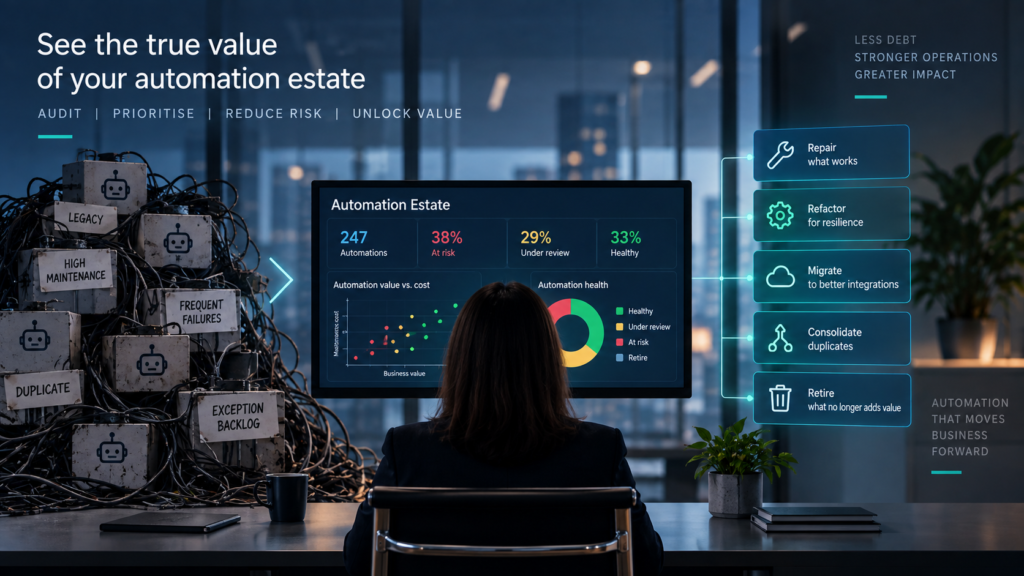
Repair, refactor, migrate and retire are different decisions
An automation debt audit should not end with a replacement programme.
Some bots need repair. A high-value workflow running against a stable process may remain entirely appropriate after a specific failure is corrected.
Others warrant refactoring because the basic design remains sound but duplicated logic, error handling or fragile components are increasing maintenance effort.
Migration becomes more compelling where the surrounding architecture has changed. APIs, workflow engines, integration platforms or newer automation capabilities may now provide a more supportable path than the original implementation.
Consolidation addresses a different problem: multiple teams solving the same process independently and carrying duplicate credentials, monitoring and support overhead.
Retirement is appropriate where the process has disappeared, volumes have collapsed, another service already performs the work or the remaining benefit no longer justifies support.
AI agents add another option without replacing this decision logic.
A deterministic RPA workflow operating against stable systems may be cheaper, easier to test and simpler to control than an agentic replacement. Introducing probabilistic reasoning into a predictable process merely because newer technology exists would exchange one form of complexity for another.
The decision should follow the operating characteristics of the work: cost, reliability, control, maintainability and the degree of adaptation the process genuinely requires.
FAQs: enterprise automation debt audit
What is enterprise automation debt?
Enterprise automation debt is the accumulated operational liability associated with automations whose maintenance effort, exception work, dependencies, governance burden or declining business value make them increasingly expensive to sustain.
It includes technical debt but also process drift, ownership gaps, redundant automations and outdated integration choices.
How is automation debt different from RPA technical debt?
RPA technical debt primarily concerns implementation choices that make bots harder to maintain or modify.
Automation debt is broader. It includes technical fragility as well as exception costs, changing applications, obsolete processes, unclear ownership and automations whose current business value no longer supports their operating cost.
What should an enterprise automation debt audit examine?
The audit should examine realised business value, maintenance effort, support incidents, exception behaviour, application dependencies, ownership, credentials, process changes, manual fallback work and alternative integration options.
The unit of analysis should be the production service, not only the bot code.
Can a bot have a high success rate and still carry significant automation debt?
Yes.
A bot may complete most transactions successfully while generating costly exceptions, requiring frequent engineering work, depending on fragile interfaces or automating a process whose business value has declined.
Run success describes execution. It does not establish economic health.
Should enterprises replace ageing RPA bots with AI agents?
Not automatically.
AI agents are useful where work requires adaptive reasoning, tool selection or handling of less deterministic tasks. Stable, rules-driven processes may still be better served by RPA, APIs or conventional workflow automation.
The replacement decision should follow the process requirements and operating economics rather than the age of the technology.
The automation estate should earn its place in production
Automation programmes are good at counting additions.
Deployments, transactions and automated hours all reward expansion. Mature portfolios also need a mechanism for subtraction.
Some automations should be repaired. Some deserve investment. Others should move to a stronger integration method, merge with overlapping workflows or leave production altogether.
Without that discipline, the estate slowly accumulates implementation decisions made for systems, processes and economics that no longer exist.
An enterprise automation debt audit makes those decisions visible.
The useful measure is not the number of bots that can still be kept alive.
It is whether the automation portfolio continues to remove more operational burden than it creates.