Rolling Back an AI Deployment Does Not Undo the Actions It Already Took
AI deployment rollback can restore the previous production version without undoing purchase orders, messages, approvals or other actions already committed. See how action windows, compensating transactions and recovery planning connect version rollback with restoration of business state.

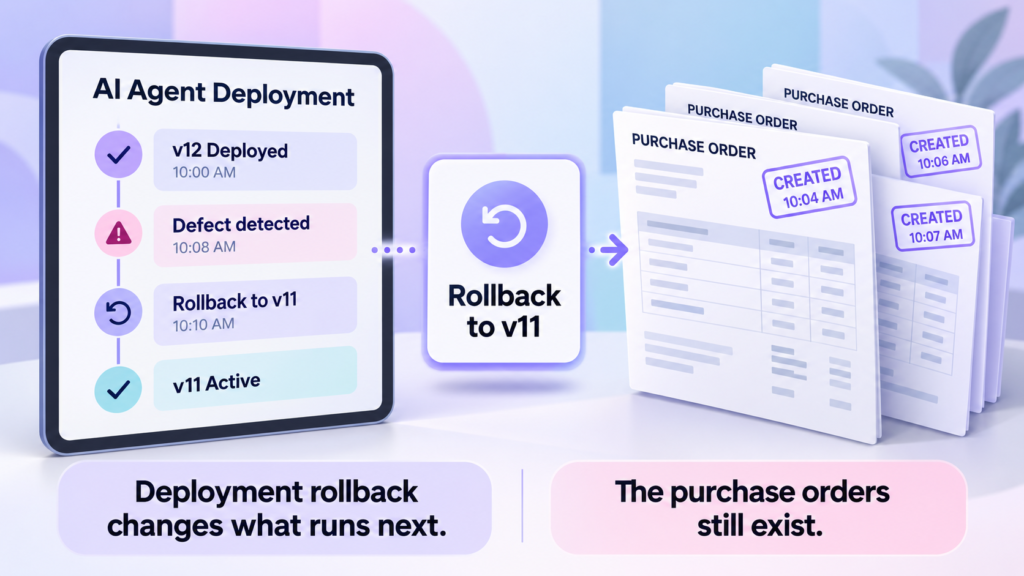
An AI deployment rollback can restore the previous production version in minutes while leaving behind purchase orders, messages, approvals or other business actions already committed by the release being withdrawn. Recovery therefore has two parts: restoring the software and recovering the business state it changed.
A procurement agent is updated at 10:00 a.m. Eight minutes later, operations notices a defect in the new release. Under one supplier condition, the agent is applying the wrong purchasing rule.
The team switches production back to the previously approved version. By 10:10, the old version is serving traffic again. Rollback worked.
During those eight minutes, however, the new release created seven purchase orders. Reverting the deployment does nothing to them.
AI deployment rollback only changes what runs next
Modern agent platforms make version reversion relatively straightforward.
Amazon Bedrock creates immutable agent versions and uses aliases to determine which version an application invokes. AWS explicitly notes that an alias can be pointed back to a previous version when a change needs to be reverted quickly.
Microsoft Foundry’s current agent model provides a stable endpoint for each agent, with version selection determining which version receives traffic. An endpoint can be pinned to a specific version rather than automatically following the latest one. The earlier Agent Application deployment model also remains supported, with a stable application endpoint and deployments referencing particular agent versions.
Those mechanisms shorten the time required to stop a defective release from handling new work. They do not rewind the outside world.
If the eight-minute release only generated draft text, restoring the previous version may be most of the recovery. If it created purchase orders, changed account settings, sent communications or triggered downstream workflows, the remaining work sits in the systems where those effects were recorded.
The recovery boundary sits outside the model
For an AI system that can act, the important state may no longer sit entirely inside the deployment.
The procurement agent may have written to the ERP. A customer-service agent may have issued credits, while an operations agent may have changed a ticket priority and triggered another workflow.
Microsoft’s compensating-transaction guidance describes the same problem in distributed applications: once earlier steps have committed, restoring an earlier application state may not reverse their effects. Recovery can require business-specific operations against the systems that were changed.
Incident response therefore needs to answer two questions:
Which version was bad?
What did that version do while it was live?
The second question determines the recovery workload.
Deployment history needs an action window
Once operations knows that version 12 served production between 10:00 and 10:08, it has a bounded interval in which to search for affected work.
The boundary may extend beyond those timestamps. A task that began before rollback might finish afterward. One agent request may issue several tool calls, and a downstream queue may commit an action after the original invocation has completed.
This distinction also matters in long-running workflows. Microsoft’s Durable Functions orchestration-versioning guidance documents how in-flight orchestration instances can remain associated with their original versions even as newer application versions are deployed.
A useful deployment record therefore connects the release to the work it performed. That can include the deployed version, request or task identity, tool operations, external transaction identifiers and final business outcomes.
Amazon Bedrock, for example, provides agent execution traces that can expose orchestration steps when tracing is enabled. Such records can help reconstruct what the agent attempted, but they still need to be correlated with the transactions actually committed in external systems.
The objective is not another observability dashboard. It is to establish the population that may need recovery.
Without that linkage, operations may restore the previous version quickly and still spend hours reconstructing which external changes came from the withdrawn release.
Not every action can be reversed the same way
Seven purchase orders do not necessarily imply seven identical recovery steps.
Some may still be drafts and can be cancelled safely. One may already have been approved, another may have been transmitted to a supplier, and a supplier may already have acted on it.
Microsoft’s compensating-transaction pattern notes that compensation does not necessarily restore every system to the exact state that existed before the original operation. Other activity may have occurred in the meantime, and undoing completed work can require different business logic from the operation that created it.
The recovery plan therefore needs to distinguish among several types of effect:
- Actions that can be directly reversed.
- Actions that require a compensating transaction.
- Actions that need reconciliation before a decision can be made.
- Actions that have crossed a point where reversal is unsafe, meaningless or legally impossible.
Microsoft also recommends identifying irreversible steps in advance and designing workflows so that they occur only after the necessary validations have passed.
For autonomous systems, this classification belongs in deployment planning before an incident occurs.
Compensation needs to preserve the original action
Suppose one purchase order has already reached the supplier.
Deleting its internal record would not undo the commitment. The organisation might instead need to cancel the PO formally, notify the supplier and retain both records.
The recovery action should remain connected to what it compensates for: the original task, external transaction, affected entity and reason for reversal. Microsoft’s guidance on correlating and auditing original operations and their compensations similarly recommends preserving that connection end to end.
That lineage matters when the release was withdrawn because its decision logic was wrong.
A month later, an auditor or process owner should be able to see that production version 12 created the PO during the affected deployment window and that the organisation later compensated for that action after the defect was confirmed.
Rollback readiness should be tested against business effects
Before giving an AI system authority to change external state, teams can test the recovery path for each important action it is allowed to take.
Can the operation be cancelled? Does it require a compensating transaction? Can downstream effects be identified reliably? What happens after the point of no return? Who owns the decision when automatic reversal is unsafe?
A procurement agent permitted only to draft purchase orders creates one recovery profile. Allowing it to release them to suppliers creates another.
Rollback readiness should reflect the consequences of the actions the deployed system can actually perform.
Business recovery starts where version recovery ends
Version control gives operations a fast way to stop a defective AI release from producing additional work.
The remaining recovery depends on the actions already committed during the affected deployment window: which remain active, which can be reversed and which require compensation or human reconciliation.
That is why an acting AI system needs a recovery design that extends beyond model, prompt or agent versioning.
Deployment rollback restores which system will act next. Compensation deals with what the previous system already did.