
Philips says SmartSpeed Precise AI-powered MRI passes 1,000 installations
Philips reports 1,000 global SmartSpeed Precise MRI installations, including deployment at Unilabs Switzerland, with company estimates of faster scanning and additional clinical capacity.

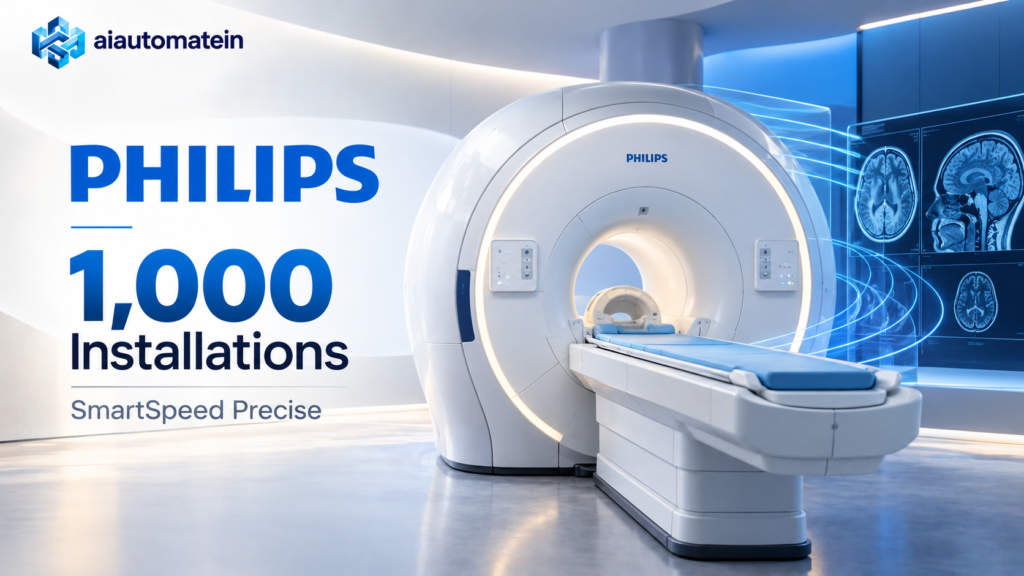
The milestone installation is at Unilabs Switzerland, where the dual-AI reconstruction technology runs across 10 MRI systems. Philips’ estimates of faster scans and added capacity remain conditional.
Philips reported that its SmartSpeed Precise AI-powered MRI technology had reached 1,000 installations worldwide on 14 October 2026. The milestone installation was at Unilabs Switzerland, where the software is used across 10 Philips MRI systems. The figure reflects deployment of an existing reconstruction technology, not the launch of a new scanner or a newly released AI product.
In its official milestone announcement, Philips said the software was used in at least 95% of compatible clinical scans performed on equipped systems worldwide, based on its installed-base data. That percentage concerns compatible scans on systems already equipped with the technology; it does not represent the share of all MRI examinations.
Unilabs Switzerland marks the deployment milestone
Unilabs operates SmartSpeed Precise on 10 Philips MR systems in Switzerland, according to the announcement. Philips presented the installation as evidence of growing use of AI reconstruction in routine imaging rather than its adoption remaining limited to research settings.
SmartSpeed Precise was introduced in 2025. It combines acceleration during MR data acquisition with two AI-based reconstruction stages designed to reduce noise and sharpen images. Philips offers the software on compatible new and installed 1.5T and 3T MRI systems, as described in its product documentation, rather than requiring every customer to purchase a new scanner.
Scan-speed claims differ from measured patient throughput
Philips says SmartSpeed Precise can produce images up to 80% sharper than conventional reconstruction and complete certain scans up to three times faster than Philips SENSE imaging. Those maximum figures come from company-defined comparisons; the sharpness assessment includes phantom testing. They should not be interpreted as universal improvements across all protocols or evidence of better clinical outcomes.
The company estimates average annual savings of 215 scanner hours per equipped system compared with SENSE imaging. It converts that time into potential capacity for approximately 624 additional MRI examinations per system each year, assuming sufficient demand, staff and scheduling capacity.
Across 1,000 installations, Philips estimates 215,000 scanner hours and potential capacity for more than 624,000 additional examinations annually.
These are modelled opportunities, not a count of additional patients actually scanned. The announcement does not provide independently audited throughput gains across all installations. Actual efficiency will depend on examination protocols, scheduling and local clinical operations.