
Hyperscience updates Hypercell to prepare complex documents for agentic AI
Hyperscience's Fall 2026 Hypercell release adds ORCA 2, document redaction, address validation, multilingual processing and assisted labelling to prepare enterprise documents for AI applications.

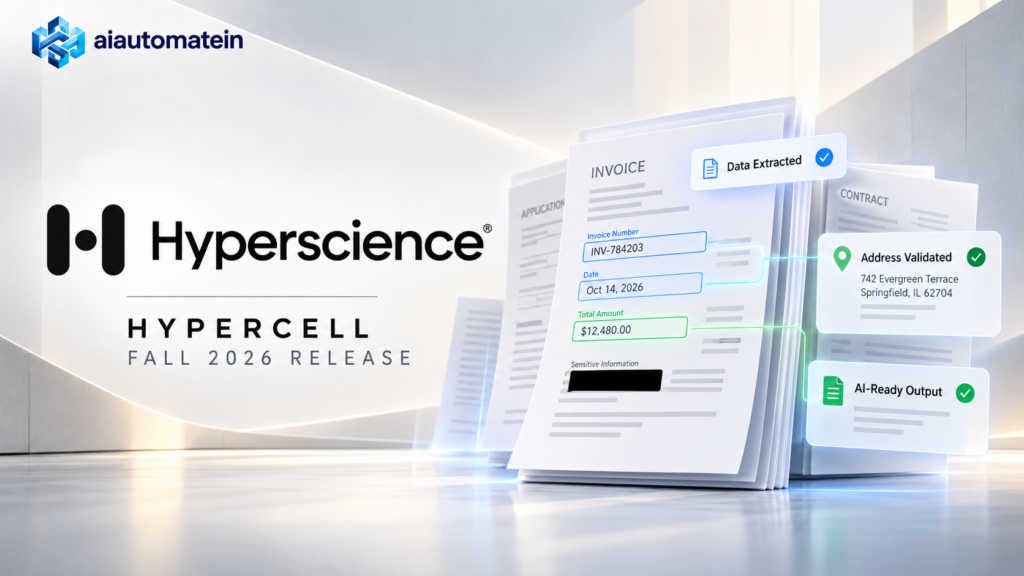
The Fall 2026 release adds ORCA 2 document understanding, personal-data redaction, address validation and assisted labelling to improve the quality of information supplied to enterprise AI workflows.
Hyperscience announced the Fall 2026 release of its Hypercell intelligent document processing platform on 29 September 2026, introducing capabilities for extracting, checking and preparing information from complex enterprise documents. The update combines its ORCA 2 vision-language model with specialised AI models, validation tools and human review to produce structured information for downstream applications and AI agents.
According to the company’s official announcement, the release extends Hypercell’s existing multi-model approach, allowing different document-processing tasks to use specialised or frontier models according to their requirements. Hyperscience said the Fall release is available to SaaS and on-premises customers.
ORCA 2 expands extraction from complex documents
ORCA 2, the latest version of Hyperscience’s vision-language model framework, adds zero-shot table extraction and improvements to processing structured, semi-structured and unstructured documents. It can also generate ground-truth data for training other models by identifying document content and its location.
The company’s version 43 release notes confirm that ORCA 2 can extract tables as rows and columns without requiring a separately trained specialised model. The documentation also describes options for managing ORCA 1 and ORCA 2 models during migration, allowing existing document workflows to transition without immediately replacing every model.
These capabilities address documents whose layouts, tables or content variations make conventional extraction difficult. Hyperscience reports improved extraction performance, although its announcement does not provide independent benchmark results for the Fall release.
Redaction and validation extend document processing controls
The release introduces Redaction and Masking capabilities for reviewing personally identifiable information across document submissions. Operators can inspect and redact recurring sensitive details, including names, Social Security numbers, dependents and dates of birth.
Hypercell can also produce searchable rendered PDFs with sensitive information removed from the underlying content, according to Hyperscience. The resulting documents are intended to support downstream indexing and retrieval-augmented generation without carrying the original exposed details into subsequent processing.
A separate Address Verification & Validation Intelligence capability parses complex address strings into structured components and checks them against configurable sources, including Google Address Validation, enterprise reference records or third-party services.
The company has also introduced in-workflow document translation across 26 languages. Translated information can be used during supervision and quality assurance, reducing the need for a separate translation process before documents are reviewed.
Assisted labelling keeps human review in the process
Hypercell’s new Auto-Labeling and Flexible Extraction capabilities combine document segmentation with frontier models to help prepare training data. Reviewers can populate extraction fields by selecting or drawing around relevant document content rather than entering every value manually.
The approach retains human involvement in validating extracted information, correcting uncertain results and producing training data for subsequent model improvement.
It also builds on Hyperscience’s earlier inference-layering architecture, introduced in its Spring 2026 release, which combined different processing models according to workload requirements.
Hyperscience has scheduled a detailed presentation of the Fall release for 5 November 2026. The company has not disclosed independently verified customer adoption or performance results specifically attributable to the complete Fall 2026 package.