
Hybrid AI makes workload placement part of platform design
Hybrid AI platform workload placement separates the logical workload from its physical deployment. See how target profiles, accelerator capacity, data locality, connectivity and service availability determine where the same AI workload can actually run.

Introduction
The computer-vision service has already passed production evaluation. Its container is versioned, the model artifact is approved and the API contract is stable.
The first factory can run it in the cloud. The second needs inference inside the plant because sending production images across the WAN adds too much latency. The third has GPU capacity on site but loses external connectivity regularly.
The application team still describes these as deployments of the same workload. The platform team has a harder problem.
A cloud deployment can rely on managed identity, hosted model services, centralized storage and continuously available telemetry. A local deployment may need a different accelerator profile, a site-specific data endpoint, a local model cache and an operating path that survives when the control plane cannot be reached.
The application may remain logically the same.
The placement architecture does not.
That is why hybrid AI platform workload placement has to become part of platform design rather than an infrastructure choice made after the application is finished.
A hybrid platform needs a stable enough workload contract that applications can run across approved environments, while still acknowledging that compute, data, connectivity and available platform services differ materially between those environments.
At a glance
- Hybrid AI extends workload execution across public cloud, private cloud, enterprise data centres, factories, branches and edge locations, each with different infrastructure and connectivity conditions.
- Workload placement requires separating application and model identity from the physical environments where they run, rather than treating each location as a different application.
- Platforms need explicit workload requirements and target profiles to determine which compute, data, accelerator, connectivity and platform services are available at each location.
- A common desired state can coexist with local execution, allowing workloads to operate across connected, intermittently connected and disconnected environments.
- The goal is not identical infrastructure everywhere, but to make location a deliberate deployment variableinstead of hiding environment-specific exceptions inside application configuration.
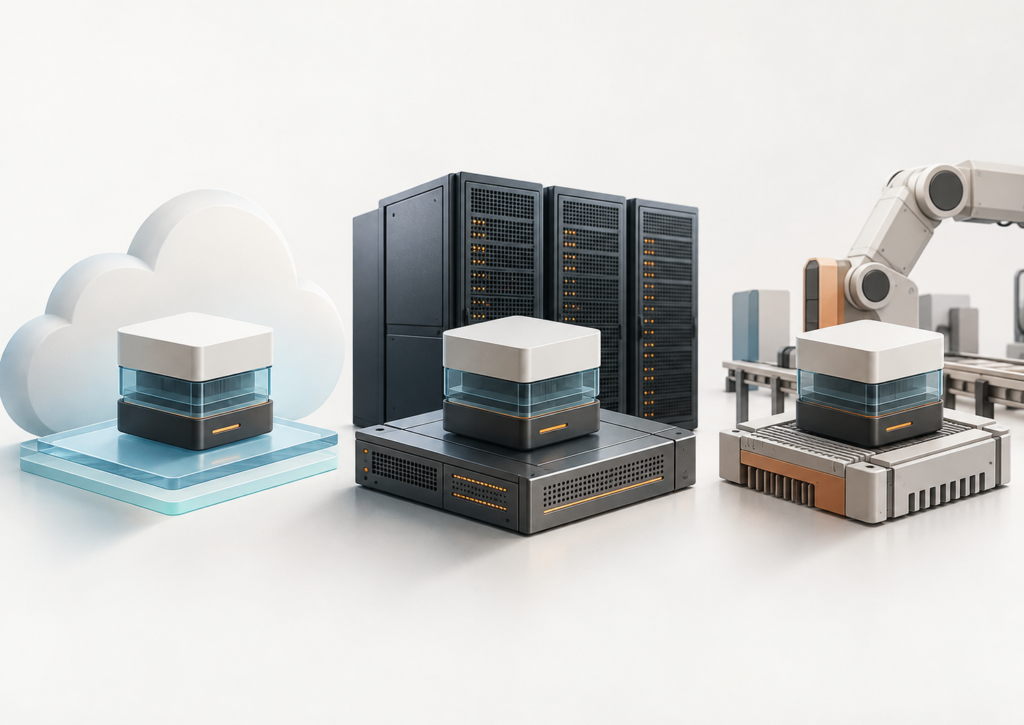
One logical workload can have several deployment realizations
Hybrid architecture becomes easier to reason about once “the workload” is separated from “the deployment.”
The logical workload may retain the same application release, model lineage and external API across multiple environments while the physical realization changes underneath it.
A cloud deployment might use hosted inference. A data-centre version could run the model on an internal Kubernetes GPU pool. A factory deployment might package the model locally because WAN latency is unacceptable. An edge target may require a smaller or optimized model because the available accelerator cannot host the cloud configuration.
Those are not necessarily four different applications.
They are four realizations of one workload.
Current infrastructure already supports pieces of this separation. NVIDIA AI Enterprise is designed to support AI applications across cloud, data-centre and edge environments, while NVIDIA NIM can be deployed through Kubernetes and other supported orchestration environments.
Microsoft similarly supports attaching on-premises and multicloud Kubernetes clusters through Azure Arc, with Kubernetes-based machine-learning workloads able to run on attached infrastructure.
These architectures do not make the environments equivalent.
They create enough common structure for the same logical workload to acquire different physical forms without becoming a completely different application each time.
Placement should be expressed through workload requirements and target profiles
Without an explicit placement model, location tends to leak into configuration indirectly.
A manifest names one cluster. An application points to an on-premises database. A deployment file requests an accelerator that exists at only one site. A registry URL assumes one network path. A model endpoint fixes the workload to a particular region.
Each setting may be reasonable in isolation. Collectively, they turn location into an accidental property of configuration.
A stronger platform describes what the workload requires rather than where an engineer happened to deploy it first.
Those requirements may include accelerator type and memory, data reachability, external-connectivity tolerance, required platform services, storage needs, latency constraints and approved environment classes.
Kubernetes already provides a lower-level form of this mechanism through labels, node selection, node affinity and topology constraints. Required affinity can restrict a workload to nodes with specific properties, while preferred affinity can express softer placement preferences.
A hybrid AI platform needs the same principle at a broader level.
The workload should describe what kind of environment it can run in; the platform should resolve which actual targets satisfy that description.
That makes the target profile a first-class part of deployment architecture.
A practical definition might look like this:
| Workload property | Common workload definition | Placement-specific profile |
|---|---|---|
| Application | Release identity | Artifact source and runtime target |
| Model | Logical model/version requirement | Local package, hosted endpoint or optimized variant |
| Compute | Resource requirement | Available accelerator/runtime at the target |
| Data | Required business data | Local endpoint, replicated store or remote service |
| Connectivity | Required communication pattern | Connected, intermittent or disconnected implementation |
| Deployment | Desired state | Cluster/site-specific configuration |
| Observability | Required telemetry contract | Immediate export, local buffering or site collector |
| Resilience | Required service behaviour | Local restart, alternate target or constrained fallback |
The common definition tells the enterprise what the workload is.
The target profile tells the platform what must change for that workload to exist in a particular environment.
That distinction is more useful than pretending cloud, data centre and edge are interchangeable.
A placement is only real when its runtime dependencies exist locally enough
Hybrid support is often described in terms of where compute can run.
That is only part of the architecture.
A workload is not genuinely placeable in a disconnected or constrained environment if the services it depends on still live somewhere it cannot reliably reach.
Google Distributed Cloud makes this especially visible. Vertex AI on GDC air-gapped can run machine-learning and generative-AI capabilities inside an on-premises environment without connectivity to Google Cloud.
Google’s air-gapped appliance extends the same model to portable hardware designed for disconnected environments.
The architectural consequence is broader than “the GPU is local.”
The model artifact must be available locally. Authentication and trust material must continue to work. Required data and runtime dependencies need reachable equivalents. Configuration cannot assume access to external services that disappear with the WAN. Operational evidence may need to remain useful locally until central systems can be reached again.
Model distribution therefore becomes part of placement architecture as well.
NVIDIA’s NIM Operator includes NIMCache and related resources for acquiring and storing model artifacts before serving depends on them, including model sources from NGC and Hugging Face-compatible repositories.
A workload is not technically placeable merely because a target has compute.
The environment must provide enough of the workload’s runtime dependencies for the application to function there.
Common interfaces do not guarantee service parity
This is where hybrid-platform design can easily overpromise portability.
A familiar API may exist in more than one environment while the underlying service catalogue differs.
Google’s current Distributed Cloud documentation illustrates the problem. Vertex AI on GDC provides a local subset of Vertex AI capabilities, and some services have different maturity levels. Online Prediction in the air-gapped environment remains Preview and is not recommended there for production use.
The implication is simple: interface compatibility is not service parity.
For each target, the platform needs to know whether the required service exists, whether the needed model is available, whether the feature is production-grade there and whether the target exposes compatible storage, authentication, evaluation and monitoring capabilities.
Hybrid architecture therefore needs a capability catalogue by execution environment.
Without one, placement remains partly guesswork.
Placement eligibility depends on compute, data and capability together
AI workloads make placement harder than conventional stateless services because compute is not uniform.
A general application may care primarily about CPU, memory and network access. An AI workload can depend on accelerator generation, accelerator memory, serving runtime, model format and optimization profile.
NVIDIA’s current AI Enterprise stack reflects that dependency directly by separating application software from drivers, operators, Kubernetes and infrastructure components across cloud, data-centre and edge environments.
NIM deployments on Kubernetes also depend on GPU-capable nodes and appropriate storage for model caching.
A target can therefore be perfectly reachable and still be a poor or impossible place to run a particular model.
Data locality changes the answer again.
A factory-inspection service may consume images generated on the production line, reference data held in a local operational database, centrally managed model artifacts and downstream analytics hosted elsewhere. Moving inference from the plant to the cloud changes the network path for every image. Moving inference back to the plant shifts the burden toward local accelerator capacity and model distribution.
The platform cannot evaluate placement from compute alone.
It needs to understand enough about the relationship between accelerator capacity, data location, network characteristics and available services to determine whether a target is technically viable.
That turns infrastructure capability into something the platform should expose in machine-readable form.
Kubernetes provides node- and topology-level primitives; Azure Arc provides management across clusters in different environments; AI runtimes and hardware operators expose model- and accelerator-specific requirements. A hybrid platform has to connect those layers into a coherent view of target eligibility.
Otherwise, workload placement remains a spreadsheet maintained by specialists rather than a platform capability.
Central desired state can coexist with local execution
Hybrid AI does not require the management plane and the execution plane to live in the same place.
A platform team may want a common source of desired state even when workloads execute across cloud, data-centre and edge environments.
Azure Arc’s GitOps model demonstrates that pattern. Git repositories can hold desired configuration while cluster-side agents reconcile that state into Kubernetes environments running in Azure, on premises, at the edge or in other clouds.
This separation is useful because it allows the platform to maintain deployment intent centrally without pretending the local environment is merely another cloud region.
The site still has its own hardware capacity, dependency topology and failure modes.
A factory that must keep operating during WAN loss needs more than remote deployment control. It needs sufficient local runtime state to continue after the central management path disappears.
Hybrid design therefore benefits from a clear separation:
central systems can define and distribute desired state;
local environments execute and sustain the workload according to what they can actually support.
That is a stronger model than requiring every target to maintain continuous connectivity to the central platform in order to function.
Recovery and operations have to remain placement-aware
Running the same release in several environments creates operational differences that are easy to hide behind a common deployment identity.
Failover is one example.
A local deployment may use an optimized model that fits one GPU class, while its cloud fallback uses hosted inference. A locally reachable database may become a replicated service during fallback. Latency can move from milliseconds to hundreds of milliseconds. An air-gapped deployment may have no immediate external alternative at all.
The application version has not changed, but the operating conditions have.
The platform therefore needs to know whether two targets are behaviourally equivalent enough to participate in the same recovery design.
That does not decide whether failover is permitted. It establishes whether the alternate environment can actually reproduce the workload dependencies and behaviour the application expects.
Operations need the same placement awareness.
If an identical release can execute at several sites, production telemetry should identify which environment actually produced the observed behaviour.
Useful evidence may include the logical workload and release, execution environment, model build, accelerator/runtime profile and significant local dependency versions. Connectivity state may also matter when intermittent links affect application behaviour.
That makes placement-specific failures easier to distinguish.
One site may experience accelerator memory pressure while the cloud deployment remains healthy. Another may use an older locally cached model package. Retrieval latency may degrade only where supporting data remains remote.
Hybrid observability is therefore not just centralized logs from multiple locations.
It is the ability to relate workload behaviour to the physical deployment context that produced it.
The platform needs a compact placement contract
The architecture can be reduced to a relatively small set of questions before a workload is considered deployable to a target.
The platform needs to know the workload identity and release; its model and interfaces; the compute, accelerator, data, storage and connectivity capabilities it requires; which services exist at the target; which placement-specific substitutions are necessary; and whether artifact delivery, deployment, health checks and recovery can be operated there.
Those answers create the technical possibility set.
They do not decide which locations the enterprise is allowed to use.
That distinction should remain explicit:
Governance can determine which technically possible locations are acceptable.
The platform first needs to know which locations are technically real.
The technical platform owns the possibility layer.
Policy and governance decide what the enterprise permits inside that set.
That boundary becomes more important as hybrid estates grow because the number of possible locations can expand much faster than the number of locations any one workload should actually use.
FAQs
What is a hybrid AI platform?
A hybrid AI platform supports AI workloads across multiple execution environments such as public cloud, private cloud, enterprise data centres and edge locations. A mature design preserves a common workload contract while allowing infrastructure, service availability and deployment implementation to vary by target.
Why is workload placement part of AI platform design?
AI workloads depend heavily on accelerators, model availability, data locality, network conditions and supporting platform services. Moving the same application to another environment can therefore change its serving architecture and runtime dependencies even when application logic stays the same.
Does hybrid AI require Kubernetes?
No. Kubernetes provides useful placement and orchestration primitives and is common in hybrid infrastructure, but the architectural requirement is broader. The platform needs a consistent way to describe workload requirements, target capabilities and placement-specific implementation regardless of the orchestrator.
Should cloud and on-premises environments provide identical AI services?
Not necessarily. Complete service parity is difficult and often unnecessary. The platform instead needs to know which capabilities exist at each target and whether those capabilities are sufficient for the workload being placed there.
Is workload-placement architecture the same as workload-placement governance?
No. Architecture determines which placements are technically possible and how workloads are packaged, deployed and operated there. Governance determines which of those possible placements are acceptable under enterprise policy, risk, resilience and jurisdiction requirements.
Hybrid architecture is the ability to place deliberately
Hybrid AI is sometimes reduced to three boxes labelled cloud, on premises and edge.
The engineering challenge is making the workload intelligible across those boxes without pretending the environments are identical.
The model has to exist where inference occurs. The target needs suitable accelerator and runtime capacity. Required data and services have to be reachable. Deployment intent has to arrive. Local execution must be able to survive the connectivity conditions it was designed for. Operations need enough placement context to explain why the same release behaves differently at different targets.
Some of those properties can be shared.
Others are inherently local.
A mature hybrid platform exposes that difference instead of hiding it behind environment-specific scripts.
It does not prove its value by showing that a workload could run in several places.
It proves its value when the enterprise can describe the workload once, understand what each target can actually provide and deliberately produce a valid deployment for the location it chooses.
The platform-design question is:
Can workload placement change without turning every new execution environment into a new application architecture?